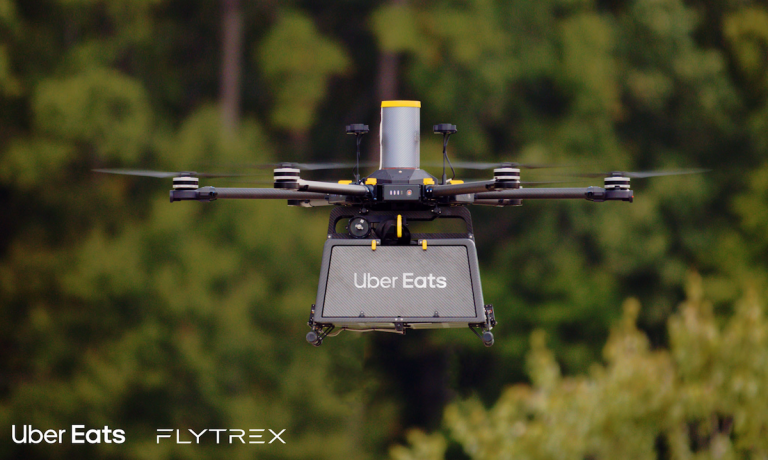
The collaboration marks Uber’s first investment in drone delivery, the company said in news release Thursday (Sept. 18).
The new service is expected to commence with Uber Eats pilot markets in the U.S. by the end of the year, and combines Flytrex’s autonomous drone delivery system with Uber’s global platform and logistics expertise.
The release notes that Flytrex is one of only four drone delivery companies with authorization from the FAA to conduct “Beyond Visual Line of Sight” operations.
“Autonomous drones are the future of food delivery—fast, affordable, and hands-free. Flytrex has already delivered over 200,000 meals to suburban households in the past three years,” Flytrex Executive Chairman Noam Bardin said in the announcement.
“Partnering with Uber—pioneers of ground-based mobility—brings together proven logistics expertise with aerial innovation.”
Advertisement: Scroll to Continue
While this is Uber’s first foray into drone delivery, the company is no stranger to autonomous delivery, having launched robotic delivery operations in the U.S. and Japan.
PYMNTS spoke about that latter effort last year Noah Zych, Uber’s global head of autonomous mobility and delivery after the company teamed with Mitsubishi Electric and Cartken.
“… One of the things that we’ve definitely learned here in the U.S. is there are some trips that are really well-suited for robots and some trips that are still better suited to be done by our couriers,” he said.
He added that a major consideration is proximity, with autonomous delivery requiring short distances for the food to arrive hot, fresh and on time. In addition, Zych noted that the technology works better for orders with smaller baskets.
In October of last year, the company announced a partnership with delivery robot/autonomous vehicle maker Avirde, letting Uber Eats customers in Austin, Dallas and Jersey City get their food delivered by Avride’s sidewalk robots.
Earlier this year, PYMNTS interviewed Serve Robotics CEO Ali Kashani, who said he envisions the future of delivery robots involving more than just take-out meals.
“There are a lot of things you can deliver,” he told PYMNTS. “Imagine medications, pharmacy [items], parcels, groceries.”
He also predicted the use of robots offering “reverse logistics,” handling product returns for customers, as well as their involvement in local commerce: Picking up clothing or shoes from local stores and bringing them to shoppers to try them on. Customers would keep the ones they want and putting the rest back in the bot to return.
“There’s a lot of other things we can do with these robots once they’re out there,” Kashani told PYMNTS. “They’re making the cost of last mile substantially lowered.”