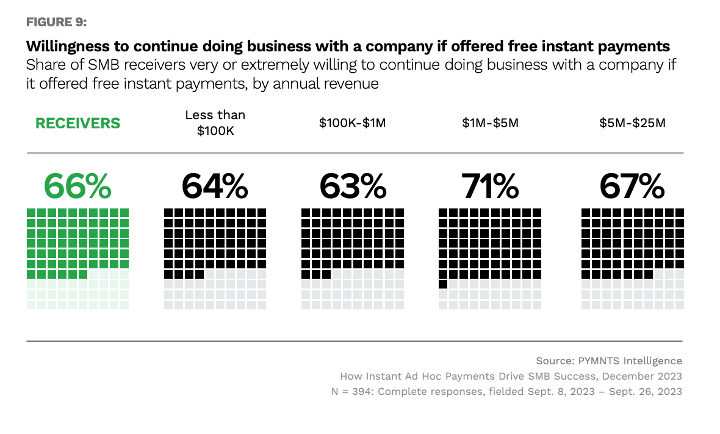
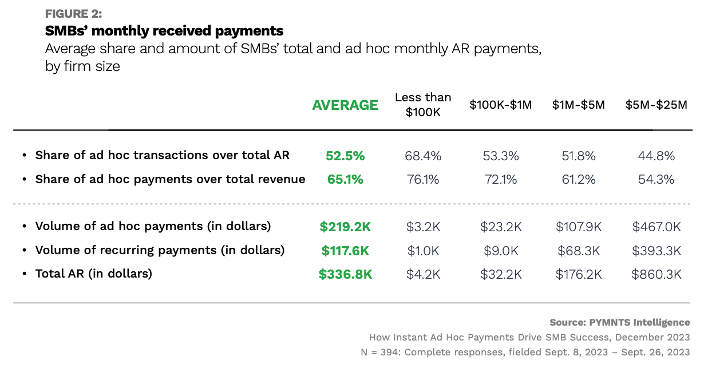
In a fast-paced business environment, the demand for flexibility in financial transactions is paramount, and non-recurring ad hoc payments account for nearly two-thirds of the monthly revenue of small and medium-sized businesses (SMBs), per recent PYMNTS Intelligence research. This reality emphasizes the importance of efficiently processing these payments to ensure a steady cash flow. The study reveals that two-thirds of SMBs are willing to continue doing business with a company that offers free instant payments, highlighting that offering free instant payments can help businesses maintain valuable client relationships.
These are some of the findings explored in “How Instant Ad Hoc Payments Drive SMB Success,” a PYMNTS Intelligence and Ingo Money research collaboration. The study examines SMBs’ reliance on ad hoc payments, their challenges when processing accounts receivable and how instant payment methods can help SMBs manage cash flows and set them up for success.
According to the study, ad hoc payments already account for 53% of SMBs’ accounts receivable, and the share is significantly larger among those businesses making less than $100,000 of revenue, at 68%.
The report identified better cash flow management as the most important motivator for these companies to receive instant payments, while delays in receiving payments were identified as the biggest challenge. “Delayed payments could be the reason why receivers are not that satisfied with their payors,” the report states.
Time inconsistencies are especially important challenges for receivers. For 1 out of 4 payees, timing issues were the most challenging issue when dealing with ad hoc payments.
Legacy payment methods with inherent delays can create uncertainty and hinder accurate assessments of a firm’s financial position. Opting for instant payment methods can streamline the complexities associated with ad hoc payments, benefiting businesses across different industries. By enabling on-demand transfers through real-time payments, SMBs gain access to their liquidity 24/7, significantly improving daily cash flow.
However, the widespread adoption of real-time payments among SMBs depends on banks’ readiness to implement faster payment solutions. “If banks have not implemented real-time payment systems, SMBs won’t be able to take advantage of the benefits,” another PYMNTS Intelligence report warns. In this sense, FinTechs can also play a crucial role in educating SMBs about the advantages of real-time payments and helping them navigate the transition. As banks and FinTechs work together to scale the adoption of real-time payments, businesses can benefit from faster, more efficient financial dealings.
See More In:
Ad Hoc Payments, B2B Payments, cash flow, commercial payments, faster payments, Ingo Money, instant payments, News, PYMNTS Intelligence, PYMNTS News, real time payments, SMBs