Even as artificial intelligence reshapes corporate finance and payments move in real time, one of the oldest habits in business continues to delay billions in payments.
Paper and manual based friction, the latest B2B and Digital Payments Tracker from PYMNTS Intelligence and American Express finds, may be costing businesses more than they realize. The cost might not show up in technology gaps, but in cultural ones.
The report, “Virtual Cards Cut Payment Delays and Protect Buyer-Supplier Ties,” shows that while 8 in 10 firms plan to improve payment processes this year, only 17% have fully automated them.
That leaves most companies exposed to the same manual bottlenecks that have plagued accounts payable for decades: errors, late payments and cash flow volatility. Virtual cards offer an antidote through automation, tokenization and real-time reconciliation, yet adoption remains uneven.
“Virtual cards empower suppliers by providing them with a simpler, smarter and safer option for accepting payments,” Dean Leavitt, CEO of Boost Payment Solutions, said in the report. “The result? A faster, safer and more transparent payment experience that benefits both buyers and suppliers.”
We’d love to be your preferred source for news.
Please add us to your preferred sources list so our news, data and interviews show up in your feed. Thanks!
3 Data Points That Tell the Story
- 97% of marketing and creative agencies reported late payments in 2025, with nearly two-thirds saying that at least 25% of invoices arrive late. The result: postponed projects and frozen cash flow.
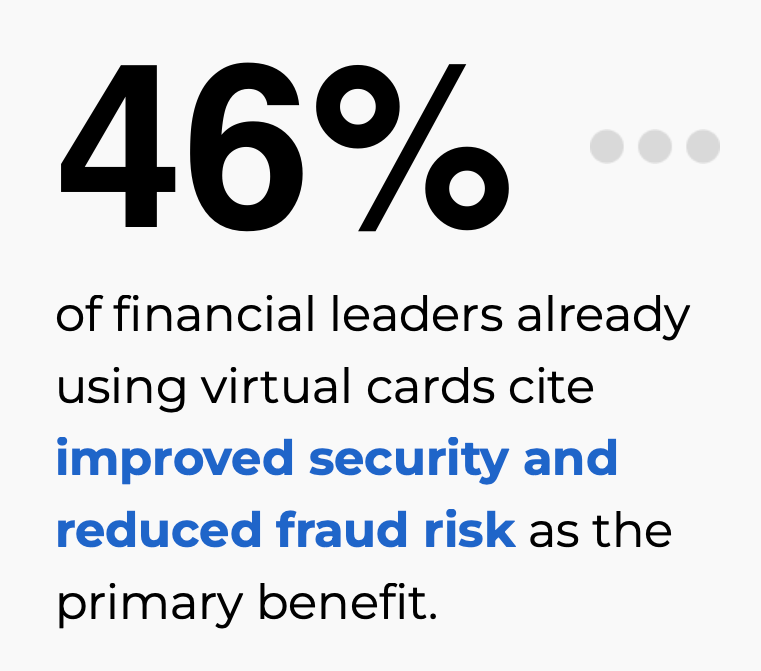
- 46% of virtual card users cite improved security and reduced fraud risk as their top benefit — a key contrast to the 65% of firms that have experienced payment fraud, mostly through paper checks.
- 88% of financial leaders globally say they are considering or adopting virtual cards — but only 48% currently use them, revealing a wide gap between enthusiasm and execution.
The PYMNTS Intelligence research suggests the obstacles are less about infrastructure and more about perception. Some suppliers still view virtual cards as complex or costly.
Others worry that buyers’ digital systems won’t align with their own. Yet, as American Express executive Widad Chaoui notes in the report, both sides benefit: suppliers get faster payments and lower days sales outstanding, while buyers gain transparency and control.
Healthcare and construction firms are emerging as early adopters. But middle-market CFOs — 78% of whom express strong interest in virtual card programs — remain stuck between awareness and action.
The hesitation underscores how entrenched manual routines and relationship inertia can delay even the most secure digital fixes.
Boost’s Leavitt argues that education and turnkey integration are critical. His company’s automated “straight-through processing” model allows buyers to pay suppliers faster while extending their own days payable outstanding — effectively improving working capital on both sides. That dual benefit, he says, is what makes 2025 a potential tipping point.
The virtual card market, valued at $14.6 billion this year, is projected to quadruple by 2032. American Express estimates transaction volumes will soar from 35.8 billion in 2023 to 174.3 billion by 2028. For CFOs navigating inflation, tariffs and supplier strain, faster and safer payments are no longer optional.
PYMNTS Intelligence concludes that the firms most likely to thrive will be those that audit their manual workflows, set measurable goals for automation, educate suppliers and partner with providers that simplify onboarding. The takeaway: digital transformation in B2B payments won’t be won by the newest technology. It will be won by the companies that finally let go of the oldest habits.



 Add as Preferred Source