Even as restaurants agree on the importance of being accessible via digital channels, many independent eateries continue to abstain from social media platforms, PYMNTS Intelligence reveals.
By the Numbers
The report “Main Street Health Q4 2023: eCommerce Protects Main Street SMBs’ Bottom Line in a Cooling Market,” a PYMNTS Intelligence and Enigma collaboration, draws from a survey of 540 small and medium-sized businesses (SMBs) with brick-and-mortar shops in commercial districts across the United States. The survey provides insights into how these business owners are approaching the challenges opportunities associated with the increasing digital transformation across industries.
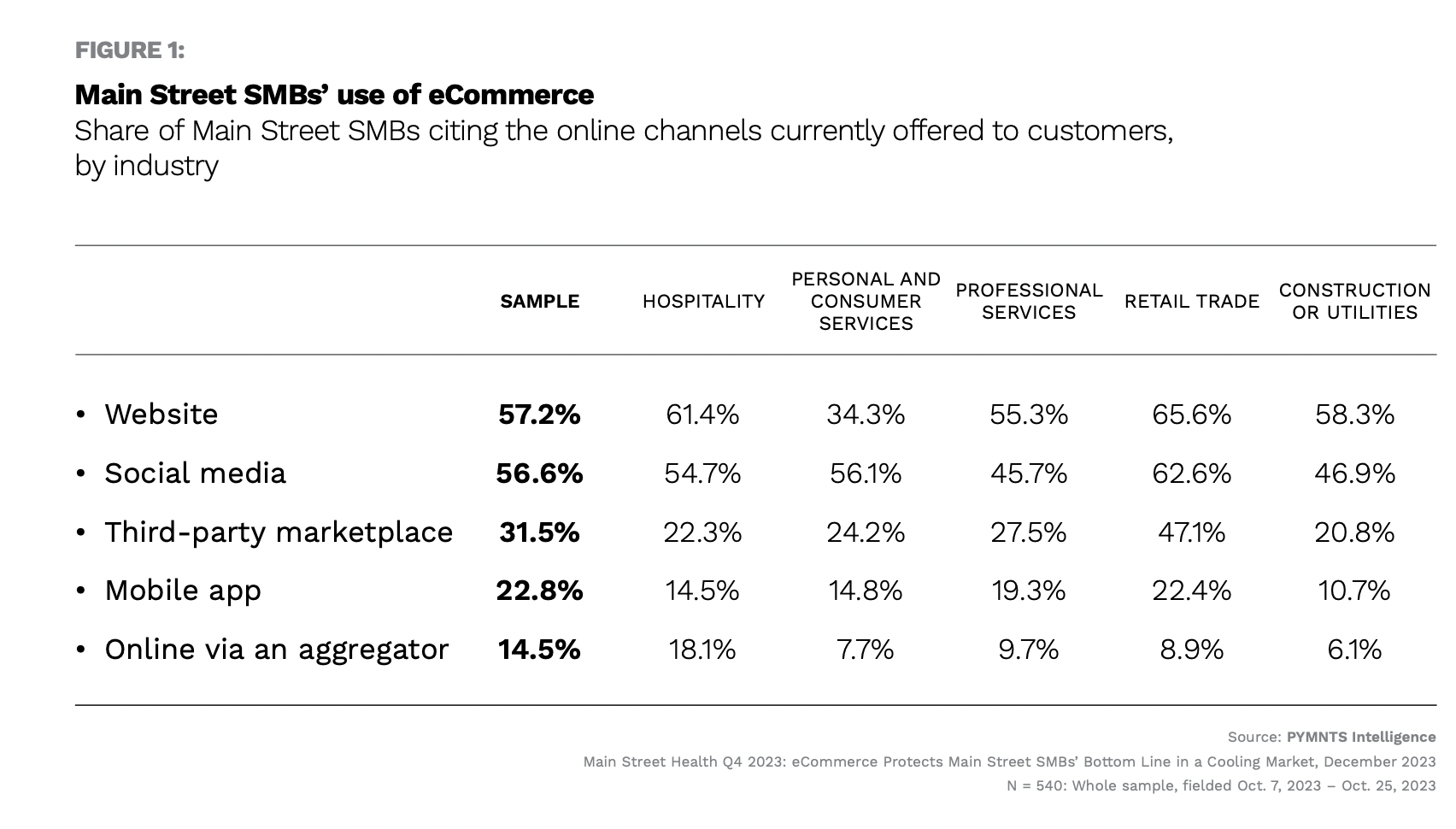
Among those in the hospitality industry, such as hotels and restaurants, more than 80% say they had to start making sales through online channels to adapt to customer preferences. However, only 55% said they currently offer social media channels, leaving nearly half off the platforms entirely.
The Data in Context
These findings are especially notable considering that many consumers rely on social media to find restaurants.
The latest edition of PYMNTS’ exclusive Connected Dining report, “Connected Dining: Word of Mouth in the Digital Age,” which drew from a May survey of more than 2,200 U.S. consumers, found that 37% of diners search for restaurant information by accessing content from a restaurant’s social media page. Additionally, that share jumped up to 42% for Generation Z and 46% for millennials.
Granted, these platforms come with their own challenges, proving to be not the most direct way to connect with consumers at the moment of high-intent searching.
“People, especially Gen Z, are doing this today on social networks, and they find themselves dealing with incredible content and amazing recommendations on the wrong platforms,” Uriel Maslansky, CEO and co-founder of Atly, noted in an interview with PYMNTS earlier this year. “It’s very, very hard to find the right restaurant around you, the right coffee shop around you, on these endless feeds.”