Small businesses have long depended on management software to keep the books balanced and payroll running.
But in 2025, the stakes are different. A growing number of small to medium-sized businesses (SMBs) are prepared to switch software providers outright if their current systems fail to integrate embedded finance.
It’s a development that reveals just how central financial tools have become to competitiveness.
According to the PYMNTS Intelligence/Worldpay report, “Platform Power: The Growing Importance of Embedded Finance to SMB Success,” 9 in 10 SMBs now say access to embedded financial products and services is essential to daily operations.
The study, based on a survey of U.S. businesses, finds that firms are shifting from survival mode after 2024’s turbulence into finance-driven expansion.
The report underscores that software is no longer just a cost-cutting utility. It is, increasingly, the engine that drives growth, customer engagement and strategic decision-making.
Advertisement: Scroll to Continue
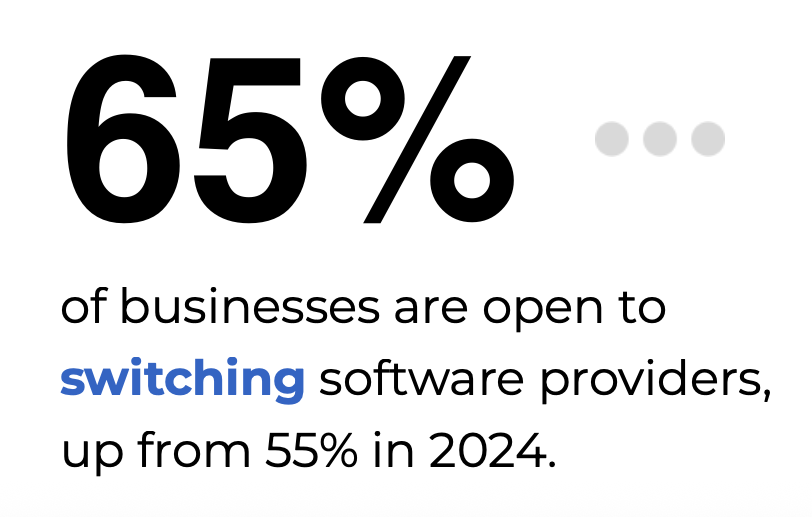
- 65% of SMBs are open to switching software providers, up sharply from 55% the year before. The share is highest among firms dissatisfied with training, integration and ease-of-use — areas where embedded finance can simplify operations.
- 37% of small businesses said they were likely to switch to a provider offering embedded lending, nearly doubling to 69% among those who had used such tools in the last year. That suggests embedded finance doesn’t just attract businesses; it locks them in once they see the benefits.
- 72% of microbusinesses and small firms using embedded lending reported being highly satisfied with their software, compared with just 57% satisfaction among those relying on other forms of credit.
These numbers reveal the deeper story: embedded finance is quietly redrawing the competitive landscape for technology platforms. Once peripheral, it is now one of the strongest determinants of software loyalty. When embedded tools are present, businesses stick; when they’re absent, churn spikes.
The report also points to sectors where these dynamics are especially pronounced. In healthcare, where regulation and costs shift quickly, 45% of firms said they require frequent platform innovation to keep up. Retailers are using embedded finance to smooth out omnichannel transactions. Logistics companies, long reliant on manual systems, are leaning on embedded tools to reduce friction across sprawling supply chains.
None of this means the growth story is irrelevant. Firms that adopt embedded finance tools saw average sales increases of 25% to 50%. Ninety percent of SMBs overall said financial services embedded into platforms were “critical.”
Nearly half of SMBs reported being unlikely to switch providers if their payments tools satisfied customer expectations, underscoring how payments in particular serve as a glue between businesses and platforms.
But the undercurrent is unmistakable: for software providers, embedded finance is no longer a value-add. It is a make-or-break feature that dictates whether customers stay or go.
As Matt Downs, Worldpay’s group president for platforms, put it in the report, “The platforms that thrive aren’t just offering basic functionality — they’re embedding comprehensive financial capabilities so seamlessly that their clients can’t imagine operating without them.”
For SMBs, that future has already arrived.