Cards are moving beyond their traditional role as a way to pay. The new race to the top of wallet is about the digital credential behind the card, one that delivers more optionality and smarter, more contextual experiences for consumers.
For issuers, that evolution opens new opportunities to connect with customers in ways that extend past the point of sale.
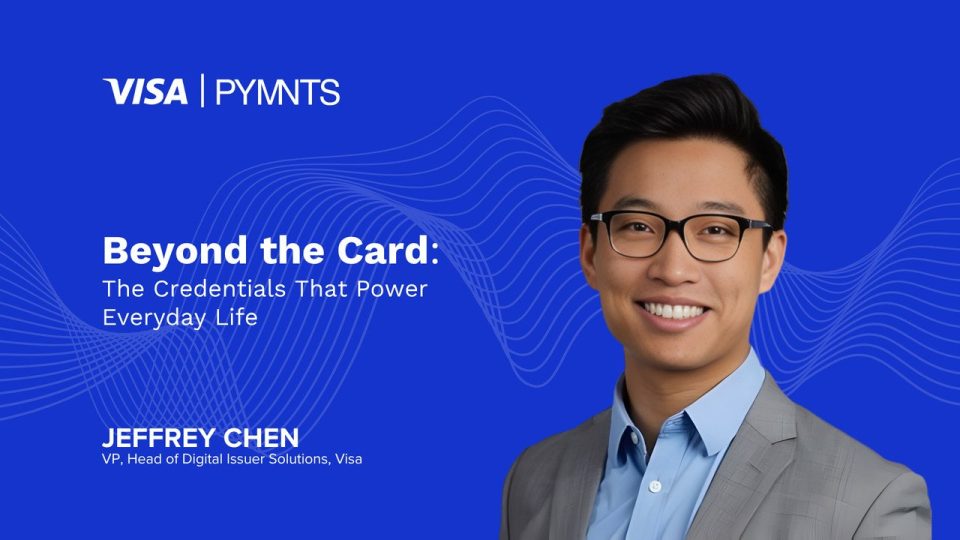
That is how Jeffrey Chen, vice president of Digital Issuer Solutions Portfolio at Visa, described the transformation underway. Speaking with PYMNTS CEO Karen Webster in the kickoff of the “Beyond the Card” series, Chen said Visa’s goal is to become an “operating system” that helps issuers meet consumers’ everyday digital spending needs.
“We’re really going deep on not just providing great experiences but making it easier to deliver these experiences, too,” Chen said. “Credentials play a really key role in all of that. It’s not just about making the account more secure. It’s about using the credential as a foundational capability to deliver amazing experiences.”
From Plastic to Platform
Chen said the idea of an operating system captures the shift in how Visa thinks about its role. Just as the best product companies create systems that make user experiences intuitive, Visa is building an architecture that can help allow issuers to meet consumers wherever they transact, often invisibly.
As Webster said, the consumer doesn’t see the technology “below the waterline.” What matters is that the experience works and works seamlessly. That invisibility is the point, Chen said. Visa’s work behind the scenes lets consumers focus on outcomes, not the mechanics of payment.
Experiences, Not Technology
Consumers are less interested in the technology powering a payment than in how it fits naturally into their lives, Chen said.
“There are so many new technologies popping up all the time,” Chen said. “It’s imperative that companies like Visa constantly think about how those technologies make the end user experience more convenient, more intelligent, more secure and more integrated.”
He pointed to generative artificial intelligence as one of the most promising tools to make those interactions intuitive.
“AI enables such natural interactions with something that might otherwise feel hard to understand,” he said. “It lets you personalize experiences in real time and build products in a differentiated and modern way.”
A Personal View on Accessibility
AI’s potential goes beyond convenience, Chen said. His own family, recent immigrants, avoided credit cards because of opaque concepts like interest rates.
“It was terrifying,” he said. “If you don’t know what it means, and you don’t know someone who does, you might never access it.”
Today, AI can help remove those barriers, he said.
“Even for my own parents, being able to converse in their natural language, in Chinese, to break down these concepts, it’s a huge unlock,” Chen said.
The real opportunity is helping companies assist underserved markets that were previously locked out, he said.
Co-Development and the AI Learning Curve
Visa’s strategy is to help issuers embrace AI responsibly and effectively, Chen said. Many financial institutions recognize AI’s potential but struggle with data readiness, integration and compliance.
Visa’s initiatives, such as the Trusted Agent Protocol, are designed to set standards for agent-enabled transactions. However, innovation depends on collaboration.
“The best thing you can do is find other like-minded companies to co-develop together,” Chen said. “The only wrong thing to do is nothing because this technology will not go away.”
Redefining Top of Wallet
As credentials get smarter, they also make it easier for issuers to achieve and maintain top-of-wallet status.
“In an ideal world, a consumer would not bring a bunch of cards in their wallet,” Chen said.
We’d love to be your preferred source for news.
Please add us to your preferred sources list so our news, data and interviews show up in your feed. Thanks!
Carrying multiple cards introduces friction and uncertainty about which one will work or deliver the best outcome.
AI-enabled credentials can help change that equation.
“If banks can tackle these fundamental problems but leverage AI’s scale, they can redefine the customer relationship and have that top-of-wallet status,” Chen said.
Rather than relying on a financial adviser or static rewards program, banks can create a 24/7, always-on relationship contextually and insightfully.
Data, Context and the Credential
The key to unlocking those experiences is connecting data that is often siloed across institutions, Chen said.
“If you’re able to actually stitch these different data silos together, then you’ve delivered a real end-to-end experience for consumers,” he said.
That integration ties directly to the credential itself, the single access point that allows for more intelligent and contextual recommendations at the prompt, he said.
Building the Digital Issuer Experience
Chen’s portfolio at Visa focuses on helping issuers expand beyond payments to support financial wellness and personalized engagement.
“It’s not just about helping a consumer with payments, but improving their financial wellness overall,” he said.
That requires connecting dozens of digital experiences into a unified operating model that raises the standard for how digital interactions feel.
Closing the Loop
As Visa builds its operating system for issuers, the card becomes more than a payment method. It becomes the digital credential that powers trust, personalization and connection between consumer and issuer, an always-on relationship shaped by data and made smarter through AI.
For Visa and its partners, the next phase is about co-creating those experiences and ensuring that every credential carries with it the intelligence and context to serve consumers wherever they are, Chen said.
“We’re at the start of something transformative,” he said.
For all PYMNTS digital transformation and AI coverage, subscribe to the daily Digital Transformation and AI Newsletters.


 Add as Preferred Source