Cloud migration is no longer the endgame for payments companies. It’s the starting line.
When global business payments giant Convera spun out as an independent company, it faced a challenge familiar to many legacy enterprises. The company’s networks span in more than 200 countries and territories, and over 140 currencies, but its infrastructure was still rooted in on-premise systems built for a slower age of finance.
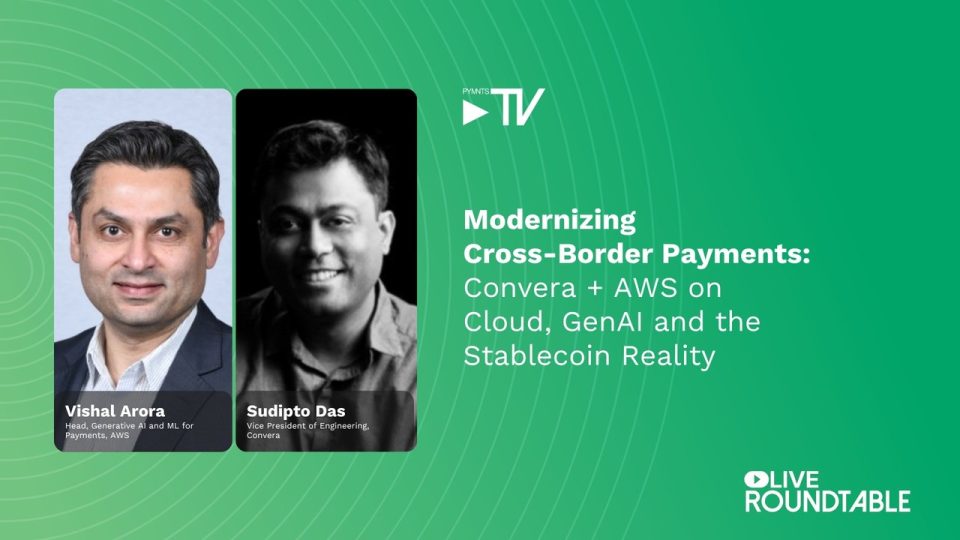
“It was an incredible 10 months to move everything from on-prem to the cloud. But the real story starts after that — that’s when you start unlocking all the benefits,” Sudipto Das, vice president of engineering at Convera, told PYMNTS during a discussion with Vishal Arora, head of generative AI and ML for payments at AWS.
What began as a “lift and shift” migration became an innovation engine, ultimately reshaping the way data, compliance and intelligence interact across geographies.
“Moving from cross-border B2B payments infrastructure to AWS does help a lot of our customers with immediate modernization gains that address some of those core challenges faced by traditional payment systems,” Arora said.
Those benefits, in Convera’s case, materialized across three fronts: scalability, global reach and innovation velocity. The company’s legacy infrastructure required early provisioning for predictable spikes at month- and quarter-end closings. The cloud eliminated that constraint.
“If you own a data center,” Das explained, “you have to procure and provision infrastructure to support those three or four days of load in a month.”
“Being on the cloud makes it simpler to have a global footprint,” he added. “The question becomes not ‘Can we set up another data center?’ but ‘When do we need it?’”
Data as the Foundation of Intelligence
While the immediate payoff of the cloud modernization came in operational agility, the upgrade was just as much about data philosophy as cloud architecture.
“A thorough understanding of all data types and flows is essential,” said Arora, adding that AWS customers increasingly use automated discovery tools to classify sensitive data and apply region-specific controls — “encryption, tokenization, geofencing” — so “regulated data never leaves its required boundaries,” while audit trails remain consistent with GDPR, CCPA and other local regulation frameworks.
“When we move to the cloud, the responsibility of managing our infrastructure does not end. It just gets rebalanced with our service provider,” Das said.
AWS handles the physical layer and certifications, and Convera’s team owns the operational posture: access management, network segmentation between production and test environments, and encryption both at rest and in motion. Automation and observability turn compliance into a continuous process rather than an annual audit exercise.
“It’s not necessarily about dividing the task,” Das said. “It’s about amplifying the trust of our customers that we are running our business in a very secure way, and AWS gives us that secure foundation … and we build the intelligent and compliant and customer-centric layer on top of that.”
Once cloud security is in place and data is in order, then the fun can begin.
The Agentic Shift Set to Redefine Payments
We’d love to be your preferred source for news.
Please add us to your preferred sources list so our news, data and interviews show up in your feed. Thanks!
If modernization was the first act, the second is about intelligence.
“Our customers are leveraging gen AI to improve productivity, reduce fraud and deliver more tailored experiences,” Arora said. “We’re seeing adoption across five areas: customer support, document processing, payments operations, fraud detection and hyper-personalization.”
“Before we really jumped into [AI], we invested heavily in getting our data house in order,” Das said, explaining that only then did the company build AI models for foreign exchange routing and treasury management.
“We always have to see what is the data that is used and what is the model output — how can we explain that?” he added, noting that the benefits compound. “Quality inputs lead to quality outputs. Better user stories accelerate engineering cycles.”
But both Arora and Das view agentic AI — systems that autonomously act within boundaries — as the next step in scaling payments innovation.
From a governance standpoint, AWS supports what Arora called “agentic capabilities” through services like Amazon Bedrock AgentCore, a managed suite for deploying AI agents at scale with secure monitoring.
Stablecoins and the Pragmatics of the Future
No modernization discussion in payments is complete without addressing stablecoins and tokenized settlements. Das’ view is balanced. In B2B, stablecoins remain complementary to existing rails rather than a replacement.
“Unless the entire world moves into the stablecoin world, there will still be a need of off-ramping … into the fiat currencies,” he said. Foreign exchange and compliance considerations remain paramount. He outlined three roles companies can play — accepting stablecoin payments, using stablecoin rails in specific corridors or focusing on last-mile off-ramping — but each depends on the maturity of regulation, operational assurance, and interoperability with traditional systems.
“There is huge potential,” he conceded, “but there are certain areas where we need to see maturity … to really see this going fully mainstream.”
Arora translated those conditions into measurable criteria. Stablecoin systems must enable “24/7/365 real-time fund transfers across borders with settlement times reduced from days to minutes or seconds,” deliver lower costs than correspondent networks, and improve liquidity by freeing trapped cash.
Smart-contract automation for compliance and reconciliation should add tangible value. And “transparency and auditability are critical,” he emphasized, since blockchain verification could streamline regulatory oversight and strengthen B2B trust.
In the end, both leaders return to the same principle: Modernization is equal parts migration and mindset. The new currency of global payments is not just data or speed; it’s trust.


 Add as Preferred Source