The gap between collecting data and extracting advantage from it has become one of the defining competitive fault lines in modern business.
“Most companies are sitting on an enormous amount of data today, and they’re doing very little with it,” Rinku Sharma, chief technology officer at Boost Payment Solutions, told PYMNTS during a discussion for the April edition of the “What’s Next in Payments” series, “The Data Game.”
“The moat is not having more data. The moat is about having the right data, knowing what questions you want to ask of that data, and building the infrastructure to act on those answers at speed,” Sharma said.
Nowhere is this shift more visible than in B2B payments, a sector historically defined by fragmentation, manual processes and limited visibility. But by connecting data across products, networks and workflows, firms that can harness the ecosystem’s latent intelligence are finding themselves able to provide a coherent view of financial activity that informs strategy as much as execution.
“The companies that are winning today are not the ones who have waited for everything to be perfect, but the ones who have started building with what they have and iterated relentlessly,” Sharma said.
Boost’s own ambition, he added, is to unlock the ability of data to answer higher-order questions for clients, such as where working capital risks are emerging, how supplier networks behave and where performance can be optimized.
From Data Exhaust to Intelligence Layer
In consumer payments, innovation is often measured in visible touchpoints: checkout speed, interface design or approval rates. B2B payments operate differently. The “experience” is embedded deep within enterprise systems such as ERP platforms, accounts payable workflows, treasury infrastructure and more, making it both less visible and historically slower to evolve.
“What we’re doing now is building the analytical layer that turns these signals into intelligence,” Sharma said. The goal is not retrospective reporting, but operational impact, “faster decisions, smarter interchange optimization, and better outcomes for our buyers and suppliers.”
Because as industries digitize, competitive advantage is being shifted away from ownership of infrastructure toward ownership of insight.
Operating at the intersection of buyers, suppliers and card networks, Boost processes commercial card transactions across thousands of relationships in more than 180 countries. That vantage point yields a dataset no single participant could assemble independently, but raw visibility is only the starting point.
“It’s not magic,” Sharma said. “It’s a result of data that is extracted from payments and about the supplier’s systems being understood and acted upon automatically.”
The impact can be tangible. Suppliers joining a modern payments network, Sharma said, increasingly receive funds automatically, accompanied by clean, structured remittance data in their preferred formats.
The elimination of manual reconciliation is not the result of a single feature, but of coordinated intelligence across systems capable of understanding supplier preferences, buyer workflows and transaction context simultaneously.
AI Collapses Distance Between Signal and Action
We’d love to be your preferred source for news.
Please add us to your preferred sources list so our news, data and interviews show up in your feed. Thanks!
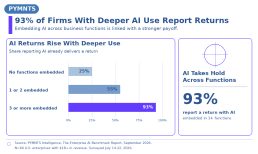
Data intelligence’s impact across B2B is also getting a concurrent boost from artificial intelligence, which is compressing the time, cost and complexity required to extract value from data.
Sharma framed AI’s impact along three dimensions: speed, cost and quality, and argued that its real power lies in how those forces compound.
“Transaction decisions that were happening historically in manual review queues or overnight batch jobs are now happening in milliseconds,” he said, noting that for large-scale B2B payments, that means parsing unstructured data, optimizing interchange and delivering enriched remittance information instantaneously.
The reason this is now possible is that cost dynamics have shifted just as dramatically. What previously required “an entire team of data scientists running and building ML [machine learning] models at scale” — along with significant compute investment — can now be deployed “in days and weeks without that huge upfront investment,” Sharma said.
But it is in quality where AI introduces the most profound change. Traditional systems have relied on predefined rules, inherently limited by what engineers anticipate. Machine learning, by contrast, surfaces patterns that were never explicitly encoded, enabling detection of anomalies and opportunities that would otherwise remain invisible.
“It looks for patterns that it has never been coded for,” Sharma said.
The result is not simply better automation, but a fundamental expansion of what organizations can perceive and therefore act upon. By analyzing cash flow patterns, payment velocity and network relationships, companies can make faster, more precise decisions.
“What real-time transaction data is doing is enabling us to have a forward-looking assessment,” Sharma said. “The question used to be what happened. Now the question is, what should we do about it right now?”
In that sense, the future of data-driven advantage may be less about ownership than orchestration. Companies that can unify disparate signals, interpret them in real time and act with clarity may define the next generation of competitive moats.
For Boost, that means evolving beyond payments infrastructure into what Sharma described as “the intelligence layer in B2B commercial payments.”
“When a supplier asks why a transaction was routed in a certain way, they deserve an answer,” he said. “The companies pulling ahead are using AI and payments as a trust-building and growth engine.”
For all PYMNTS B2B coverage, subscribe to the daily B2B Newsletter.

 Add as Preferred Source