The Clearing House is in its 173rd year of occupying the same position in the United States’ banking system. It’s the place where money that starts at one bank finishes at another.
The Clearing House was organized in 1853 to net paper checks among New York banks. It launched CHIPS® in 1970 to move large-value dollars. It operates a private-sector ACH network. It built the RTP® network in 2017, the first new U.S. payment rail in more than four decades.
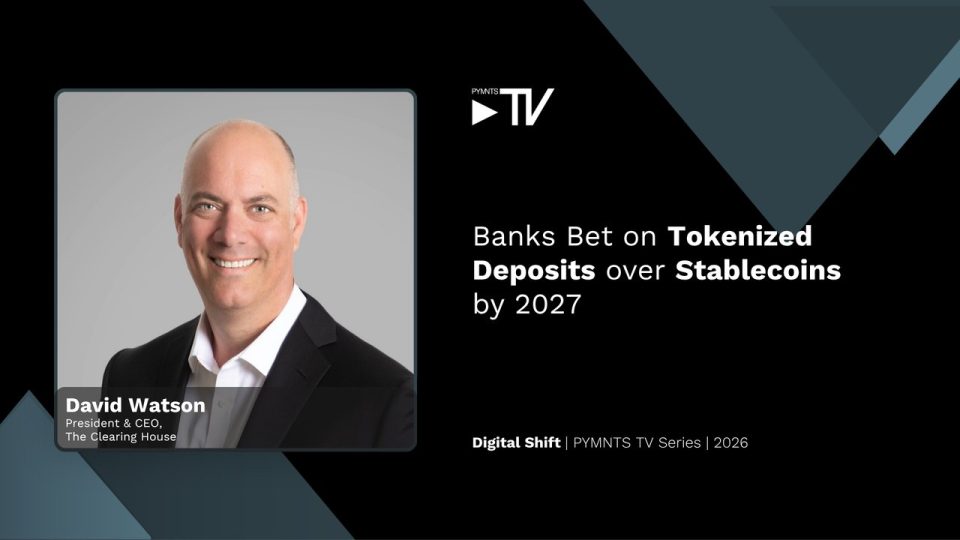
The tokenized deposit network the company is now building belongs on that list, and reading it that way changes what the project is, The Clearing House CEO David Watson told PYMNTS CEO Karen Webster.
It’s not a bank consortium experimenting with blockchain. It is the incumbent clearing and settlement infrastructure extending its franchise to a new instrument, which is wholesale tokenized fiat, issued by banks, moving in real time between institutions and across geographies. That’s a materially different proposition from a pilot, and the reason Watson said the effort has a plausible path to scale that most tokenization projects lack.
Why Tech Without a Use Case Is Just a Science Project
Watson described what The Clearing House is building as a clearing and settlement network that lets banks exchange their respective tokenized deposits while the corresponding fiat funds move simultaneously. A tokenized deposit becomes more useful when a corporate treasurer can move it beyond the bank that issued it, and for multinational companies that maintain relationships with numerous banks, that’s one of the practical limitations of bank-specific tokenization. The money may be digital and programmable, but the customer still needs to move it among institutions.
The initiative reflects a conclusion that banks reached after examining stablecoins, tokenized deposits and conventional payment systems side by side, Watson said. They don’t necessarily perform the same job.
“Stablecoins, tokenized deposits, traditional fiat, they all have a place, and they all have a solution of some sort to different things,” Watson said. “It’s when they all come together in different ways, shapes and forms that you actually get the best benefit of all.”
Why the Liquidity Math Favors the Bank Rail
That division of labor is already visible in the use cases, and where the stablecoin comparison gets decided.
Watson said he sees stablecoins as potentially useful for international person-to-person payments, where moving relatively small amounts across borders remains cumbersome. Zelle is one example. Using a stablecoin to extend an account-to-account proposition internationally can make sense because it applies the technology to a specific payments problem. Stablecoins also have an established role moving money into and out of crypto.
Tokenized deposits present different economics when the transaction involves a multinational company moving hundreds of millions or billions of dollars. Watson emphasized liquidity as much as keeping deposits on bank balance sheets. Stablecoins can tie up liquidity, while CHIPS, The Clearing House’s wire platform, uses liquidity mechanisms that allow an average of $26 in payments for every dollar held in an account.
“Stablecoins trap liquidity,” Watson said. “That’s OK if it solves other problems and it’s not a big deal. But when you get into the sort of sums we’re looking at, you don’t want trapped liquidity.”
At corporate treasury scale, that ratio is the argument. A tokenized deposit that settles over infrastructure engineered for large-value liquidity efficiency is not competing with stablecoins on novelty. It is competing on the cost of the dollars a treasurer must leave parked, offering 24/7, real-time, programmable movement on top.
How the Network Would Work
The first demand is coming from corporate treasurers, Watson said. A multinational company may value the programmability and round-the-clock availability of a tokenized deposit, but it may have relationships with two banks or 20, 40 or 50. The problem is moving between those banks without repeatedly leaving the tokenized environment.
Watson illustrated the mechanics with Citi and JPMorganChase. A corporate customer that wants to move $100 million from a Citi tokenized deposit to a JPMorgan tokenized deposit could otherwise have to redeem the Citi token, wire the resulting fiat funds to JPMorgan and then have JPMorgan issue its token.
The Clearing House network is designed to reduce that process to one instruction. The first token would be burned, the second minted and the fiat funds moved between the banks simultaneously, while associated data and programmability travel with the transaction.
We’d love to be your preferred source for news.
Please add us to your preferred sources list so our news, data and interviews show up in your feed. Thanks!
Citi, JPMorgan and other banks’ individual tokenized deposit initiatives create demand for a way to move between bank systems. Many banks asked The Clearing House to build the capability so their customers could exchange tokens. The same infrastructure could eventually connect other bank consortia or external ledgers when customer demand supports it.
Critical Mass Before Ubiquity
The incumbent-infrastructure argument also changes the discussion about reach. The network doesn’t have to touch every financial institution before customers can use it. Watson pointed to CHIPS, which settles more than $2 trillion a day among roughly 40 to 50 banks. The RTP network, by contrast, is moving toward broader reach and processes about 1.6 million payments per day and has over 1,300 bank and credit union participants.
Webster identified the tension between critical mass and complete coverage.
“You don’t need ubiquity to have a successful network because you have critical mass, for sure,” Webster said, adding that the long tail of institutions still represents a segment that ultimately needs to be served to reach the level of ubiquity that ACH and checks maintain.
Built From the Problem, Not the Technology
Watson described the tokenized deposit project as a year-and-a-half of work involving The Clearing House and banks. Rather than beginning with a blockchain product and searching for somewhere to use it, the participants examined what existing 24/7 instant payments could already accomplish and then concentrated on problems they couldn’t yet solve, including programmability and other on-chain functions. The work considered stablecoins, tokenized deposits and further development of fiat payment systems.
That history informs Watson’s advice to banks confronting a widening selection of digital money projects. There may be no single technology decision that settles the issue.
“The winners will be the people that are able to navigate all of those [options]… and decide when is the right time to use each one because they all have a time and place,” Watson said.
The Clearing House expects to begin answering these questions with actual transactions in 2027. The organization plans to select its technology partner in the coming months, work with banks on design and integration during the fall, prepare initial banks and customers in the first quarter, and have transactions running by the second quarter, Watson said.
If it holds, the 2027 entry on the list reads like the ones before it. It’s a new instrument, cleared and settled in the same place the last four instruments—checks, wire, ACH and instant payments—were.
Watch the full interview with The Clearing House President and CEO David Watson to learn more about:
- Why government disbursements have historically helped payment networks reach critical mass.
- How incentives affect bank adoption and where tokenized securities could create another use case.
- Why Watson said experimentation will remain unavoidable as banks decide where to place their bets in on-chain finance.
For all PYMNTS digital transformation coverage, subscribe to the daily Digital Transformation Newsletter.


 Add as Preferred Source