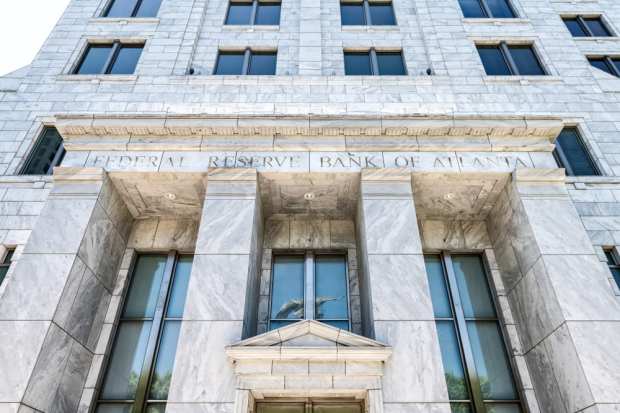
Real gross domestic product (GDP) is projected to plummet 52.8 percent in the second quarter, according to the Federal Reserve Bank of Atlanta’s GDPNow as of Monday (June 1). The model, which offers a “nowcast” of the official estimate before its release, had forecast a 51.2 percent drop on May 29, according to an announcement.
The nowcasts of real personal consumption expenditures growth for Q2 fell from a 56.5 percent drop to a 58.1 percent drop, and real gross private domestic investment growth fell from a 61.5 percent drop to a 62.6 percent drop. Additionally, the nowcast of the contribution of the change in net exports to Q2’s real GDP growth fell to 0.43 percentage points from 0.73 percentage points.
We’d love to be your preferred source for news.
Please add us to your preferred sources list so our news, data and interviews show up in your feed. Thanks!
The Atlanta Fed said the next GDPNow update will be on Thursday (June 4). The branch noted that GDPNow is not an official forecast, but is “best viewed as a running estimate” built from available information. It also said that “subjective” changes are not made to the GDP, as the forecast is only based on the model’s mathematical results.
The Atlanta Fed cautioned, “In particular, it does not capture the impact of COVID-19 beyond its impact on GDP source data and relevant economic reports that have already been released. It does not anticipate the impact of COVID-19 on forthcoming economic reports beyond the standard internal dynamics of the model.”
In addition, the Atlanta Fed said it won’t support the GDPNow app as of Friday (June 5).
Separately, the Congressional Budget Office (CBO) said on Monday (June 1) that the pandemic’s ultimate financial impact will likely be a decrease of $7.9 trillion to the U.S. GDP until 2030. The figure includes rescue funding approved to date by Congress, which has been in the multi-trillions, with aid going to people, companies and services such as testing.
In response to Sen. Chuck Schumer’s inquiry, CBO Director Phillip L. Swagel said the downturn is likely to come from the shuttering of businesses as well as social distancing procedures.


 Add as Preferred Source