If you’ve been watching the NFL playoffs or scrolling social media lately, you’ve probably noticed a surge in ads for consumer artificial intelligence (AI) tools.
Left Mr. Fuzzy the Teddy Bear on the airplane? Google Gemini says it can help you retrieve him. Stumped about what to name your new jewelry designs? Tap Microsoft Copilot, just like actress Kristin Cavallari. Feeling sluggish on a dreary winter jog with friends? ChatGPT can draw up a fitness plan with behavioral psychology-infused motivation tips. Need an original song about Uncle Jack’s football obsession? Suno can write you one that sounds like a powerhouse ballad.
As AI develops at lightning-quick speed and fuels sharp debate over whether it will replace jobs, technology giants and startups are engaging in a high-stakes “hearts and minds” campaign to convince consumers they need AI in their ordinary lives. Like ChatGPT’s “Everyday Magic” advertising campaign, launched late last September, tech and AI companies want to persuade millions of consumers that the technology is a helpful and creative assistant in daily life, not a digital beast that will, in one interpretation, destroy jobs and possibly humanity.
Hooking individuals first is key. People who use conversation and generative AI to build grocery lists, write songs and plan their days are the gateway to more profitable enterprise subscriptions by companies and organizations for workplace AI tools that can create decks, analyze supply chains and otherwise boost productivity and innovation.
Recent research by PYMNTS Intelligence shows that consumer AI adoption of AI tools has hit a critical point: More than 6 in 10 adults in the United States used a dedicated AI platform last year at least once last year for everything from managing their finances and health to learning and planning travel to shopping and writing. This climbs to about two-thirds among millennials and Gen Z, highlighting how quickly AI is becoming a part of life for younger consumers, many of whom have never known a world without the internet.
What’s more, typical AI users aren’t just sampling the technology occasionally. We classify about 4 in 10 consumers as either “mainstream” or “power” users, meaning that they use AI frequently and for a wide range of tasks. These findings closely track with a recent survey by the St. Louis Fed that found 54% of adults in the U.S. have used at least one generative AI tool, including 49% that have done so outside of work.
Advertisement: Scroll to Continue
The Monetization Question
Consumer AI has become a $12 billion global industry since the original ChatGPT emerged in late 2022, according to Silicon Valley venture capital firm Menlo Ventures. By one estimate, it could reach more than $674 billion by 2030.
ChatGPT gets the most love from users, with more 4 in 5 AI users turning to it at least once, far above Google Gemini (48% of users) and Microsoft Copilot (30%), a forthcoming PYMNTs Intelligence report on a survey of U.S. consumers last December through earlier this month finds.
The technology’s rapid adoption by consumers isn’t just hype. But monetizing the tectonic shift is another matter, because very few consumers actually pay to use AI tools. OpenAI, the company behind ChatGPT, recently reported about 800 million active monthly users of its chatbot, but a report by The Information last November said that only 5% of them are on paid tiers — and that includes enterprise users. Open AI aims to increase that to 8.5% of an estimated 2.6 billion global users by 2030, or 220 million people.
With tech giants, including chipmaker Nvidia, set to pour an estimated $2 trillion into technology this year, the AI buildup is famously expensive, pushing the big players to scramble for expanded revenue. This translates to more paid tiers that focus on usage caps and “credits”— for free tiers, ads.
Top AI Assistants
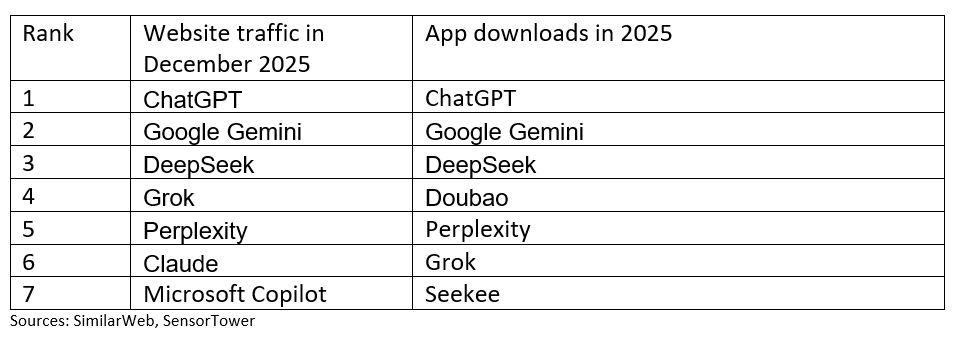
Here’s how the top AI assistants stack up on global website traffic and app downloads (Apple App Store and Google Play), according to SimilarWeb and SensorTower data.
The Great Tier-ification
A core part of the monetization effort is adding new tiers and bundling options at both ends of the pricing spectrum.
At the entry level, this means inexpensive plans that nudge consumers with free accounts toward basic paid subscriptions. For example, this month OpenAI launched an $8 per month ChatGPT Go tier targeting free users who want more messaging, uploads and image creation features. That’s less than half the price of the $20 per month Pro tier that was previously the cheapest paid option. Not to be outdone, Google just went live in the U.S. with its AI Plus tier, priced at $7.99 per month.
At the top end of the market are the so-called “prosumer” tiers that target heavy users, like content creators. Perplexity, for example, launched a $200 per month Max tier last July aimed at highly active users, professionals and teams. OpenAI charges the same for its Pro tier, while Google’s AI Ultra comes in at a $250 per month and includes 30TB of storage.
As part of this “tier-ification,” AI providers are introducing stricter usage caps and credit systems to differentiate their offerings — and to encourage heavy users to upgrade.
Enter the Ads
Ultimately, many consumers may stick with free options for the foreseeable future. That puts the spotlight on another primary source of revenue: ads.
To date, the leading AI companies have generally avoided running commercial advertisements on their websites and platforms, maybe to help keep the user experience optimal while consumers get hooked on this new technology. But this is starting to change.
OpenAI has announced plans to test ads in ChatGPT, starting in the U.S. on the Free and Go tiers. The company says ads will sit below answers at the bottom of the user interface, be clearly labeled and tie into the live conversation at hand. This signals that how as the industry’s economics tighten — with free usage exploding and massive infrastructure and operating costs — even the AI leader is shifting to model that looks more like a content business.
Other players are going in similar direction. An early pioneer, Microsoft has been embedding ads into its Copilot search and shopping flow since 2023. X reportedly has plans to place ads inside Grok responses or suggestions, effectively dishing up sponsored recommendations to the exact problems users are discussing. Meta is going further still: In December, it began treating interactions with Meta AI as personalization datapoints that can shape the ads and content users see across in other platforms including Facebook and Instagram.
Ads are not a guaranteed revenue machine, though. Perplexity recently suspended the model it introduced in late 2024 of running sponsored follow-up questions — ads that flow into a user’s ongoing query. This approach appears to have failed or at least to have risked turning off too many users.
Google is the big exception. The company’s global VP of advertising told Business Insider earlier this month there are “no plans” to run ads in Gemini, and suggested that doing so would undermine credibility.
Read more:
How AI Becomes the Place Consumers Start Everything
Shoppers Trust Banks Over Retailers to Let AI Buy
Big Tech Expands AI Across Climate, Search and Public Services
For all PYMNTS AI coverage, subscribe to the daily AI Newsletter.