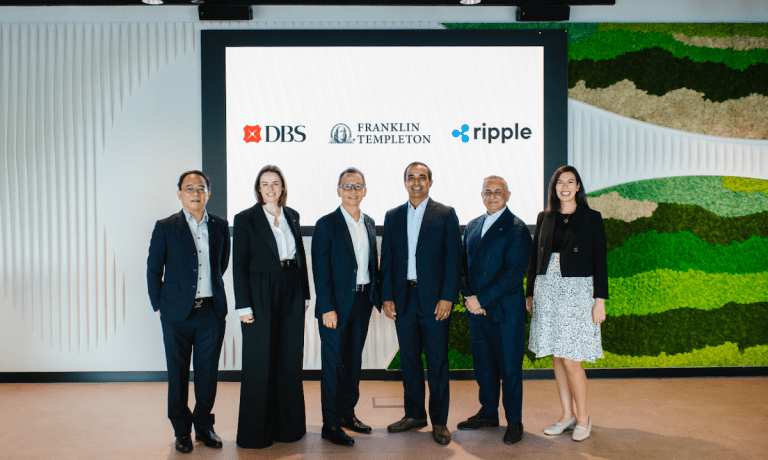
This collaboration will see the companies launch trading and lending solutions powered by tokenized money market funds and stablecoins, Ripple announced Thursday (Sept. 18).
“2025 has been marked by a series of industry-firsts when it comes to traditional financial institutions moving onchain — and the linkup between Ripple, DBS and Franklin Templeton to enable repo trades for a tokenized money market fund with a regulated, stable and liquid mode of exchange such as RLUSD is truly a game-changer,” said Nigel Khakoo, vice president and global head of trading and markets at Ripple.
“Investors can also seamlessly rebalance their portfolios between a stablecoin and a yield-generating money market fund, all within a single, trusted ecosystem, unlocking real-world capital efficiency, utility and liquidity that institutions demand.”
According to a Ripple news release, the partnership will see DBS’s Digital Exchange list sgBENJI — the token of Franklin Templeton’s tokenized money market fund — alongside Ripple’s RLUSD. This setup lets DBS clients trade RLUSD for sgBENJI tokens, allowing them to “rebalance their portfolios into a relatively stable asset 24/7 and within minutes, while earning yield during periods of volatility,” the companies said.
As the partnership progresses, DBS will explore helping customers unlock liquidity by using their sgBENJI tokens as collateral, the release added.
Advertisement: Scroll to Continue
“Tokenization, long the buzzword of blockchain evangelists, has entered its next phase,” PYMNTS wrote earlier this year after Robinhood and Kraken — on the same day — announced tokenization-related projects.
“While initial coin offerings (ICOs) and non-fungible tokens (NFTs) dominated earlier narratives, the current wave of interest centers around tangible, regulated assets — stocks, bonds, commodities and now carbon credits.”
BlackRock CEO Larry Fink has gone on record claiming that all assets should be tokenized on a blockchain and tradable online, arguing in his 2025 annual shareholder letter: “Every stock, every bond, every fund — every asset — can be tokenized.”
In other stablecoin-related news, PYMNTS wrote earlier this week about the digital assets’ growing role as a foundational payment layer for B2B transactions.
“It’s been accelerating a lot in the last few years, especially this year with new regulations coming in the U.S. and prior year in the EU,” Bryce Jurss, vice president, head of Americas, digital assets at Nuvei, said in an interview with PYMNTS. “That guidance has helped really shape blockchain as an infrastructure and stablecoins on that blockchain infrastructure.”