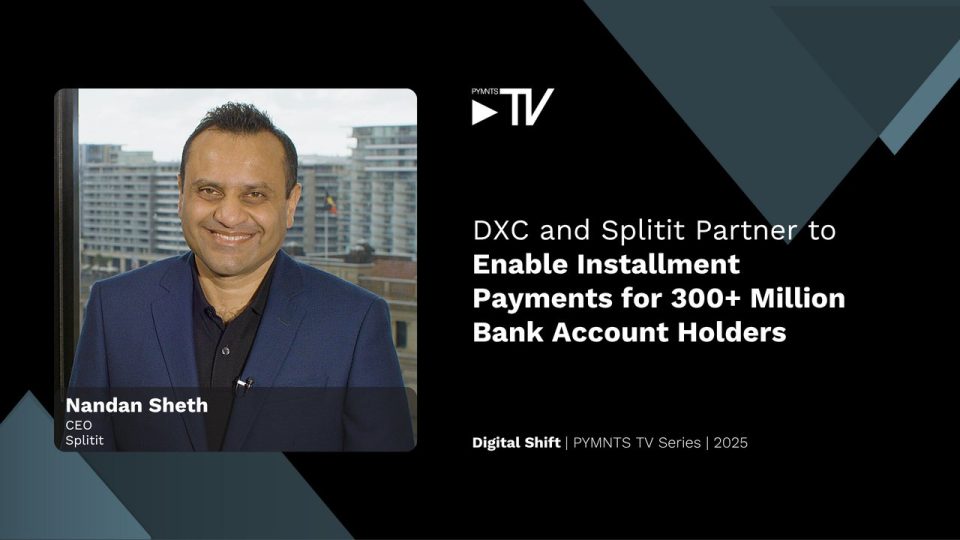
The two companies announced a collaboration to integrate Splitit’s installment technology into DXC’s Hogan core banking platform, which supports more than 300 million accounts and $5 trillion in deposits across 40 major banks.
The integration will allow financial institutions to enable pay-over-time plans directly from debit cards and demand deposit accounts (DDAs) without creating new credit lines or third-party relationships.
Splitit CEO Nandan Sheth told PYMNTS CEO Karen Webster that the partnership represents “one of the more important” steps in the company’s evolution, calling it “an opportunity that can scale” because Hogan powers 40 of the world’s largest banks. By embedding Splitit’s installment capabilities into the core system, he said, banks can “enable personalized installments directly to their debit card and DDA customers, fully embedded in their existing experience.”
Reclaiming Ground Lost to BNPL
The partnership aims squarely at helping banks compete with buy now, pay later (BNPL) providers that have gained traction with debit-first consumers. Sheth noted that “contemporary FinTech BNPLs are picking off debit consumers from the banks in the millions,” adding that debit represents “a significant opportunity” for financial institutions that have long struggled to monetize checking and debit portfolios.
By using Splitit’s technology, he said, banks can offer “transactional credit, not revolver credit,” in a way that is simple to consume and helps them “retain and hopefully grow their consumer base rather than see a hemorrhaging of that base.”
The model is designed to be flexible. Banks that wish to handle underwriting and origination can use Splitit purely as a technology layer. For smaller issuers, such as community banks and credit unions, Splitit can step in as a lending partner. “We can be a SaaS [software-as-a-service] provider that enables all the bits and bytes back to the core,” Sheth told Webster, “or we can do the underwriting and the extension of the loan back to the merchant.”
A Core-Level Advantage
We’d love to be your preferred source for news.
Please add us to your preferred sources list so our news, data and interviews show up in your feed. Thanks!
The relationship began through a bank introduction. “One of our large bank partners said, ‘You should talk to our core banking provider,’ and they mentioned DXC,” Sheth recalled. “Once we got in there, we spoke to the C-Suite. They have a very progressive mindset, focused on innovation, transactional revenue and monetizing the assets they have. The timing was good.”
Integrating Splitit’s proprietary AI engine into Hogan will let banks personalize offers at checkout or even post-purchase, using behavioral and transactional data to optimize take-up rates. The goal, Sheth said, is to “create better conversion and stimulate the cardholders to pick up appropriate offers and not try to mass market to every single transaction.”
Splitit’s network already spans thousands of merchants, but Sheth emphasized that its reach through digital wallets and commerce platforms will be the real multiplier. “We’re embedded in the Samsung Wallet,” he said, adding that the wallet’s 30 million U.S. consumers and near-universal merchant acceptance make it a natural distribution channel. “The combination of our direct merchant network, platforms such as TikTok Shop, plus the wallets provides a level of acuity and scale that banks will benefit from.”
Those integrations also give banks new insights into customer spending, data Sheth said will stay strictly within each bank’s control. “Because we’re connecting to the core and going to have access to transactional data, the cross-marketing opportunities with the consumer and the bank are tremendous,” he said. “We’ll use the bank’s data to drive conversion and ensure that offers are very personalized.”
Fair Fees and Early Launch
Sheth believes the model brings fairness to a segment often criticized for high BNPL costs. “There’s going to be a sense of fairness in terms of the fees and APRs that are going to be charged by the banks,” he said. “Their cost of capital and understanding of risk are very different from third-party BNPLs, so the consumer will end up getting a better deal.”
Splitit and DXC have dedicated teams finalizing the integration, with a production-ready rollout expected in the first quarter of 2026 and three pilot banks lined up. “We feel very confident about launching at least two of the three by Q2,” Sheth said.
While the partnership will debut in the U.S., Sheth said interest extends well beyond. “We’re finding that debit card usage in the U.K. and Europe is getting stronger and stronger,” he said. “Being able to embed an installment credit vehicle on an existing DDA or debit card is very interesting for those banks because that consumer base wants transactional credit.”
In the end, Sheth believes this alignment of timing, technology and trust gives both banks and consumers what they’ve been missing. “The consumer will pay lower fees, the banks will earn new fee income on debit portfolios where growth has been anemic,” he said. “It’s a good cross-section of a segment that is large but underserved.”


 Add as Preferred Source