Agentic commerce is approaching an awkward transition point in its adoption cycle. The artificial intelligence (AI) foundation is getting good enough to shop for consumers faster than the commercial system responding to it is getting comfortable letting it buy.
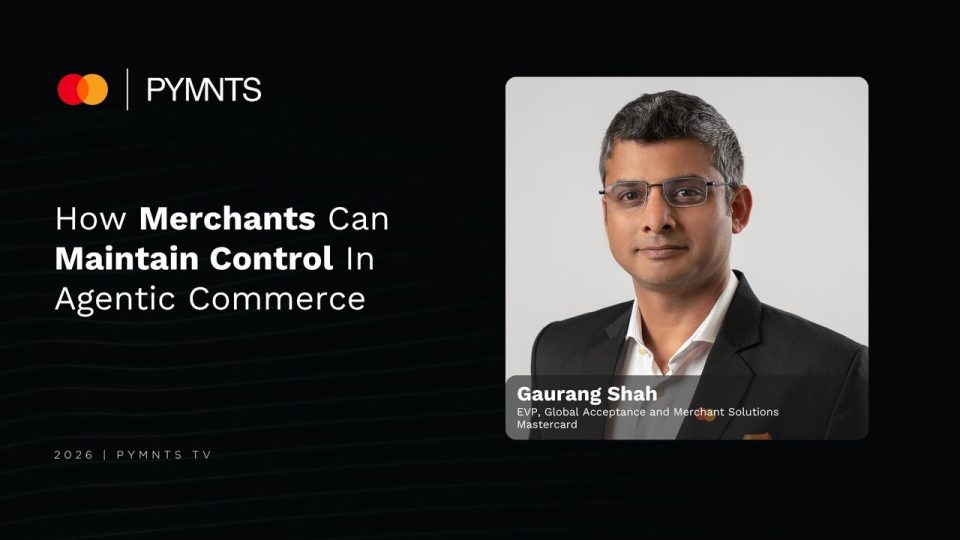
“The searches are already happening,” Gaurang Shah, executive vice president, Global Acceptance and Merchant Solutions at Mastercard, said during a conversation hosted by PYMNTS CEO Karen Webster. Consumers are experimenting with agents because “the access is very easy,” he said. But today, “they are definitely stopping at the recommendations.”
The next generation of agentic payments will need to move more than money. It will need to move proof. Consumers generally expect protection if something goes wrong. Merchants may have a different view of where responsibility should sit when an agent initiates the transaction.
“The consumer though has the baseline expectation that they’re protected. Whatever happens, they’re going to be protected,” Webster said. “And the merchants feel that liability should rest with whoever the agent broker is.”
That conflict turns identity, authorization and intent into payments problems.
Merchant Control Becomes Part of the Payments Stack
Shah described the challenge facing the marketplace as a “trust equation” between consumers allowing agents to transact and merchants agreeing to accept those transactions.
A merchant needs to know whether the agent reaching its checkout is legitimate, whether the consumer authorized it, what the agent was permitted to do and potentially whether the transaction remained within those parameters.
Webster noted that consumers are already using AI for “discovery, ranking, comparing,” before returning to familiar destinations to complete the purchase. That means the customer journey can begin migrating away from merchant-owned channels even before merchants formally participate in agentic commerce.
Shah compared the transition with the arrival of search engines, marketplaces, mobile apps and eCommerce. Merchants learned to operate across each new distribution layer. But autonomous agents introduce a more consequential intermediary because they can potentially decide which merchant wins the transaction.
Merchants still want to be “discoverable,” “trusted” and “transactable,” Shah said. But they also want to preserve their direct customer relationships and their ability to differentiate on something other than price.
We’d love to be your preferred source for news.
Please add us to your preferred sources list so our news, data and interviews show up in your feed. Thanks!
AI Is More Likely to Create Another Channel Than Replace the Storefront
There is also a growing indication that merchants will resist an all-or-nothing choice between their own digital properties and third-party AI platforms.
Shah said merchants he has spoken with generally want both.
“They want to offer both channels,” he said, stressing the importance of meeting customers wherever they are. Merchants, Shah added, want their catalogs available to outside agents while building agentic experiences on their own properties, creating “parity on their own channel versus the third-party channel.”
Webster distilled the imperative to five words: “Be where the consumer is.”
That matters because the simplest optimization function for a shopping agent could also be one of the most destructive for brands: find the cheapest acceptable product.
Agentic commerce therefore creates an emerging battle over what an AI recommendation should optimize for. Price is measurable. Brand equity, service quality, authenticity, loyalty benefits, return experience and consumer preference are harder to encode. Yet those are precisely the variables on which many merchants make their margins.
Search engines once decided what consumers saw. Marketplaces decided where products competed. Social platforms increasingly influenced what shoppers wanted. Agentic platforms could go a step further and decide what gets bought.
Watch the full PYMNTS TV interview with Gaurang Shah to hear more about:
- Why agentic commerce is moving faster in discovery than in transaction execution. Shah says consumers are already using AI agents to search, compare and narrow choices, but are still stopping at recommendations because they are not yet ready to hand over full purchasing authority.
- Why merchant control may be the real bottleneck to agentic commerce. Shah says merchants want to be discoverable, trusted and transactable without surrendering pricing, brand equity or the customer relationship — while Webster warns that poorly designed agent optimization could turn commerce into “a race to the bottom.”
- Why trust infrastructure will determine when AI agents can actually buy. Shah and Webster point to agent identity, consumer intent, payment credential protection and liability as the key unresolved layers, with merchants needing confidence that an agent is legitimate, authorized and operating within clear guardrails.
PYMNTS CEO Karen Webster is one of the world’s leading experts in payments innovation and the digital economy, advising multinational companies and sitting on boards of emerging AI, healthtech and real-time payments firms. She founded PYMNTS.com in 2009, a top media platform covering innovation in payments, commerce and the digital economy. Webster is also the author of the NEXT newsletter and a co-founder of Market Platform Dynamics, specializing in driving and monetizing innovation across industries.
Gaurang Shah is the executive vice president, Global Acceptance and Merchant Solutions at Mastercard.


 Add as Preferred Source