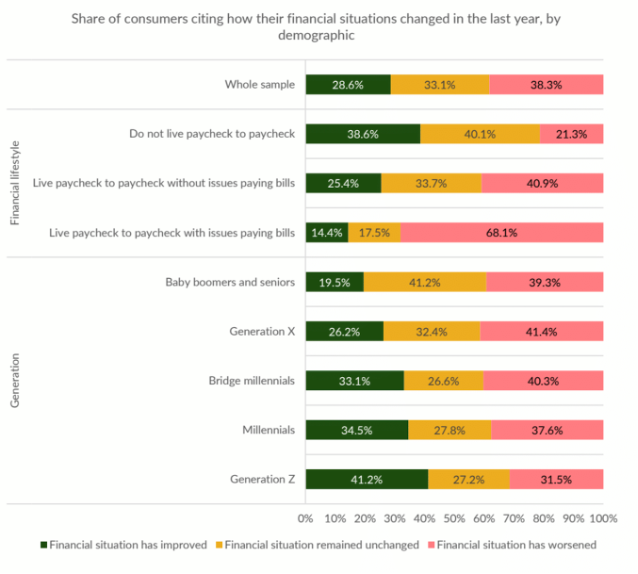
The unemployment rate is at pre-pandemic levels and inflation has dropped from 9.1% in July 2022 to 3.2% in October 2023, according to the Bureau of Labor Statistics. Yet 38% of all consumers say they are worse off than last year, and 62% are very or extremely concerned about the economic outlook. Generation Z consumers seem to be the only ones who say their economic situation has improved this year.
Gen Z, an Exception
According to the latest “Paycheck-to-Paycheck Report” by PYMNTS Intelligence and LendingClub, some 41% of Gen Z consumers said their financial situation has improved this year as compared to the previous year, while 31% say the opposite. This generation is the only one with a higher number of consumers who claim to have improved their financial situation this year.
The report also highlights that Gen Z consumers are the most likely to cite increased funds this year, which is in line with the perception of their overall financial situation. This has been reflected, for instance, in their level of spending. As extracted from another PYMNTS Intelligence study, Gen Z is the generation that is likely to increase their spending on gifts the most during the holiday season, with a 55% increase as compared to last year.
About the Numbers
“New Reality Check: The Paycheck-to-Paycheck Report” is a research series conducted by PYMNTS Intelligence in collaboration with LendingClub that examines consumers’ financial situation over the year, including access to credit, holiday shopping, and the impact of inflation in household economy. The study provides comprehensive data and insights segregated by demographic groups.