Among Gen Z consumers who changed their primary credit card, 22% used organic social media or influencer content to discover or research the card they ultimately selected, according to the September PYMNTS Intelligence report “The Switching Trigger: How Issuers Can Stop Their Credit Cards From Losing Top-of-Wallet Status.” Just 1% of baby boomers and seniors who switched did the same.
Turning to those social channels for recommendations comes as young consumers are already more willing to reconsider what they use. The report found that 56% of Gen Z cardholders changed their primary card during the previous two years, more than triple the rate among baby boomers and seniors. Overall, 78 million U.S. cardholders switched primary cards at least once.
How Gen Z Finds Its Next Primary Card
Gen Z’s card search extended beyond the issuer.
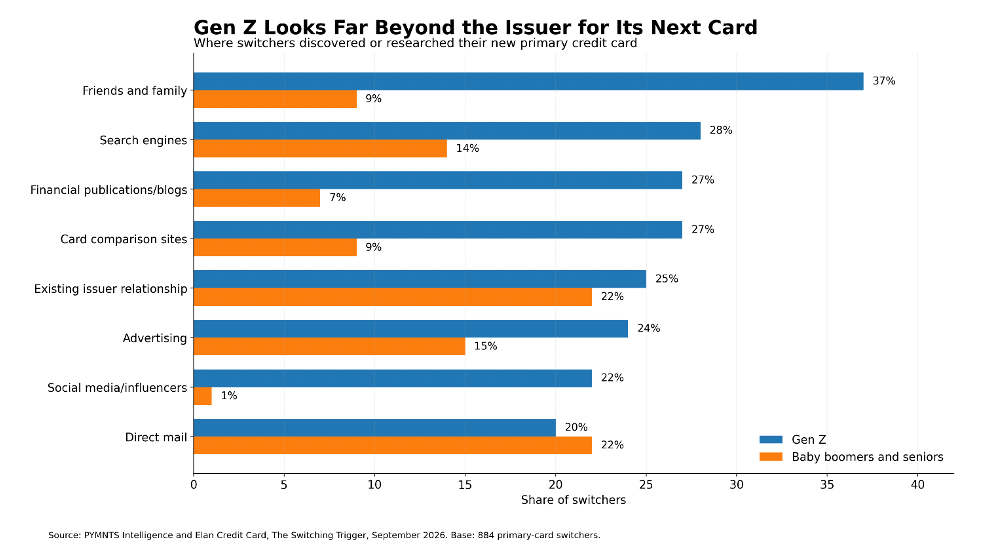
Friends and family led at 37%, but search engines, financial publications, comparison sites and social content all played substantial roles, according to the report. The issuer’s existing relationship with the consumer, at 25%, was one source among many.
There wasn’t much room to recover after another card got noticed. The report revealed that 38% of switchers seriously considered only the card they ultimately chose, while another 40% considered just one alternative, and 71% finished the process within a month.
Discovery is now a part of card competition, PYMNTS Intelligence research found as far back as 2023.
The PYMNTS Intelligence report “The New Challenges Facing Finance: Algorithms, Finfluencers and the Quest for Reliability” found in October 2023 that 62% of Gen Z viewed TikTok as a source of financial knowledge. More recently, the financial industry’s proximity to the creator ecosystem has narrowed. In April, Visa and TikTok launched a debit card for creators in the United Kingdom, aimed at helping creators manage income generated through TikTok LIVE.
We’d love to be your preferred source for news.
Please add us to your preferred sources list so our news, data and interviews show up in your feed. Thanks!
For credit cards, short-form financial content has obvious subject matter, including rewards rates, welcome bonuses, annual fees, travel perks and redemption rules. Those features can be ranked and compared before a consumer ever visits an issuer’s site.
The information can also simplify a rewards market that has become crowded.
“The reality is that rewards have become table stakes,” Vinita Savani, executive vice president of cards and loyalty at Royal Bank of Canada, told PYMNTS in April. “Every program offers value and most cards offer points.”
For issuers, influencers add another participant to that experience before the customer relationship even begins. A creator explaining why one card’s points are easier to use, or why a welcome bonus outweighs an annual fee, can help determine which products receive a closer look. For issuers, the September PYMNTS Intelligence findings put influencer content alongside search, comparison sites and financial publications as one of the sources that can help a card make a Gen Z consumer’s shortlist.
What Actually Pulls Switchers to Another Card
Discovery gets the card considered; value wins the switch. Consumers still need a reason to move. Better rewards attracted 38% of switchers, higher credit limits lured 36% and sign-up bonuses tempted 30%, the September PYMNTS Intelligence report showed.
For Gen Z, however, the digital experience nearly joined that top tier. Better rewards attracted 35%, higher limits interested 33%, sign-up bonuses enticed 32%, and a better app or digital experience lured 31%.
“It is all about the right time, the right message, the right offer to the right audience,” Mladen Vladic, head of product for payment networks at FIS, told PYMNTS in July.
For Gen Z card switching, that audience may already have heard someone else’s message first. For a generation that switches cards readily and narrows the field quickly, getting onto the shortlist is becoming a competition of its own.



 Add as Preferred Source