The percentages are still pretty small either way, accounting for just 3.6% of the investments of those living paycheck-to-paycheck with difficulty according to “Paying With Cryptocurrency: Can Crypto At Checkout Become A Profit Center For Merchants?” an August report by PYMNTS and BitPay.
Crypto accounts for 2.1% of the savings and retirement portfolios of people who do not live paycheck-to-paycheck, and 2.3% of those who live paycheck-to-paycheck easily.
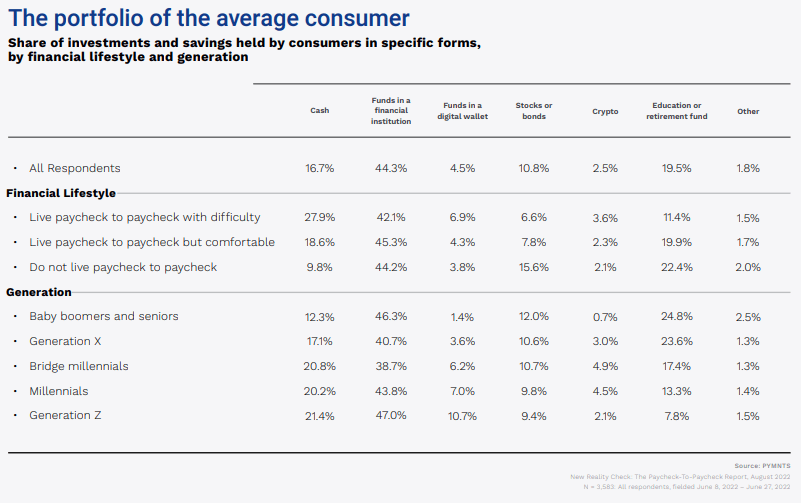
Unsurprisingly, bridge millennials and millennial had more of their portfolios in crypto — 5% and 4.5% respectively, followed by Generation Xers at 3%. Gen Z, on the other hand, was surprisingly less eager to invest in cryptocurrencies, with just 2% having it among their investments. Although being younger, it’s possible that smaller and newer portfolios play a part in that.
As for why, appetite for risk appears to have a big part to play according to the survey, which polled 3,583 consumers in June. With the people living paycheck-to-paycheck most willing to take on high-risk, high-reward investments like cryptocurrency.
More than twice as many financially well-off respondents to the survey (46%) called having a diversified portfolio a factor that influences their investment and savings decisions. Just 22% of living paycheck-to-paycheck with difficulty said that, as did 25% of those doing so comfortably.
Advertisement: Scroll to Continue
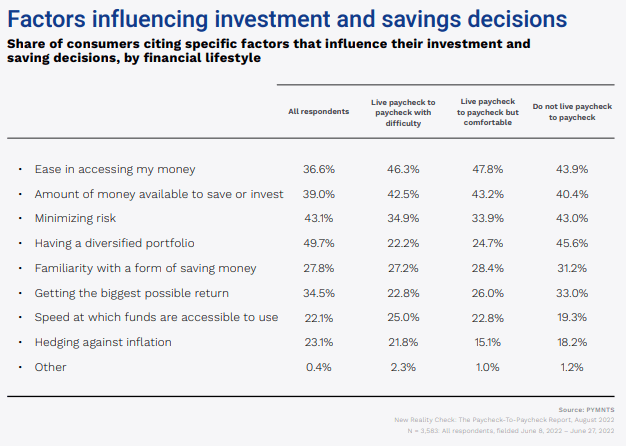
Then there’s outright minimizing risk, which was cited by 35% of those living difficultly and 34% of those living comfortably, compared to 43% of those not living paycheck-to-paycheck at all.
Beyond that, liquidity proved to be a bigger requirement of those living paycheck-to-paycheck. A full quarter of that group said the speed at which those funds are accessible was a key factor, compared to 23% of those in the middle and 19% of the most well-to-do.