Stablecoins may be finding their lane with chief financial officers, not as a financial revolution, but as a controlled way to move money through more familiar banking channels.
That is the clearest opening in “Waiting for Certainty: Why Most CFOs Are Holding Back on Crypto and Stablecoins,” a recent installment of PYMNTS Intelligence’s 2026 Certainty Project. The report finds that most middle market firms are still cautious about digital assets. Current use remains limited, with 13% of firms using stablecoins and 5% using other cryptocurrencies.
Yet the data also shows that finance leaders are not rejecting all digital assets equally. Stablecoins appear to have a more practical path forward because they are tied to traditional currency and may fit more easily into payment and treasury workflows.
We’d love to be your preferred source for news.
Please add us to your preferred sources list so our news, data and interviews show up in your feed. Thanks!
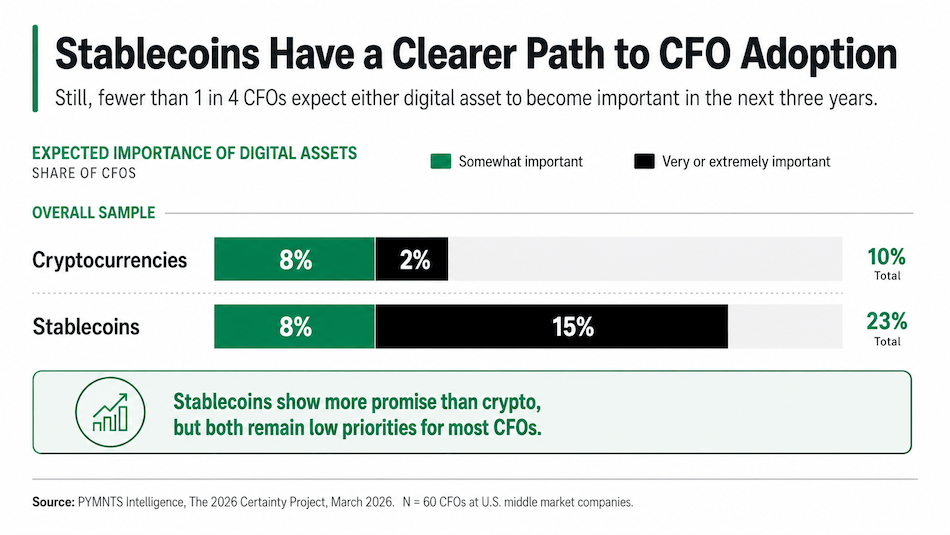
The near-term outlook remains measured. Fewer than 1 in 4 CFOs expect stablecoins to become even somewhat important to their companies within the next three years. Only 10% say the same about cryptocurrencies.
That is a low ceiling for a technology that has attracted major attention from banks, payment providers and policymakers. But the positive signal is that CFOs can describe what would make stablecoins more useful. They are looking less for novelty and more for clearer rules, better bank connections and less operational risk.
Key Points
- 23% of CFOs expect stablecoins to become at least somewhat important over the next three years, including 15% who say they will become very or extremely important. By comparison, only 10% say cryptocurrencies will become at least somewhat important.
- 45% of CFOs say integration with major banking providers would make stablecoins more meaningful as part of payment flows. That is the strongest factor cited for stablecoins and suggests that firms may be more comfortable when digital assets move through institutions they already use.
- 40% of CFOs say regulatory clarity and compliance certainty would boost stablecoin relevance, compared with 28% who say the same for cryptocurrencies. The data points to a practical adoption path centered on rules, controls and familiar oversight.
The report also shows why CFOs remain careful. Regulatory or compliance uncertainty is the top barrier, cited by 67% of firms for stablecoins and 77% for cryptocurrencies. Integration with existing financial systems is another concern, cited by 43% for stablecoins and 40% for cryptocurrencies.
Even among companies already using these assets, the behavior is cautious. Stablecoins are most often used to pay domestic suppliers or vendors, cited by 88% of users, while 63% use them to receive cross-border payments. Once funds arrive, companies usually do not hold them for long. The report finds that 88% of incoming stablecoin payments and 100% of incoming cryptocurrency payments are immediately converted to U.S. dollars.
That pattern points to an important distinction. CFOs are not treating digital assets as a replacement for cash management. They are treating them as a possible payment rail that still has to connect back to dollars, banks and existing controls.
For payments providers, banks and treasury platforms, the opportunity is not to persuade CFOs to embrace digital assets for their own sake. It is to make stablecoin use feel more like an extension of the systems finance teams already understand.



 Add as Preferred Source