Banks have spent much of the past two years asking whether artificial intelligence should be viewed as an enhancement or a competitive differentiator.
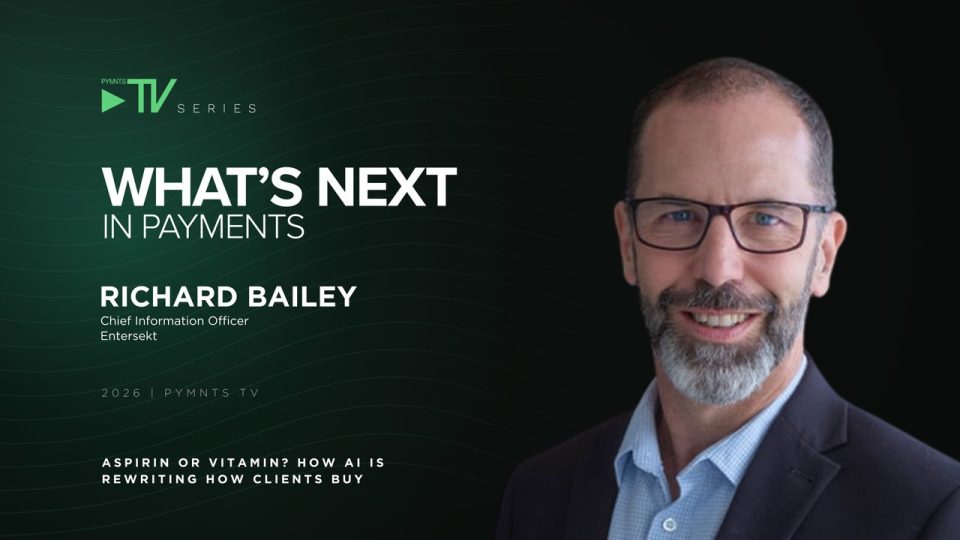
Richard Bailey believes the discussion should begin somewhere else entirely. During a recent “What’s Next in Payments” interview, the Entersekt chief information officer suggested that AI has progressed beyond the familiar “aspirin or vitamin” framework and is entering a third category: an antiviral that must adapt continuously as fraud mutates.
Bailey did not hesitate when asked whether Entersekt’s customers are seeking prevention or opportunity.
“In our world, for Entersekt, it’s fundamentally pain driven. Our customers are in pain, and they’re looking for the aspirin,” he told PYMNTS.
That pain extends beyond fraudulent transactions themselves. Bailey cited the growing difficulty of resolving disputed payments, onboarding customers securely and responding to attacks that change almost as quickly as institutions can defend against them.
The practical consequence is that buyers are no longer looking for AI because it sounds innovative. Instead, they want measurable improvements in authentication, fraud mitigation and customer experience.
Those pressures inevitably intersect with conversion. Every additional authentication hurdle risks frustrating legitimate users, yet weaker controls expose institutions to fraud losses. Bailey suggested that customers increasingly judge technology by whether “AI move[s] one of our KPIs,” as he put it, rather than whether it simply sits on top of an existing platform.
The Fraudsters Have Changed the Equation
The urgency has increased because attackers are using the same technologies.
“AI has definitely given some tailwinds … to fraud,” Bailey indicated. “Fraud actors now have the ability to apply AI to their attacks. They can enrich their attacks and apply multiple attack vectors at any one time.”
That shift has altered the defensive calculation. Static rules and periodic updates may struggle against adversaries capable of generating convincing synthetic identities or deploying deepfakes at scale.
Bailey pointed to a future in which authentication itself becomes dynamic. “If AI is using deepfakes, for example, then voice biometrics and facial biometrics doesn’t work anymore. We might need to look for another way of defending against that type of attack,” he said.
We’d love to be your preferred source for news.
Please add us to your preferred sources list so our news, data and interviews show up in your feed. Thanks!
Thus the antiviral analogy. Rather than simply treating symptoms or improving general health, AI should constantly recognize new threats and adjust defenses while transactions are taking place.
AI Has to Become Infrastructure
Bailey also challenged the notion that adding a copilot or chatbot amounts to meaningful transformation.
“The real shift,” he said, “is not really from aspirin to vitamin or vitamin to aspirin. It’s from is AI a feature of the product layered on top of the product … or is it now part of the infrastructure of the product?”
A support assistant that summarizes fraud cases may improve efficiency, but infrastructure-level AI can influence authentication decisions, recommend policy changes and react to new attack patterns before losses escalate.
Bailey went further by arguing that the industry is approaching a point where “it’s becoming a feature of the infrastructure of the product,” enabling organizations to trust AI with operational decisions inside regulated environments.
Cobbled-Together AI Is Unlikely to Hold Up
The conversation also highlighted why assembling disconnected products may prove insufficient. Attractive interfaces can be replicated quickly. Durable advantages come from capabilities that are considerably harder to reproduce. Financial institutions must understand why AI reached a decision, explain that reasoning to regulators and auditors and certify compliance with industry standards.
The second advantage is access to governed information. Bailey argued that “the model may be replicable, but not the data.” Relevant, clean and properly managed customer information creates context that generic AI systems cannot easily duplicate.
His closing observation tied those themes together. As he told PYMNTS, “the big decision now for buyers around AI is not, can I use AI, but can I use AI to run the business?”
Watch the full interview with Richard Bailey to learn more about:
- Why Entersekt believes fraud prevention has become an operational pain point rather than a technology exercise.
- How Bailey distinguishes AI as an aspirin, a vitamin and an adaptive antiviral.
- Why explainable decisions and governed data may become the industry’s strongest competitive advantages.


 Add as Preferred Source