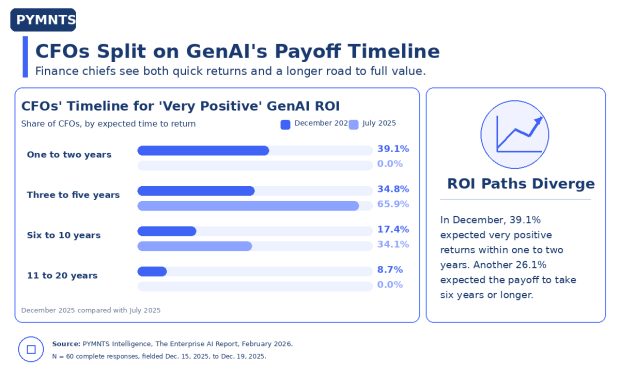
CFOs have stopped treating generative artificial intelligence returns as one date circled on the calendar. By December, 39.1% expected very positive returns within one to two years, even as 26.1% expected the payoff to take six years or longer.
That split is the clearest sign that finance leaders are getting more practical about the technology. The PYMNTS Intelligence report “What Happens When CFOs Get Serious About Gen AI” found that CFOs at large U.S. companies are expanding gen AI across finance, reporting fewer drawbacks and adopting a more detailed view of return on investment. The findings come from a December survey of 60 CFOs at companies with at least $1 billion in annual revenue.
We’d love to be your preferred source for news.
Please add us to your preferred sources list so our news, data and interviews show up in your feed. Thanks!
- Early returns look reachable. In July 2025, none of the surveyed CFOs expected gen AI to produce very positive returns within one to two years. Five months later, 39.1% did. The share expecting that level of return in three to five years fell to 34.8% from 65.9%. That movement suggests targeted projects are starting to show a clearer path to value.
- CFOs are widening the scorecard. Customer experience was the most cited measure of gen AI returns at 78.3%, followed by improved margins at 75%. Sixty percent tracked lower operating costs, while 56.7% measured increased revenue per customer, up from 18.3% in July. Only 25% used headcount reduction as a measure, down from 36.7%. The emphasis is moving toward productivity, growth and service rather than staff cuts.
- Full integration still takes time. CFOs estimated that embedding gen AI throughout the organization would take an average of 6.28 years, nearly twice the 3.19 years they forecast in July. They appear to view the rollout like renovating a building one floor at a time: individual spaces can improve quickly while the complete project takes longer. That distinction helps explain why near-term confidence and longer implementation schedules can rise together.
The report also found that gen AI’s role expanded sharply in financial reporting, capital management and working capital optimization. Meanwhile, the average number of drawbacks cited by CFOs fell to 4.23 from 6.92. Errors, implementation trouble and maintenance costs all declined. Experience appears to be turning early friction into manageable operating work.
The remaining challenges are more focused. Skills shortages were cited by 78.3% of CFOs, data security and privacy by 70% and reliance on vendors by 46.7%. Those concerns point to the next stage of work: building talent, controls and vendor oversight around programs that are already producing results.
At PYMNTS Intelligence, we work with businesses to uncover insights that fuel intelligent, data-driven discussions on changing customer expectations, a more connected economy and the strategic shifts necessary to achieve outcomes. With rigorous research methodologies and unwavering commitment to objective quality, we offer trusted data to grow your business. As our partner, you’ll have access to our diverse team of PhDs, researchers, data analysts, number crunchers, subject matter veterans and editorial experts.
See More In:
AI, B2B, B2B Payments, CFO, data brief, featured insights, Featured News, generative AI, News, Payments Intelligence, PYMNTS Intelligence, PYMNTS News


 Add as Preferred Source