An atomic physicist goes looking for the molecule that can reveal a buried land mine before someone steps on it. Years later, he is helping banks find the fraudster hiding inside a chain of legitimate-looking people, companies and payments.
That sounds like the setup for a joke, but it is the arc of Ari Tuchman’s career and the idea behind Quantifind, the company he co-founded in 2009. The link between land mines and money laundering is signal detection: finding one small clue that means danger inside an overwhelming amount of information that means nothing at all.
At Stanford, Tuchman worked on quantum sensors designed to identify minute traces of explosives associated with land mines. Machine learning helped separate that tiny chemical signal from all of the ordinary molecules in the atmosphere, so the threat could be identified before a person found it the hard way.
Follow the money and the problem looks surprisingly similar. Fraudsters don’t announce themselves. They hide behind a company, a counterparty, an executive or a series of transactions that each may look legitimate when viewed on its own.
Quantifind searches the relationships moving with the money, including counterparties, executives, corporate ties, news reports and other connections, to locate the person or entity that doesn’t belong. It is the financial-crime equivalent of finding the molecule in the air that says the ground ahead is not safe.
Financial Crimes 99% Problem
That way of describing Quantifind also exposes what is broken in financial-crime screening. Banks have become very good at collecting possible signals, but not nearly good enough at deciding which ones matter.
“You have to remember that the industry has an expectation of 99% false positives,” Tuchman told PYMNTS CEO Karen Webster. “What other industries tolerate that level of mistake?”
Banks didn’t end up there because they are careless. A false negative can allow a money launderer, fraudster or national-security threat through, so legacy systems cast the widest possible net and hand investigators almost everything they catch.
The result is an investigative system built around noise. False positives consume time and money, subject legitimate customers to scrutiny and make the truly dangerous signal harder to see because it is buried inside enormous volumes of alerts that go nowhere.
Webster put a sharper edge on the cost of getting it wrong. The consequences are more than just money. A bad assessment can hold up a transaction, close an account or pull a legitimate customer into an investigation.
Tuchman said Quantifind’s job is to reduce the bad alerts before they reach investigators, not to replace the people responsible for deciding whether suspicious activity warrants action. That distinction becomes more important as artificial intelligence moves from finding a risk to acting on it.
The Nine Degrees of Separation Applied to Money Movement
A transaction alone often can’t answer the most important question. Who’s really behind it? Tuchman offered the example of plastics shipped from China to a manufacturing facility in Mexico, followed by finished goods moving to California.
That trade and payment pattern could describe a toy manufacturer or conceal fentanyl trafficking. The answer isn’t necessarily in the shipment or payment itself, but in the network around it and whether the companies, executives, counterparties and histories fit together.
A newly formed company with little history may deserve a closer look, as may an entity that seems oddly disconnected from the industry in which it claims to operate. Quantifind combines those surrounding sources so banks don’t have to stitch together dozens of separate datasets before an investigator can see the full chain.
When Criminals Get Agents
The urgency is increasing because banks aren’t the only ones gaining access to AI. A criminal who once needed people to manufacture fake emails, invoices or identities can now automate much of that work and do it at a scale that was previously impossible.
We’d love to be your preferred source for news.
Please add us to your preferred sources list so our news, data and interviews show up in your feed. Thanks!
“I can have agents generate 10,000 of these a day now instantly,” Tuchman said. Webster put the strategic question plainly: “What happens when criminals have their own agents?”
That changes both the volume and the shape of the signal banks must find. It also helps explain why Tuchman is skeptical that the biggest general-purpose language model is automatically the right answer for every financial-crime job.
Some screening decisions must happen within a few hundred milliseconds, while other assignments can require 100 million entities to be screened within hours. Those are specialized, high-volume engineering problems in which speed, accuracy and control matter more than a model’s ability to do a little bit of everything.
Detection Is Not Decision
Tuchman said large banks are moving quickly toward agents that detect risk, but they are much more careful about agents that can decide a customer’s fate. Some banks build their own workflow agents and use outside systems for intelligence, while others rely more heavily on vendors.
Quantifind can supply the risk signals to whichever agent or workflow a bank chooses, or provide more of the software stack itself. Tuchman calls that role agentic middleware. In plain English, Quantifind finds and organizes the evidence, then hands it to the bank’s system and its investigators to decide what happens next.
“If we allow a foundational model to kick people out of the bank, close their accounts, hand their money over to the federal authorities automatically, you’re asking for trouble,” Tuchman said. He expects people to retain control over consequential decisions for now and does not expect fully agentic decisioning to become standard at major banks within the next 12 months.
Within five years, he expects banks to move much closer to that line, which means governance will have to become part of the system rather than a review that happens after the fact. He also expects AI to produce more of its own performance reporting, potentially giving regulators such as FinCEN or the OCC automated measures of decisions and accuracy, with people checking the results.
How Quantified Got Its Start
National Science Foundation funding helped lead to Quantifind’s creation, and the company’s first experiments used historical Reuters news feeds to identify networks of bad actors. The information available to its models has since grown from millions of articles to tens of billions of articles and other sources, but the problem Tuchman is solving hasn’t changed.
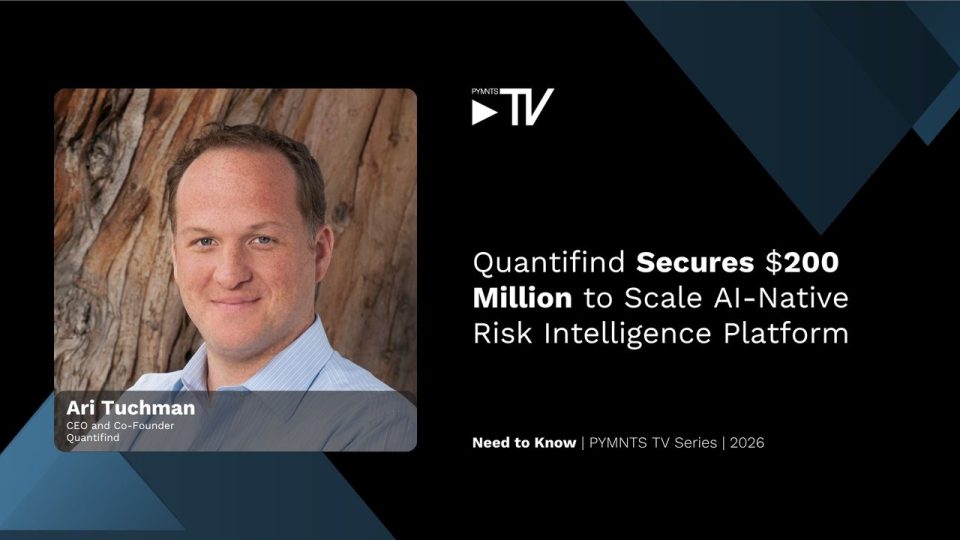
Investors are betting that the method can travel much further. Quantifind raised $200 million in a growth investment led by Summit Partners, with existing investors Citi Ventures, S&P Global, Deloitte and Stephens Group also participating.
The company plans to use the capital for additional AI development, expansion in Asia-Pacific and other international markets, and moves beyond its traditional AML and KYC work into fraud and credit risk. Tuchman said that could include predictive signals of bankruptcy as well as other high-stakes risk problems.
The tools have changed dramatically since Tuchman was looking for traces of explosives in the air. The mission hasn’t changed. To find the dangerous signal early enough, and with enough confidence, that someone can act before the damage is done.
Watch Karen Webster’s full interview with Ari Tuchman to learn more about:
- How Tuchman’s work in atomic physics and land-mine detection led to financial-crime analytics.
- Why a fraudster may be visible only through the people, companies and transactions connected to the money.
- Why purpose-built models can be better suited than general-purpose LLMs to high-volume bank screening.
- How banks are connecting their own agents to outside risk-intelligence systems without surrendering control.
- Why automated performance reporting could become part of regulatory oversight of agentic systems.


 Add as Preferred Source