How can the payments landscape enable autonomous transactions without undermining trust, governance and accountability?
It’s a question that payment networks and acquirers are racing to figure out before artificial intelligence agents finish their maturation from digital novelty to foundational commerce infrastructure.
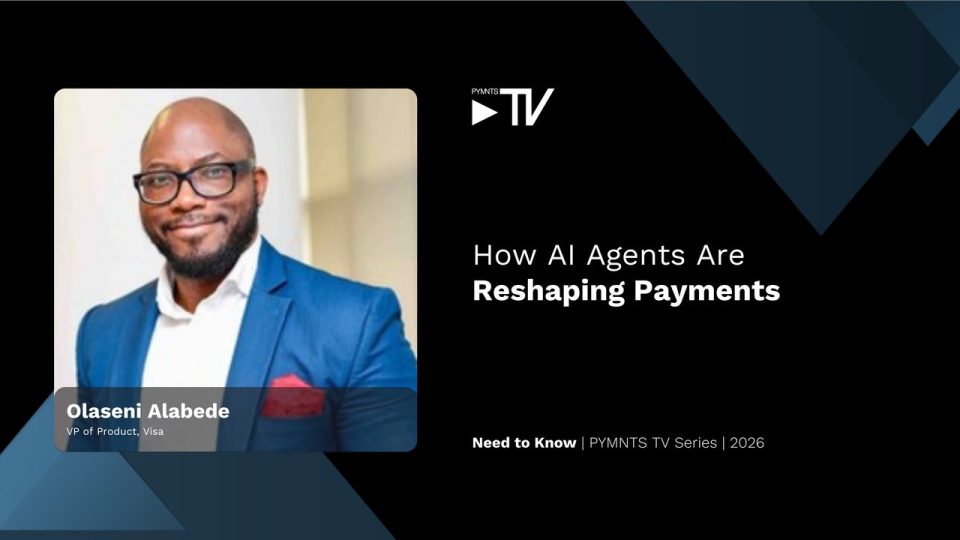
“When I speak with the acquirer, I always encourage them to treat agentic-driven eCommerce the same way they treated eCommerce itself or mobile transactions when they came out,” Olaseni Alabede, vice president of product at Visa, told PYMNTS. “Essentially, it is just another channel that plugs into their core stack.”
The transition is less revolutionary than many assume, he said. The underlying payment rails, tokenization systems and orchestration layers largely remain intact. The difference lies upstream, where autonomous agents, not humans, begin initiating transactions.
“Instead of a consumer initiating the transaction, as you will with eComm or mobile, an agent will be doing that on behalf of the consumer,” Alabede said. “Now that introduces new signals into the system. But all the payment rails, tokenization, orchestration layers, all those don’t fundamentally change.”
Rather than constructing parallel systems for AI commerce, acquirers will likely need to adapt existing fraud, authorization and dispute infrastructure to recognize machine-initiated behavior patterns alongside human ones.
See also: Acquirers Say Risk and Readiness Are Slowing Agentic Commerce
The Infrastructure Challenge Behind Agentic Commerce
While the concept of agentic commerce has generated considerable excitement across the payments ecosystem, the operational reality is forcing acquirers, networks and merchants to rethink the mechanics of identity, authorization and liability before autonomous commerce can scale.
“Before building any system, before updating any fraud model or before updating even their dispute processing, the first thing acquirers need to do is really get clear internally on what qualifies as an agent-initiated transaction,” Alabede said.
That clarity extends beyond simple authentication. Acquirers must determine how agent identity is represented, how intent is documented, and what metadata accompanies autonomous purchases through the transaction lifecycle.
The concept Alabede repeatedly returned to was what he called “minimum viable intent,” a framework he described as foundational to any scalable agentic commerce environment.
“What does that mean?” he asked. “It is being able to ask a couple of questions as an acquirer. Number one, who is the agent? Who authorized the agent to carry out whatever transaction it is carrying out? What is it allowed to do? How is it making the payment? And then lastly, can we trace the agent activity?”
Without those controls, he warned, “fraud models would degrade” and “dispute resolution breaks.”
The emphasis on traceability reflects a broader concern emerging across financial services. Autonomous commerce systems introduce new ambiguity into liability chains that historically centered on identifiable human action. In traditional eCommerce, transaction intent is relatively straightforward. With AI agents, intent becomes delegated, conditional and potentially dynamic.
Trust Becomes the Core Payments Product
We’d love to be your preferred source for news.
Please add us to your preferred sources list so our news, data and interviews show up in your feed. Thanks!
Alabede described future transactions in which consumers provide agents with parameters rather than direct checkout actions.
“I tell an agent, ‘Buy me a pair of shoes or this gift for my wife within this price range at this merchant,’” he said, adding that capturing those instructions and preserving them as transaction context becomes critical to validating consent later.
That architecture places unusual pressure on identity frameworks. In agentic commerce, identity extends beyond verifying the consumer. The agent itself must also be trusted.
Industry groups and payment networks are already moving toward those standards. Alabede pointed to initiatives including Visa’s own Trusted Agent Protocol, frameworks emerging from the FIDO Alliance, and efforts underway through EMVCo. The common objective is interoperability around agent identity, authorization and transaction accountability.
“Trust is the foundation when it comes to agent eCommerce transactions,” Alabede said. “Because again, the consumer is not the one initiating the transaction directly. The consumer is delegating to an agent.”
“The agent needs to be trusted,” he added. “Which means that the agent may be registered somewhere by some authority … You want to avoid scenarios where the consumer says, ‘Hey, I asked the agent to do A, and it did B.’”
The Standards Race Before the Scale Race
That trust challenge is not merely technical. It is behavioral and operational as well. Consumers will need confidence that AI agents act within defined boundaries, merchants will need assurance that autonomous buyers are legitimate, and, ultimately, acquirers and issuers will need visibility into machine behavior patterns that differ from traditional consumer activity.
“Once we are all aligned on those basics, then we can start to ask the question around can the identity be trusted, how is the identity represented, how is the consent shared, and how is liability assigned?” Alabede said.
At the same time, merchants are beginning to adapt their digital storefronts for machine discoverability as much as human browsing. Alabede referenced Visa Intelligent Commerce Connect, which aims to help merchants surface products more effectively within agent-driven shopping interfaces.
Gift purchasing, travel planning, subscription management and other reversible transactions are likely candidates for early adoption. These environments provide enough structure for AI delegation while limiting exposure to complex disputes and regulatory risk.
“Agent commerce, in my view, is a marathon. It’s not a sprint,” Alabede said. “So, it’s better to be right and to … actually cut your teeth with standard use cases—use cases that are bounded, predictable, and you can trace.”
For all PYMNTS AI coverage, subscribe to the daily AI Newsletter.


 Add as Preferred Source