Consumers under the most financial pressure aren’t abandoning the checkout. They’re choosing payment tools that can give them more control over it.
That’s the central finding of “The New Checkout: Crimped Consumers Lean Into Online Retail and Digital Wallets,” a PYMNTS Intelligence report based on a survey of 2,108 U.S. adults. Seventeen percent of consumers said they had faced a cash shortfall for living expenses or an emergency during the previous 90 days.
We’d love to be your preferred source for news.
Please add us to your preferred sources list so our news, data and interviews show up in your feed. Thanks!
Those consumers shopped differently than people under less strain. They used digital wallets more often, spent more per transaction and favored retailers known for value. The results suggest that a wallet can function like a dashboard, helping shoppers see their spending while gaining access to installment options.
Key Points:
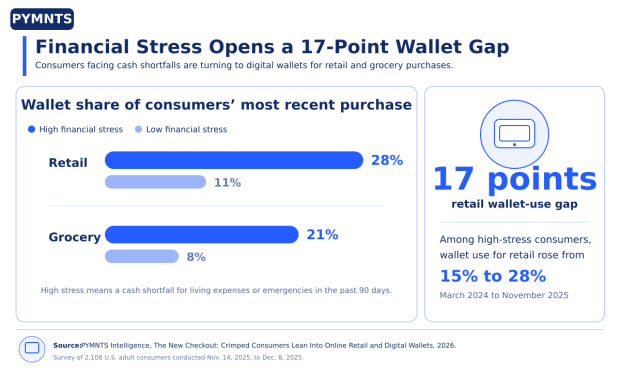
- Wallets gain ground among pressured shoppers. Consumers under high financial stress used a digital wallet for 28% of their most recent retail purchases, compared with 11% among low-stress consumers. For groceries, the shares were 21% and 8%. The report says access to buy now, pay later plans and real-time spending information could help explain the gaps.
- Adoption rises fastest where strain is highest. Among high-stress consumers, wallet use for retail purchases climbed 13 percentage points, to 28% from 15%, between March 2024 and November 2025. Grocery use rose 11 points, to 21% from 10%. Low-stress consumers posted increases of 3 points for retail and 1 point for groceries.
- Younger shoppers lead the move. Thirty-six percent of Gen Z consumers used a wallet for their most recent retail purchase in November 2025, up 21 percentage points from March 2024. Across all consumers, the share reached 15%, a 5-point increase. The pattern gives merchants and financial providers a positive opening to offer clearer budgeting features and flexible ways to pay.
Financial pressure also influenced where and how people shopped. High-stress consumers were 6 percentage points more likely to buy groceries online than low-stress consumers. They spent an average of $109 on their last grocery purchase and $111 on retail, versus $95 and $88 among low-stress shoppers.
Walmart drew 56% of high-stress online grocery shoppers, while Target attracted nearly three times the share of high-stress online retail shoppers as it did low-stress shoppers. Strain also spread unevenly, rising 12 percentage points among Gen Z consumers, 8 points among millennials and 9 points among parents. The findings indicate that consumers are still spending, but they’re using value, visibility and flexibility to keep purchases within reach.


 Add as Preferred Source