Fraud budgets are moving in two different directions. Fifty-one percent of global eCommerce merchants expect spending on fraud-management staff to remain flat or decline, while 63% plan to increase investment in fraud-management technology.
The numbers frame fraud orchestration as an operating-efficiency question as well as a security one. “Orchestrating Trust: The Future of Fraud Prevention in Payments,” produced in collaboration with Spreedly, examines how merchants can coordinate identity checks, behavioral analytics, device intelligence, transaction scoring and payment routing through a common decision layer. The report also points to mounting pressure to control the cost of fraud operations as payment flows and attack methods become more complex.
We’d love to be your preferred source for news.
Please add us to your preferred sources list so our news, data and interviews show up in your feed. Thanks!
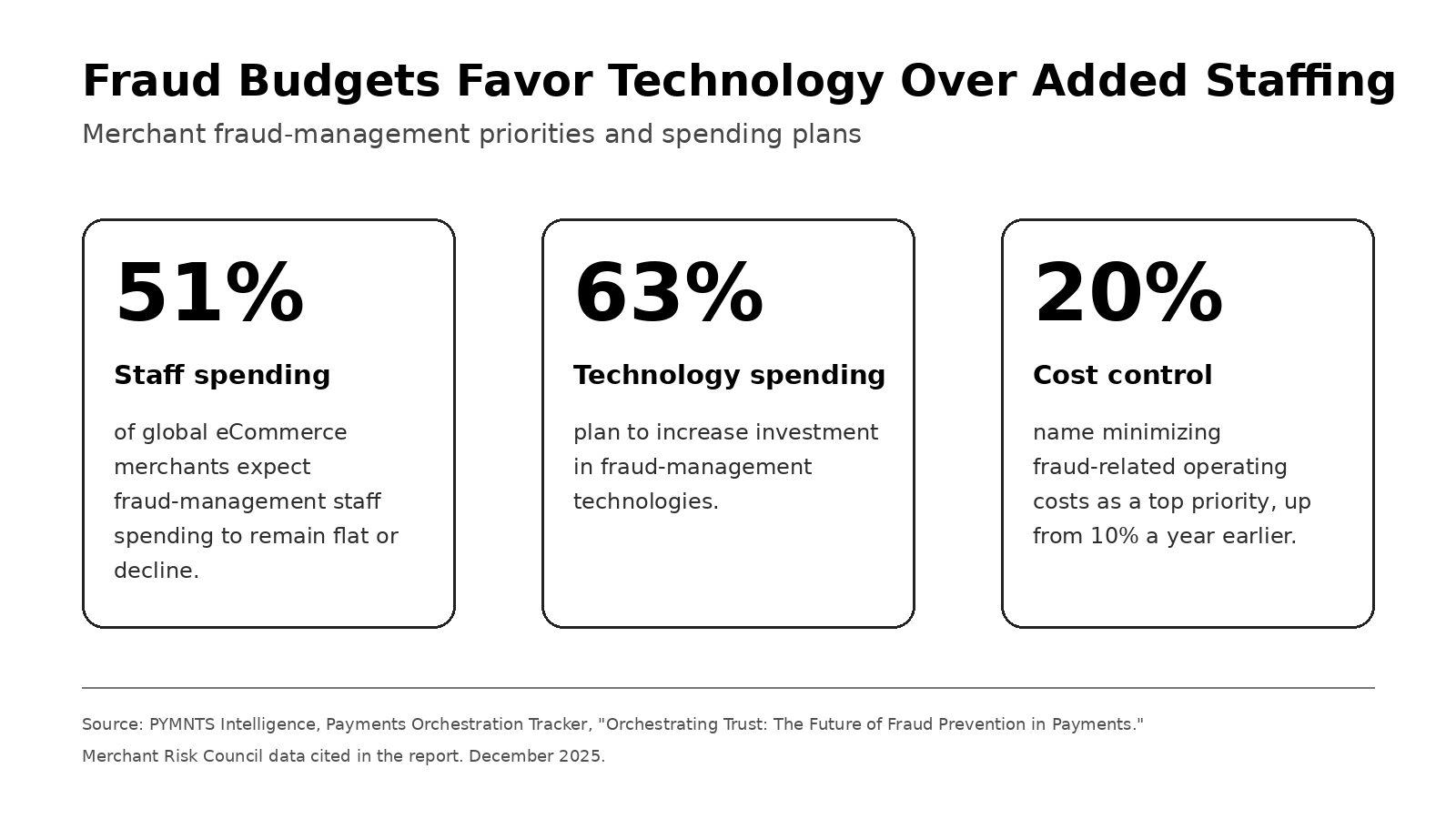
- Cost control is moving up the fraud agenda. The share of merchants naming lower fraud-related operating costs as a top priority doubled year over year, from 10% to 20%, according to Merchant Risk Council data cited in the report. At the same time, the 51% expecting fraud-staff spending to stay flat or fall leaves technology to absorb more of the workload.
- Technology spending is moving the other way. Sixty-three percent of merchants plan to increase investment in fraud-management technology. The report links that spending to automated and machine-learning-powered workflows that can consolidate data, reduce manual review and apply controls according to transaction risk.
- Orchestration adoption is already broad among financial institutions. Datos Insights data cited in the report show 53% of U.S. financial institutions already use fraud orchestration, while 16% are implementing it and 26% plan to adopt it. The platforms can combine APIs, third-party signals, internal data and machine-learning scoring in a single decision layer.
Merchants are also trying to avoid making fraud controls more expensive by rejecting good customers. Eighty-five percent cite preventing fraud without degrading the customer experience as their biggest fraud-prevention challenge. Nearly half, 47%, estimate that as much as 5% of legitimate orders are wrongly declined as fraudulent.
The budget data put a measurable constraint around that problem. Merchants are preparing to spend more on fraud technology without a comparable increase in fraud staffing. Orchestration can become the layer that determines when additional checks are needed, when trusted customers can move through with less friction and how several fraud tools are used without requiring teams to manage each integration separately.
At PYMNTS Intelligence, we work with businesses to uncover insights that fuel intelligent, data-driven discussions on changing customer expectations, a more connected economy and the strategic shifts necessary to achieve outcomes. With rigorous research methodologies and unwavering commitment to objective quality, we offer trusted data to grow your business. As our partner, you’ll have access to our diverse team of PhDs, researchers, data analysts, number crunchers, subject matter veterans and editorial experts.



 Add as Preferred Source