Hooman Radfar is building Collective for business owners who are also the people doing the work. A consultant might be the company’s only employee, responsible for finding clients, managing those relationships and delivering every project.
That same person has to keep the books, deal with taxes and meet the other requirements of running a business. Buying software or hiring someone to help can still leave the owner responsible for making sure everything gets done.
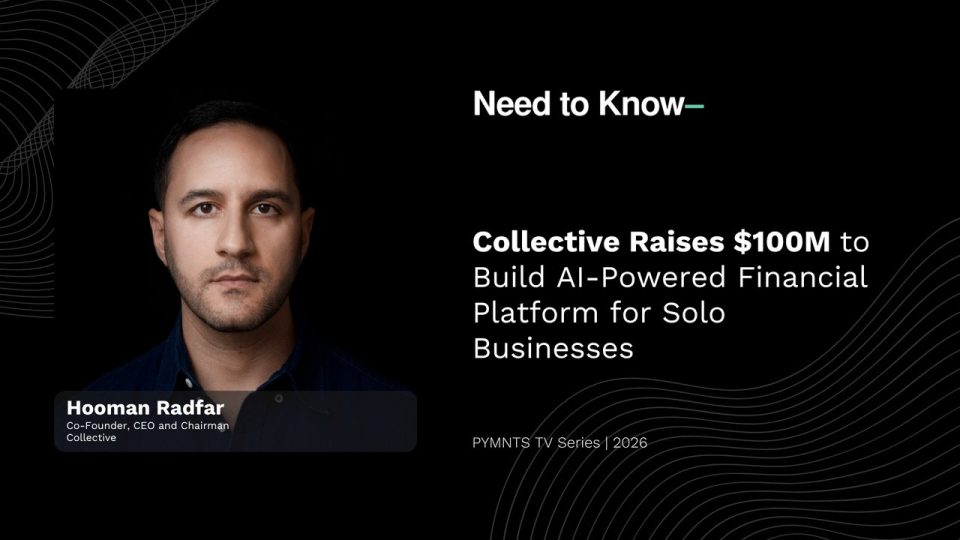
For Collective’s co-founder and CEO, the opportunity is to take more of that financial work off the owner’s hands. In his conversation with PYMNTS CEO Karen Webster, Radfar described a service built around completing the work and giving customers back the time they spend managing it.
Getting Help Still Leaves Work for the Owner
Radfar said owners generally face two choices. They can choose software, learn the financial workflows and supervise them, effectively becoming their own finance chief. Or they can hire accounting and tax professionals and manage the costs and communications that come with those relationships.
That help might come from Aunt Susan or the bookkeeper down the street. Even when someone else does the books, the owner can still be the person supplying records, answering questions and coordinating with whoever handles payroll or prepares the taxes.
“You still have to manage it all as part of the business,” Webster observed. Collective, she suggested, offers a way to have that work handled together: “what you’re offering is basically this one-stop shop.”
For a consultant, those exchanges compete with client deadlines and deliverables. Delegating individual tasks can help, but the owner still needs someone to make the financial work fit together.
Collective Takes Responsibility for Completing the Work
“We are accountable for forming [their] company,” Radfar told Webster. He said Collective also takes responsibility for closing the books, getting them ready for taxes and completing filings, with payroll among the services it provides.
AI supports that execution, while people verify work, handle approvals and escalations, and answer customers’ questions. Owners interact with Collective through web and mobile applications, email and other channels, including having a person on the other end to address more complex queries.
Radfar’s understanding of those customers began at home. He grew up in Pittsburgh, where his parents were physicians running their own businesses. Their concerns were price, performance and getting the work done, he said, with little interest in acquiring advanced technology for its own sake.
That experience informs how he wants Collective to explain financial tasks. An owner needs language they can understand and clarity about what needs to happen. Not that easy, he told Webster. For some customers, the business is the household’s sole source of income, making wasted time and administrative confusion particularly consequential.
One of Collective’s members gave Radfar a concrete example of the benefit. The customer said using Collective meant he could attend his child’s Wednesday baseball game instead of spending that time on the books, a change he described as the service’s biggest benefit.
AI Expands What a Business of One Can Earn
Radfar sees that financial support as part of a larger opportunity. More than 30 million solo entrepreneurs in the United States generate almost $2 trillion annually, and he believes artificial intelligence could help more of them earn millions without raising venture capital or hiring large teams.
He said he has seen customers using AI reach $1 million in sales within months. Some businesses on Collective’s platform generate $10 million annually, although the company serves businesses with employees as well as solo owners.
Webster’s question is how far that model can go. “If you had infinite productivity and any one person could manage agents as they would employees, theoretically, could you generate the value of a venture-backed business?” Radfar asked.
He thinks they can. The attraction is retaining ownership while generating revenue that previously required more employees and outside capital. Radfar said that possibility would make him reconsider starting a venture-backed company if he were leaving school today.
He remembers the constraints of building his first company, when he had to provision data centers and install equipment. That work restricted what founders could attempt. Assembling and managing financial operations can similarly consume the time an owner needs to develop the business.
AI Changes the Economics Inside Collective
We’d love to be your preferred source for news.
Please add us to your preferred sources list so our news, data and interviews show up in your feed. Thanks!
The same technology is changing Collective’s ability to serve those owners. Its capacity depends on how much work employees can supervise, and Radfar pointed to monthly bookkeeping closes as a measure of the change.
A conventional bookkeeper serving comparable businesses might complete 40 monthly closes using accounting software, he said. Collective reached 300 during the summer and is moving toward 600.
“We’ve hit an inflection point, and that’s why we’re scaling so rapidly,” Radfar said. Years spent developing the platform and its internal Agent OS have changed staffing requirements, so “we just don’t have to hire as many people to grow as we used to have to hire,” he added. He described Collective’s margins as software margins without disclosing a percentage.
Financial Software Providers Still Have Advantages
Bringing that work together has consequences for the providers an owner used to hire separately. Webster pressed Radfar on the effect: “There are services that they used to use that they’re no longer using. And at scale, that hurts those providers who used to be part of that stack.”
Radfar acknowledged that Collective can displace applications. His view of the “SaaSpocalypse” was more nuanced when it came to providers that maintain financial records or support payments.
“I think some of the system-of-record tools are much harder to build,” he said. “They take years.” Established providers also have customer relationships, distribution and data they can use to introduce AI.
Building an application independently brings its own obligations, he added. Owners have to maintain what they build and address security failures as their businesses expand, adding responsibilities that can grow along with the business.
New Capital Broadens the Reach
Collective launched around the COVID pandemic, which Radfar said helped customers accept an online provider. It has since served more than 16,000 businesses. Early customers included consultants, marketers and developers; contractors, Olympians, college athletes and newly formed companies have broadened its base.
The company’s $100 million financing, announced Thursday (Oct. 29), supports its next stage. The package includes a $40 million Series B led by General Catalyst, QED Investors and Gradient Ventures, with Intuit Ventures among the participants, plus $60 million from General Catalyst’s Customer Value Fund for customer acquisition.
Collective also plans to use funding to accelerate product development in banking and insurance. Those plans would extend the range of financial needs it can address for owners who would otherwise have to arrange those services separately.
The business remains primarily direct-to-business customers. Radfar described current and prospective relationships ranging from accounting partnerships to inquiries from public technology companies serving solo operators. Such relationships could allow other providers to offer Collective’s financial services to their existing customers.
For Radfar, the opportunity starts with the owner who has clients to serve and work to deliver. As AI expands what that person can accomplish, Collective’s proposition is to handle more of the financial administration required to keep the business running.
Watch the full interview with Hooman Radfar to learn more about
- How founders could direct agents as they would employees.
- What Collective takes responsibility for completing.
- Why Radfar expects established financial software providers to retain advantages.


 Add as Preferred Source