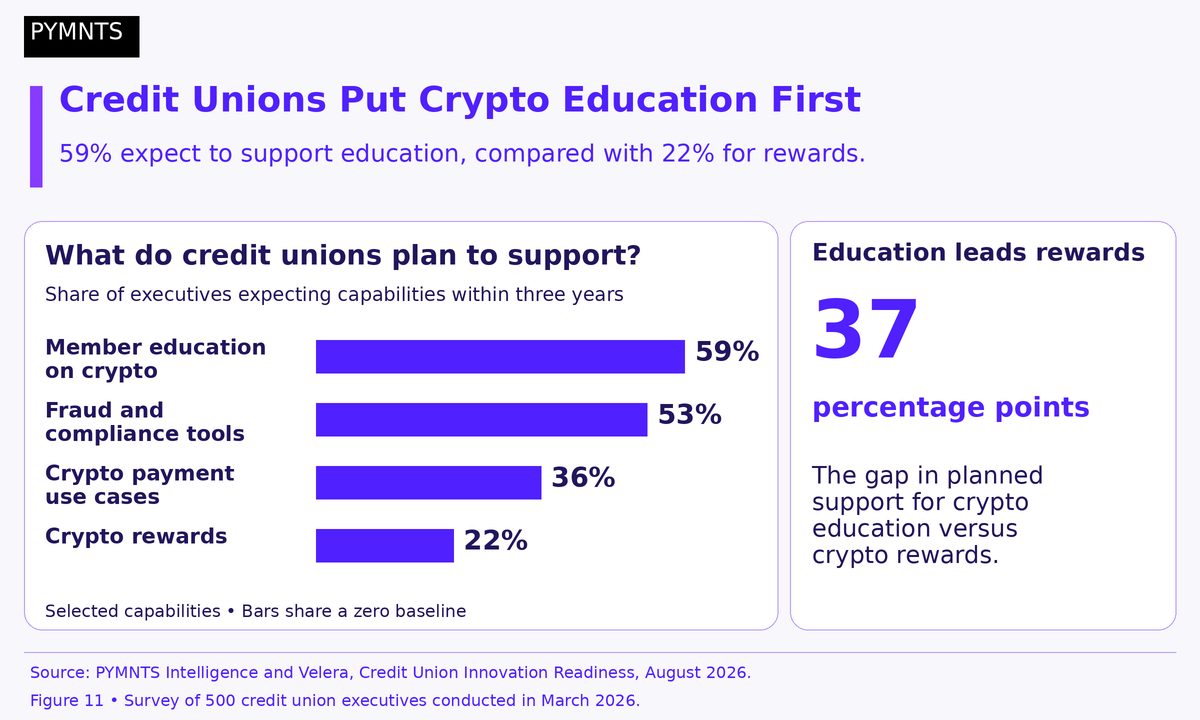
Credit unions see an opening in cryptocurrency that starts with helping members understand it, with planned education services leading crypto rewards by 37 percentage points.
The August PYMNTS Intelligence report “Credit Unions Sit on the Sidelines While Members Already Own Crypto” examined credit unions’ perceptions of member demand and their plans for digital assets. Most executives said they saw limited interest, even as separate consumer findings showed that young members already owned crypto.
Credit unions should prioritize education and protection while considering which transaction services to offer, according to the report.
Key findings from the report:
- Education gives credit unions a starting point. Within three years, 59% of credit union executives said they expect their institutions to offer or support member education on crypto, compared with 22% for crypto rewards. That 37-percentage-point difference put guidance ahead of incentives. Education can serve as a driving lesson before members take the wheel, helping them understand an unfamiliar financial product. For credit unions, it offers a way to participate in members’ crypto decisions without first introducing a service for buying or selling it.
- Protection ranks close behind guidance. Within three years, 53% of credit union executives said they expect to support fraud prevention and compliance tools, just 6 percentage points below education. That emphasis aligned with executives’ concerns, as 52% identified cybersecurity and fraud risk as a barrier to crypto adoption. The findings suggested institutions see preparation as a substantial part of their role. They can develop the capabilities to address these concerns while deciding how far to expand their offerings.
- Transaction services remain part of the plans. Within three years, 36% of credit union executives said they expect to support crypto payment uses, while 30% anticipated enabling buying, selling or holding through a partner. External wallet connections followed at 28%. These expectations showed that credit unions aren’t ruling out services that let members use digital assets. Education led partner-supported trading capabilities by 29 percentage points, suggesting a broader appetite for helping members understand crypto than for facilitating their investments.
Other findings helped explain why that approach could find an audience. According to the report, 17% of credit union members already own cryptocurrency, rising to 27% among Generation Z and millennial members. Yet 75% of executives reported limited or no member demand.
Ownership doesn’t establish demand for a credit union trading service, but it does show that crypto is already part of some members’ financial lives. Education gives institutions a practical way to engage these members while learning what additional support they would value.
At PYMNTS Intelligence, we work with businesses to uncover insights that fuel intelligent, data-driven discussions on changing customer expectations, a more connected economy and the strategic shifts necessary to achieve outcomes. With rigorous research methodologies and unwavering commitment to objective quality, we offer trusted data to grow your business. As our partner, you’ll have access to our diverse team of PhDs, researchers, data analysts, number crunchers, subject matter veterans and editorial experts.