Finance teams are more prepared to explain missing money than to keep their businesses running without it.
That’s one finding from “Time to Cash™: What Two Years of Data Say About Faster Cash and Rising Risk,” a PYMNTS Intelligence report produced in collaboration with JPMorgan. Drawing on two surveys of U.S. CFOs, the report finds that companies have made progress collecting and managing cash, with 80% shortening their cash conversion cycle in the latest survey.
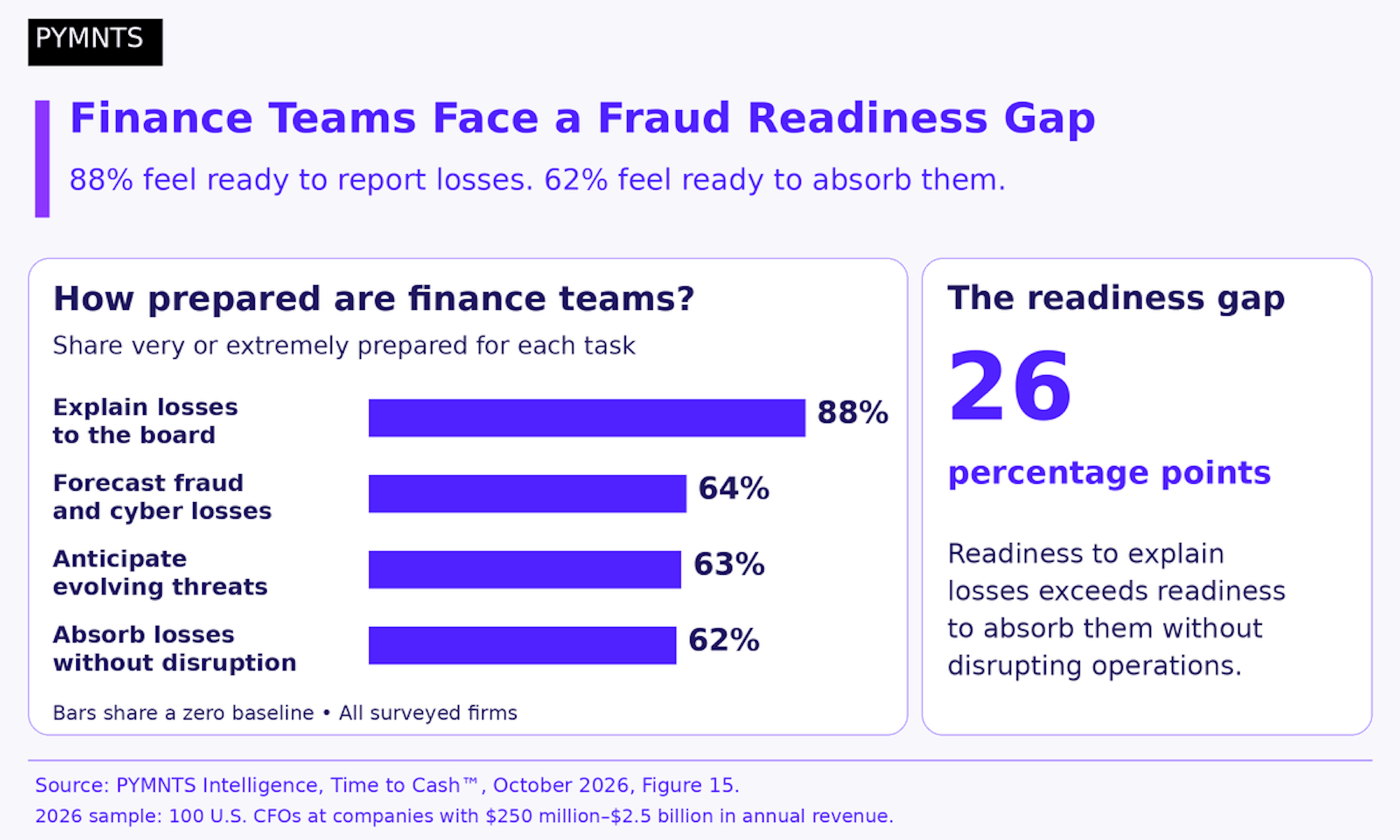
Protecting that money presents another opportunity. While 88% of CFOs say their teams feel very or extremely prepared to explain fraud and cyber losses to the board, 62% feel equally prepared to absorb those losses without disrupting operations. That 26-percentage-point gap gives finance leaders a clear priority as they improve payment security.
- Companies can strengthen protection without reviewing every payment manually. Sixty-two percent automatically clear low-risk outgoing payments, while 72% apply tighter verification to higher-risk incoming transactions. These approaches let finance teams concentrate attention where it’s most needed. Think of the checks as an airport security lane that directs additional screening toward flagged items. The goal is to protect cash while allowing routine transactions to proceed efficiently, preserving the gains companies have made in moving money.
- AI capabilities already used for cash management may support fraud detection. Among companies using two or more types of AI for cash flow, 71% use AI or machine learning to detect fraud in real time. That compares with 53% among companies using one type or none, an 18-percentage-point difference. The findings don’t establish that broader AI adoption causes stronger protection. They do suggest an opportunity to apply existing data and technical capabilities to identifying suspicious payments.
- Backup arrangements offer a practical next step. Just 45% of companies have a documented incident-response and continuity plan, and 39% maintain alternative payment channels and banking relationships. Those preparations can help businesses continue paying suppliers and receiving money when an attack interrupts normal operations. For CFOs, protecting cash includes preparing for the period after a payment system fails, when bills still come due and customers still need to pay.
The broader findings show why this work is becoming a larger part of finance. Eighty-seven percent of CFOs expect their responsibilities for fraud and cybersecurity risk to grow over the next two years, while 88% expect a larger role in selecting and overseeing technology. They’re building on measurable progress: 83% reported fewer cash shortfalls when paying suppliers. Pairing those operational improvements with stronger fraud preparation gives finance teams a practical way to protect the progress they’ve already made.
At PYMNTS Intelligence, we work with businesses to uncover insights that fuel intelligent, data-driven discussions on changing customer expectations, a more connected economy and the strategic shifts necessary to achieve outcomes. With rigorous research methodologies and unwavering commitment to objective quality, we offer trusted data to grow your business. As our partner, you’ll have access to our diverse team of PhDs, researchers, data analysts, number crunchers, subject matter veterans and editorial experts.