Jim Collins published “Good to Great” 25 years ago, giving executives a guide to building companies that could improve year after year through disciplined people and processes.
For banks heading into 2027, one scenario that tests the concept comes when a payment goes wrong at a time their systems were built to be idle. For example, an instant payment can arrive on a Sunday, but the bank’s reconciliation and settlement routines may still be organized around the close of a business day.
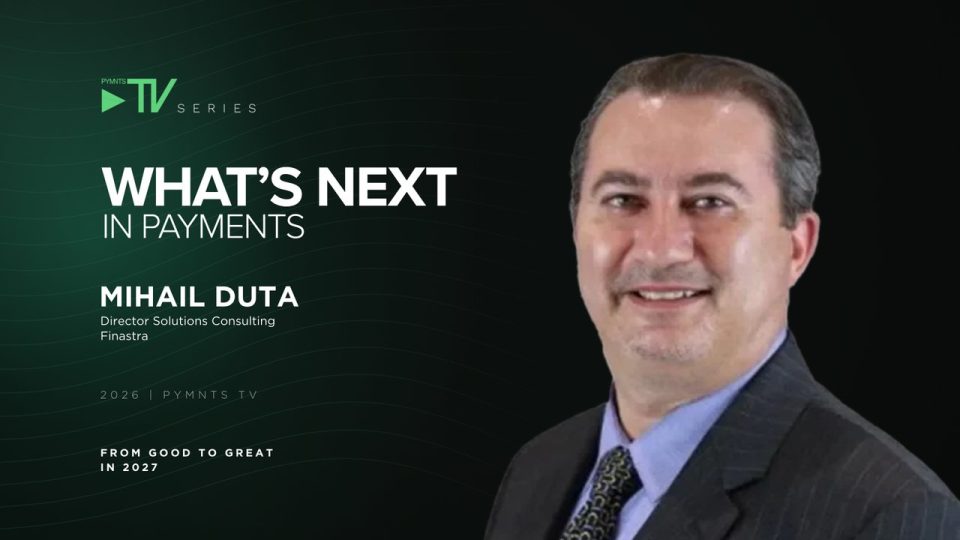
In a PYMNTS “What’s Next in Payments” interview, Mihail Duta, director of solutions consulting at Finastra, said batch processing remains embedded in reconciliation, reporting and end-of-day settlement. He also pointed to the cost of handling exceptions by hand.
Duta cited a Finastra finding that 23% of commercial clients ranked payment errors as their biggest pain point with their provider. For the customer, an error can mean waiting for a payment to go through. For the bank, it means assigning someone to find and correct it.
Those are different moments of friction, and they don’t have to wait for the same system overhaul. Duta said Finastra’s 2026 research found that 87% of institutions planned to invest in modernization over the next 12 months. He said his concern is what they buy with that money. Replacing an old Fedwire system with a new one that handles Fedwire alone can solve the immediate software issue while leaving the bank to start another integration when it wants to add a payment service.
“Modular incremental steps deliver value sooner with less risk,” Duta said, adding that he favors systems that can handle several payment networks and use open interfaces to connect new services.
A bank might begin by receiving FedNow® Service payments, for example. The first purchase should leave the bank room to add a capability whose demand or timing it can’t yet predict, such as with stablecoins, Duta said.
Preparing for that uncertainty also requires changing how banks make decisions.
“You can modernize your stack, but you can still move slowly if decision-making, procurement and risk appetite are calibrated for a different era,” Duta said.
Leaders should run experiments quickly and drop those that don’t work, he said. That gives the bank a way to learn what an investment will do before committing to a broader rollout.
What AI Can Do With a Payment Exception
“AI is only as strong as the system beneath it,” Duta said, adding that he expects payment hubs to use the detailed transaction data carried in ISO 20022 messages in everyday work such as fraud prevention and liquidity management. The data must be clean and available where the work takes place. Banks also need rules for who reviews an artificial intelligence recommendation and who can act on it.
Each AI investment should be tied to an operating measure, such as investigation time, error rates or staff capacity, Duta said. At Finastra, one application uses records of past transaction repairs to suggest how a payments operator might handle a new exception. A person stays involved in each action. A bank assessing the tool can track the time operators spend resolving cases and whether the repairs are correct.
A Circle project addressed a different piece of modernization. Finastra ran a proof of concept to connect settlement in Circle’s USDC stablecoin to its enterprise payments software, Duta said. That was a test of the integration. A bank weighing the service would still have to decide when offering that settlement option makes sense for its customers.
Duta said he speaks with organizations that Finastra connects to, including the Federal Reserve, and the company meets monthly with a customer user board. These conversations give the software provider a way to hear about changes in payment infrastructure and what bank customers are asking for.
Heading into 2027, Duta said his advice is to begin working out how to offer a service before a customer is waiting for it.
Watch the full interview with Finastra’s Mihail Duta to learn:
- What banks should look for when replacing payment software.
- How banks can measure whether AI helps operators resolve exceptions.
For all PYMNTS AI coverage, subscribe to the daily AI newsletter.