Thirty years after longtime Intel CEO Andy Grove warned executives that a strategic threat might arrive from outside their familiar competitive set, artificial intelligence is making that challenge front and center for payments companies.
Grove described technological and market changes powerful enough to reorder an industry as “10X forces.” He considered the internet one of them in “Only the Paranoid Survive,” published in 1996, but did not foresee the smartphone eventually challenging the personal computer. His larger point was more durable. Competition capable of overturning an established business can come from somewhere management is not watching.
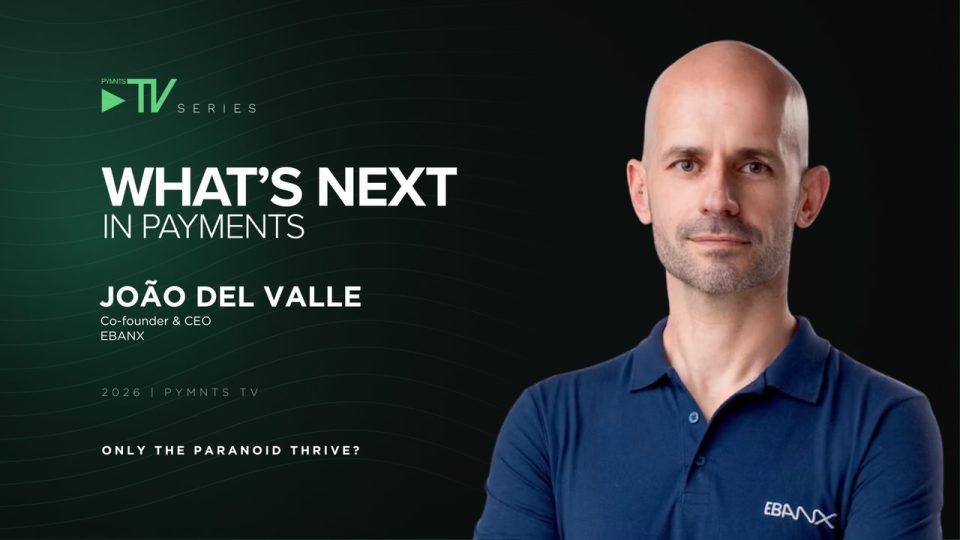
João Del Valle, co-founder and CEO of EBANX, said his attention is directed beyond the payments companies already known. In a What’s Next in Payments interview with PYMNTS CEO Karen Webster, he pointed out how AI is setting a new pace for the evolution of the industry.
Companies “are changing so much that a new competitor may come from a completely different kind of organization,” Del Valle said. AI can change the cost, speed and organizational requirements of building a company.
Grove’s 10X framework considered customers, suppliers, existing competitors, potential competitors, partners and the prospect that an existing business could simply be performed differently. Del Valle said the last two possibilities deserve particular attention now.
AI-native firms may pressure EBANX to execute faster while protecting assets that cannot be replicated simply by writing more software, including customer relationships, geographic presence, regulatory infrastructure and partnerships.
Technology itself offers less shelter than it once did. Standard technology has become cheap, which makes a familiar collection of platform features less defensible, Del Valle said. A payment method, feature or piece of infrastructure that once took years to assemble could become easier for another company to reproduce.
“AI can make the build happen faster, and you can get to product market fit faster than perhaps was true even just a couple of years ago,” Webster said.
The consequence for payments firms remains difficult to forecast. Innovation consequently has no dependable point of origin. Del Valle cited concentrations of activity in countries such as the United States, Singapore, China and France, while observing that companies elsewhere are moving close behind. A small organization using AI throughout its operations can behave differently from a conventional company employing hundreds or thousands of people.
“Five years from now, we won’t have even an idea of what a payments platform will look like, given the amount of innovation that’s going to happen,” Del Valle said.
But there’s a path to follow.
“The best ingredient for a transformation is to have a solid base,” he said.
We’d love to be your preferred source for news.
Please add us to your preferred sources list so our news, data and interviews show up in your feed. Thanks!
Watching How Organizations Work
Del Valle’s focus on organizations also reflects how AI is changing communication inside companies. He said he is watching information flows, interactions between agents and people, and the emergence of what he described as “company brains” and “personal [individual] executive brains.” Companies are experimenting with internal AI operating systems and determining how those systems exchange knowledge with employees and one another.
That creates a management problem as well as a technological one. Grove argued that CEOs are often late to recognize a strategic inflection because the earliest warnings originate several organizational layers below them. By the time those warnings reach senior management, their significance may have been softened.
Webster asked Del Valle how an executive can avoid that trap, noting that information can get, as she put it, “watered down because everyone wants to try to mitigate the bad news.”
Del Valle said executives need to disrupt hierarchy, remain close to operating details and understand the technology themselves. He recently spent several months in San Francisco immersing himself in AI, primarily to understand what the technology can do. Knowing what has become technically possible can expose which jobs, structures and processes are vulnerable to change.
Del Valle said he expects workforce reskilling to be a key trend in the years ahead. EBANX can provide tools, resources and direction, but he said he does not regard AI proficiency as something employees can acquire through a conventional corporate course.
“Don’t wait for the company,” Del Valle said. “This revolution is on you.”
Companies still must hit sales, product and operating targets while they invest in capabilities whose financial contribution may not arrive immediately, Del Valle said. A business that neglects its existing operation in pursuit of AI could find itself without the performance needed to finance the transformation.
His advice, therefore, returned to a conventional commercial test. Understand precisely what customers value and pay for.
Watch the full interview with EBANX’s João Del Valle to learn more about:
- How Del Valle is studying AI capabilities to identify functions and organizational structures that may be vulnerable to disruption.
- Why management layers can prevent executives from receiving an unfiltered account of technological and competitive changes.
- How EBANX is approaching internal knowledge management as agents become part of the way employees and executives work.
For all PYMNTS AI and digital transformation coverage, subscribe to the daily AI and Digital Transformation Newsletters.


 Add as Preferred Source