Banks can give customers more payment choices without giving them more decisions to make.
That’s the opportunity outlined in “Why Multi-Rail Strategy Is Banking’s Next Competitive Edge,” an October PYMNTS Intelligence report produced in collaboration with The Clearing House. The report examines how banks can coordinate cards, automated clearing house payments, instant transfers, wires and digital assets. Its third key finding puts the emphasis on how banks select and manage those networks. Connecting to more systems creates options. Choosing the right one for each transaction can turn those options into better service. Think of it as a navigation app that selects a route based on the destination and current conditions. Customers specify what they need, while the bank handles the details.
Key Points:
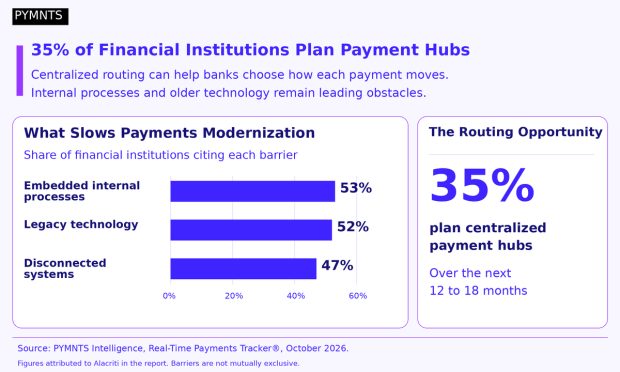
- 35% of financial institutions plan centralized payment hubs. According to Alacriti research cited in the report, those institutions expect to implement hubs over the next 12 to 18 months. These platforms can automate decisions that would otherwise require manual work. A bank can weigh a payment’s urgency, cost, size and risk alongside available funds and the recipient’s ability to accept it. That gives banks a practical way to coordinate networks with different rules and settlement schedules. Customers don’t need to understand those differences to benefit.
- Instant payments can support broader customer relationships. The report cites Amplify Credit Union’s experience after it enabled incoming payments through the RTP network. Consumer accounts receiving instant payments grew 12% faster than the overall portfolio. Business accounts grew 25% faster after receiving at least one instant payment, adding roughly $1 million in deposits over a quarter. Members receiving instant payments were also three times more likely to use their debit cards. The example suggests faster access to money can support activity beyond the initial transfer, although it doesn’t establish that every institution will see similar results.
- Operational improvements can help banks put those capabilities to work. Alacriti found that 53% of financial institutions cited deeply embedded internal processes as a primary modernization barrier, while 52% cited legacy technology and 47% pointed to disconnected systems. Those findings help explain why adding payment networks alone won’t resolve the challenge. Banks also need a common way to coordinate funding, fraud controls and payment records.
The report also finds that different networks continue to serve different needs. PYMNTS Intelligence research cited in the report shows that 76% of surveyed financial institutions enabled RTP for commercial customers, compared with 40% offering FedNow. As availability expands, banks have an opportunity to make payments easier to use while managing the complexity themselves.
At PYMNTS Intelligence, we work with businesses to uncover insights that fuel intelligent, data-driven discussions on changing customer expectations, a more connected economy and the strategic shifts necessary to achieve outcomes. With rigorous research methodologies and unwavering commitment to objective quality, we offer trusted data to grow your business. As our partner, you’ll have access to our diverse team of PhDs, researchers, data analysts, number crunchers, subject matter veterans and editorial experts.