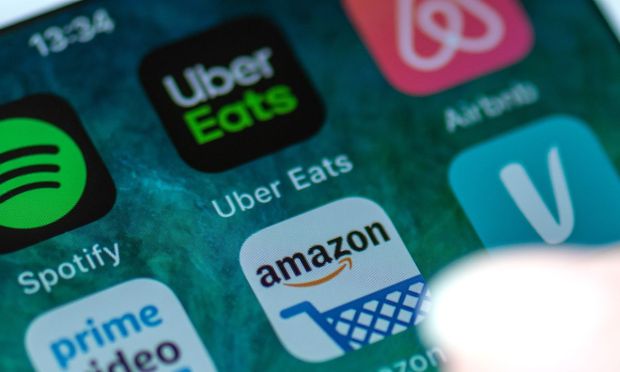
Amazon announced last week that Prime members can get free Uber Eats restaurant delivery on orders of more than $25. That triggered a sell-off in DoorDash shares, The Wall Street Journal (WSJ) reported Sunday (Nov. 8), calling the reaction “overdone.”
The report argued that the Uber Eats partnership would just be replacing an earlier collaboration with Grubhub, which didn’t see a boost in share price by teaming with Amazon.
The new Amazon-Uber Eats partnership is available in nearly 10,000 cities and towns in the U.S., including metro areas like Atlanta, Boston and Los Angeles, as well as rural and suburban areas.
“Together with Amazon, we built an experience for Prime members designed to make restaurant delivery feel as natural, convenient, and affordable as ordering anything else on Uber Eats,” said Andrew Macdonald, president and chief operating officer of Uber.
“We’re excited to connect our restaurant community with new Prime fans, while giving Prime members a seamless way to enjoy great food from restaurants through Uber Eats.”
The bigger question around the new partnership, WSJ added, is whether DoorDash’s recently announced $17 billion acquisition of Instacart lets it compete effectively with Amazon and Walmart on grocery delivery. It’s a “relatively untapped” market, the report said, with Emarketer data showing that eCommerce will account for 15.5% of grocery sales this year.
DoorDash CEO Tony Xu said in a recent earnings call that grocery delivery is “just a fraction of what its potential could be” because shoppers are “still being asked to pay a premium for imperfect delivery.”
In Xu’s view, the key to a more perfect grocery delivery is via direct inventory management, WSJ said, with the company planning to invest “substantial sums” on warehousing and autonomous delivery.
Still unclear is how much investment it will take to take on Walmart and Amazon, as DoorDash’s capital expenditures for last year were roughly 4% of Walmart U.S.’s supply chain, customer-facing initiatives and technology investments, the report said.
Meanwhile, Amazon continues to try to capture a bigger share of the grocery business long dominated by Walmart.
Food and beverage now account for roughly 60% of Walmart’s retail business, with research from the September edition of the “Share of Wallet: Amazon vs. Walmart” report from PYMNTS Intelligence estimating that Walmart controls approximately 21% of U.S. food and beverage spending, versus around 3% for Amazon.
“More strikingly, Walmart’s advantage has expanded since 2019 even as Amazon has nearly doubled its share of retail overall,” PYMNTS wrote at the time.
“Grocery isn’t simply another category. It represents a recurring consumer retail behavior that brings households back into Walmart’s ecosystem every week, sometimes multiple times a week. And as retail competition shifts from winning individual transactions toward maximizing lifetime customer value, that frequency could become Walmart’s most valuable strategic asset.”