Embedded finance programs have spent years proving they can attract customers. The more difficult challenge now is determining whether those customers stay.
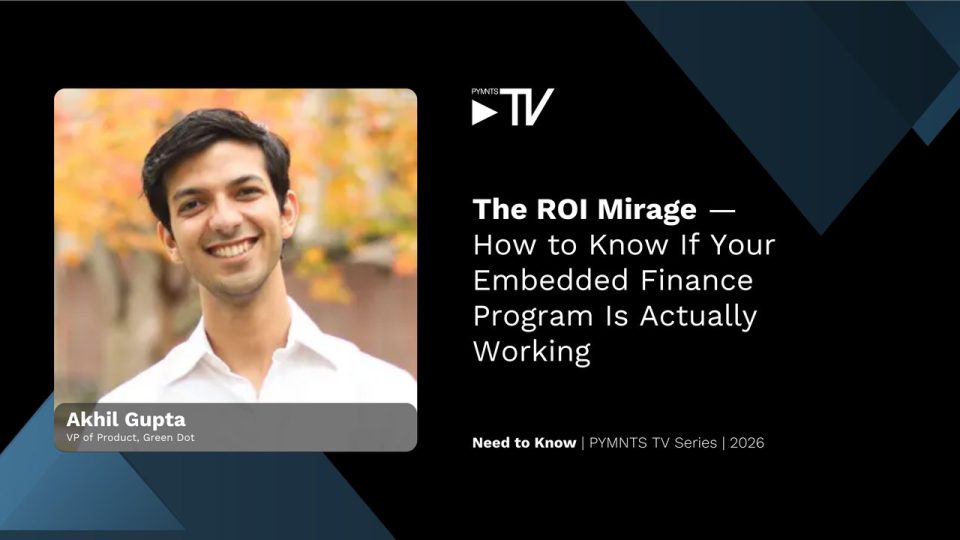
During a recent conversation with PYMNTS, Akhil Gupta, vice president of product at Green Dot, argued that when examining embedded finance, executives can believe a program is succeeding when the underlying economics tell a more complicated story, especially when it comes to lifetime value of customers.
“Most embedded finance programs get it wrong either in terms of measuring the wrong things … or attributing it correctly,” Gupta told PYMNTS of LTV.
One of the most common mistakes, Gupta said, is an excessive focus on initial interactions.
“A lot of embedded finance programs will look at the funnel and think of the activation rate … as one of the benchmark metrics,” he said.
The problem is that activation only captures one stage of customer behavior.
A strong signup rate can mask weaknesses elsewhere in the customer journey. Customers may abandon the onboarding process. They may activate a financial product once and never use it again. They may respond to incentives without becoming engaged users.
“You want to look at your entire funnel, not just your acquisition rate,” Gupta said, adding that “you might have a very leaky funnel and you’re dropping customers who don’t want to put in the effort to activate because you haven’t communicated enough of the value of the program.”
He contended that embedded finance providers should evaluate performance through a set of different lenses.
Gupta recommended firms “look at the program in three different buckets. Acquisition, engagement and retention.”
The Lifetime Value Challenge
The conversation becomes even more complicated when customer lifetime value enters the equation.
Lifetime value remains one of the industry’s favorite metrics because it captures both customer spending and customer longevity. Yet Gupta believes many organizations struggle with attribution.
Embedded finance products do not operate independently. Payments, lending, deposits, rewards and marketplace activity frequently influence one another. Determining which activity can legitimately be attributed to a financial product becomes difficult.
Gupta said companies should compare users who engage with embedded finance offerings against similar customers who remain on the platform without using those services. Doing so provides a clearer picture of incremental value rather than simply measuring revenue generated by users who may have remained active regardless.
Interchange Pressure Changes the Math
We’d love to be your preferred source for news.
Please add us to your preferred sources list so our news, data and interviews show up in your feed. Thanks!
The industry’s measurement debate is unfolding as interchange economics face continued scrutiny.
Gupta said future pressure on interchange as inevitable.
“Most of us can agree is not a question of if, but just when,” he said.
That reality is pushing providers to reconsider how embedded finance programs generate revenue.
According to Gupta, the programs best positioned to withstand interchange compression share several characteristics. Financial services are deeply woven into the broader product experience. Revenue comes from multiple sources rather than a single transaction stream. And the underlying infrastructure remains flexible enough to adapt as market conditions change.
He pointed specifically to the importance of architecture.
“The architecture itself is modular enough that the program is able to respond to regulatory shifts and changes,” Gupta said.
Modular systems allow businesses to add capabilities, adjust controls and introduce new services without rebuilding entire platforms. In a market where both regulation and technology continue to evolve, adaptability is becoming a competitive requirement rather than a technical preference.
Promotions, rewards and sign-up incentives can generate substantial activity. Yet activity often fades when those incentives disappear.
True loyalty survives after the intervention ends.
“The way to really measure loyalty and separate it out from just activity is to do A/B testing, run experiments,” Gupta said, adding, “Ultimately what you want is to inculcate a habit in your customer base through an embedded set of program features where they just love your product.”
Watch the full interview with Akhil Gupta to learn more about:
- Why activation rates can conceal weaknesses elsewhere in the embedded finance funnel.
- How customer lifetime value is often measured correctly but attributed incorrectly.
- Why modular architecture and genuine customer loyalty may matter more than interchange economics over the long term.


 Add as Preferred Source