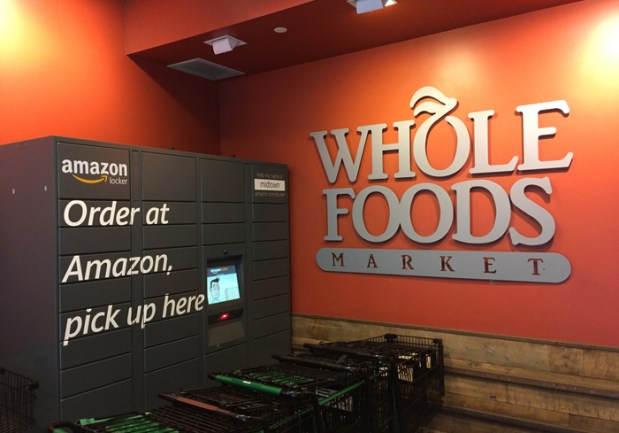
Amazon customers who stop at Whole Foods to retrieve a package might stay to purchase additional goods, such as a drink or promotional item. Their trips also provide an opportunity for Whole Foods to make shoppers aware of changes at the grocery chain.
For its report, inMarket looked at nearly 100 Whole Foods stores in markets such as New York, Los Angeles, Chicago, Dallas-Fort Worth and San Francisco metropolitan areas. Of the 98 stores inMarket looked at, 76 had Amazon Lockers.
To generate more impulse sales, Whole Foods could place products near its lockers. The retailer could also provide fast payment options, such as self-checkout, Stewart Samuel, program director for IGD Services, told Reuters.
The news comes as Amazon’s annual report shows that it’s thinking long term when it comes to Whole Foods, with the online retailer’s unconditional purchase obligations increasing to $24.2 billion last year. According to CNBC, that amount is beyond the $13 billion it spent last year on the national supermarket chain.
Before the Whole Foods acquisition, Amazon had just $1.6 billion of purchase obligations — and that amount never exceeded more than $2 billion in company history. After the purchase, Amazon took on an additional $22 billion in contractually obligated future purchases, mainly due to Whole Foods’ contract with its largest supplier, United Natural Foods.
Experts say Amazon’s disclosure shows it’s focused on turning Whole Foods into a major revenue driver, especially since the company’s disclosure extends until 2025.
“It is definitely a clear signal of Amazon’s commitment and confidence to make the Whole Foods deal work,” said Patrick Badolato, an accounting professor at the University of Texas. “There’s a huge commitment to keeping many of the core Whole Foods products there.”