America’s biggest retailers are about to turn a weak government sales report into a six-company test of consumer endurance.
U.S. retail and food service sales fell 0.6% in July, the first monthly decline since October and the largest in 14 months. The drop surprised economists who expected a 0.1% increase. Sales still rose 5% from a year earlier, but the Census Bureau’s figures aren’t adjusted for inflation. The closely watched control group, which feeds into estimates of economic growth, declined 0.4%. The Census Bureau reported total July sales of $763.6 billion.
Some of the weakness came from unusual timing. Online sales fell 2.2% after Amazon moved Prime Day into June. Auto sales dropped 1.8% and gas station receipts fell 0.9%. Clothing sales rose 1.9%, building material sales gained 0.3% and restaurant spending increased 0.5%. Those gains suggest consumers haven’t closed their wallets. They’re becoming more selective.
Their mood has darkened. The University of Michigan’s preliminary sentiment index dropped to 51 in August from 55.2 in July. Only 8% of consumers expect their income to grow faster than inflation during the coming year. Lower-income consumers recorded some of the largest declines in confidence.
The first corporate reading arrives Tuesday from Home Depot. Wall Street expects earnings of $4.73 per share on revenue of $47.2 billion. Oppenheimer analyst Brian Nagel expects slightly lower earnings and sees little evidence of a sustained home improvement recovery, according to Kiplinger’s earnings preview. Executives will likely focus on professional contractors, repair projects and continued delays in large renovations. Home Depot previously said consumer uncertainty and housing affordability pressure kept underlying demand close to 2025 levels. Its full-year guidance calls for comparable sales ranging from flat to 2% growth.
We’d love to be your preferred source for news.
Please add us to your preferred sources list so our news, data and interviews show up in your feed. Thanks!
Lowe’s reports Wednesday, with analysts expecting earnings near $4.23 per share. The company will likely point to professional customers, appliances, services and online sales as sources of stability. Its first-quarter comparable sales rose 0.6%, helped by 15.5% online growth. The tougher topic will be do-it-yourself shoppers delaying expensive projects. Home Depot and Lowe’s can therefore show whether consumers still fund necessary repairs while leaving optional renovations on the drawing board.
Target, which also reports Wednesday, faces a different hurdle. New CEO Michael Fiddelke must show that the company’s recovery survived the end of the spring tax-refund boost. Target’s first-quarter comparable sales grew 5.6% as traffic increased 4.4%, prompting the retailer to raise its full-year sales forecast to growth of around 4%. Analysts expect quarterly earnings of roughly $2.32 per share. Executives will be pressed on traffic, markdowns, food and essentials sales and whether discretionary categories can keep growing as confidence slips.
TJX and Ross Stores may offer the strongest results because consumer caution can send more shoppers into off-price stores. TJX reports Wednesday with analysts expecting earnings near $1.19 per share. CEO Ernie Herrman is expected to emphasize customer traffic, access to branded inventory and the chain’s ability to preserve its price gap. TJX entered the quarter planning comparable sales growth of 2% to 3% after posting 6% growth in the first quarter.
Ross reports Thursday after forecasting second-quarter comparable sales growth of 6% to 7%. Its first-quarter comparable sales jumped 17%, but CEO Jim Conroy acknowledged that tax refunds helped. The call should reveal how much of that momentum survived once the refunds faded. A strong report from Ross or TJX would support the trade-down thesis even if overall retail demand softened.
Walmart delivers the broadest reading Thursday morning. Analysts expect earnings of 74 cents per share on $186.9 billion in revenue. Jefferies analyst Corey Tarlowe expects an in-line quarter, supported by eCommerce and advertising. He also expects Walmart to reinvest potential tariff refunds in lower prices rather than take an immediate margin lift. Executives John Furner and John David Rainey will likely discuss grocery traffic, fuel spending, price investments and gains across income groups. Walmart previously projected second-quarter sales growth of 4% to 5%.
PYMNTS Intelligence data explains why value will dominate every call. In July, 67% of consumers lived paycheck to paycheck and 26% struggled to pay their bills. Four in five households blamed necessities for summer budget pressure. Fifty-eight percent expect to keep paying off summer costs after the season ends.
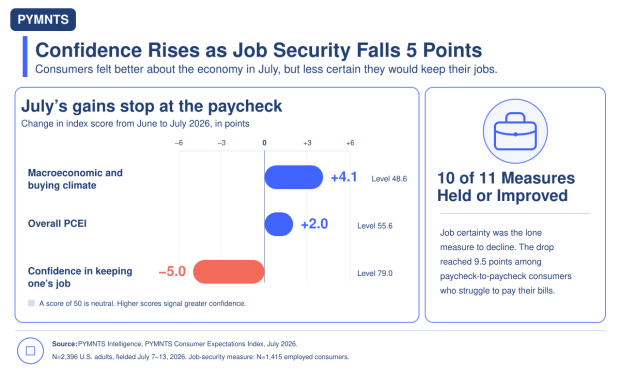
The July PYMNTS Consumer Expectations Index had risen to 55.6, but confidence in job security fell five points. Friday’s data suggest that concern is spreading. This week’s earnings will show the commercial result: fewer large commitments, heavier use of promotions and continued spending at retailers that make a strained paycheck go further.


 Add as Preferred Source