Payroll has traditionally lived in the administrative corner of small business operations. That arrangement increasingly looks out of step with how businesses actually move money.
For small- to medium-sized businesses (SMBs), payroll is rarely isolated from broader operating decisions. Labor costs, working capital timing, cash availability and payment flows all converge in one recurring obligation: paying people accurately and on time. That convergence is one reason payroll is becoming part of the embedded finance conversation.
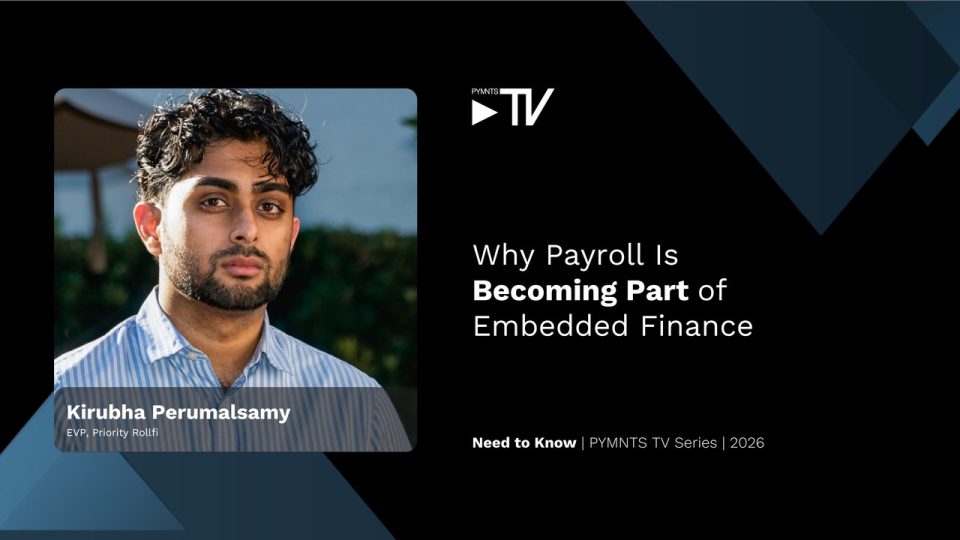
In a conversation with PYMNTS, Kirubha Perumalsamy, executive vice president of Priority Rollfi, said SMB software platforms are being pushed toward consolidation rather than specialization. Businesses increasingly expect payroll, banking and payments to operate inside the same environment instead of across disconnected systems.
“If you look at SMB software today, platforms are trying to do a lot more than they traditionally used to,” Perumalsamy said. “SMBs don’t really want point solutions. They want all-in-one software.”
Payroll remains one of the largest recurring expenses most SMBs manage. Moving payroll closer to financial workflows gives owners greater visibility into timing and operational trade-offs.
Payroll’s Friction Problem Has Become Harder to Ignore
Payroll software historically approached SMBs as a single market. Perumalsamy said that assumption breaks down quickly once businesses move beyond straightforward wage structures.
“A lot of historical software for SMBs has taken a one-size-fits-all approach,” he told PYMNTS. “But even if you’re an SMB, every industry works differently and the way people get paid is different.”
He pointed to automotive repair shops as one example. Technician compensation can vary depending on the type of work completed, creating payroll calculations that standard systems struggle to capture. Restaurants create another layer of complexity through combinations of base wages, tipped income and different pay structures across staff roles.
The challenge becomes greater because payroll inputs often live in separate systems.
Scheduling platforms track labor. Time management systems record hours. Banking platforms manage settlement. Payroll platforms process payment. Businesses frequently spend time moving information manually between each layer.
Perumalsamy described embedded payroll as an attempt to condense those handoffs.
Using the restaurant example, he noted that scheduling systems already know staffing requirements and hours worked. Instead of exporting data into another environment, payroll can be triggered inside the existing workflow.
No Margin for Error
Perumalsamy argued that payroll differs from many financial products because tolerance for mistakes is low.
“Payroll is, time and time again, one of the stickiest systems inside a business, and that’s because the margin for error is essentially zero,” he said. “Even the smallest hiccups can cause massive headaches for a business.”
That dynamic changes the relationship between software platforms and customers. Platforms that become part of payroll operations move from being optional tools into systems that businesses depend on every pay cycle.
We’d love to be your preferred source for news.
Please add us to your preferred sources list so our news, data and interviews show up in your feed. Thanks!
“When payroll connects with the payments and banking operations of the business, they essentially become the central nervous system for day-to-day operations of the business,” he said.
The practical effect is not simply convenience. Seasonal businesses, for example, can combine labor schedules, payroll obligations and payment activity to anticipate staffing needs earlier rather than react after demand changes.
Data Flow Creates Earlier Signals for Banks and Platforms
Embedded payroll may also create a different kind of operational insight.
Perumalsamy said payroll can serve as a recurring indicator of financial condition because labor obligations persist regardless of revenue volatility.
“Payroll tells you a lot about the health of a small business because it’s recurring, it’s time sensitive, and it’s directly tied to cash flow,” he said.
He noted that businesses often monitor revenue trends while underestimating payroll pressure until deadlines approach.
For banks and platforms, connected payroll data can create earlier visibility into stress points and liquidity needs.
Perumalsamy cited a property management operator with locations across several states where payroll previously required lengthy reconciliation among managers and accountants. Connecting time records directly into payroll shortened processing and improved visibility into upcoming cash requirements.
Priority Rollfi, which operates as a subsidiary of Priority, embraces that broader thesis.
Perumalsamy said the combination of payroll with payments, treasury and banking infrastructure reflects how software platforms increasingly build financial products in stages rather than isolation.
The shift toward embedded payroll may ultimately be driven as much by generational change as by technology. Perumalsamy said a growing number of SMBs are being handed to younger owners who expect the same level of integration from business software that they experience in their personal lives.
“There’s a massive wave of businesses where the owners are retiring and handing off the companies to the next generation,” he said. The younger generation is adept with technology, and “the expectation is their business software should do the same thing” as the rest of their digital tools, he said. As payroll, payments, banking and treasury functions continue to converge, that expectation may prove to be one of the strongest forces reshaping how SMBs manage money.

 Add as Preferred Source