Nearly a decade after The Clearing House launched the RTP® network, the United States’ first real-time payments network, the promise of instant money movement remains more aspiration than reality for many businesses.
However, as the last decade has proven, rewiring the enterprise financial stack is not just about being fast for fast’s sake. It’s about matching use case to capability.
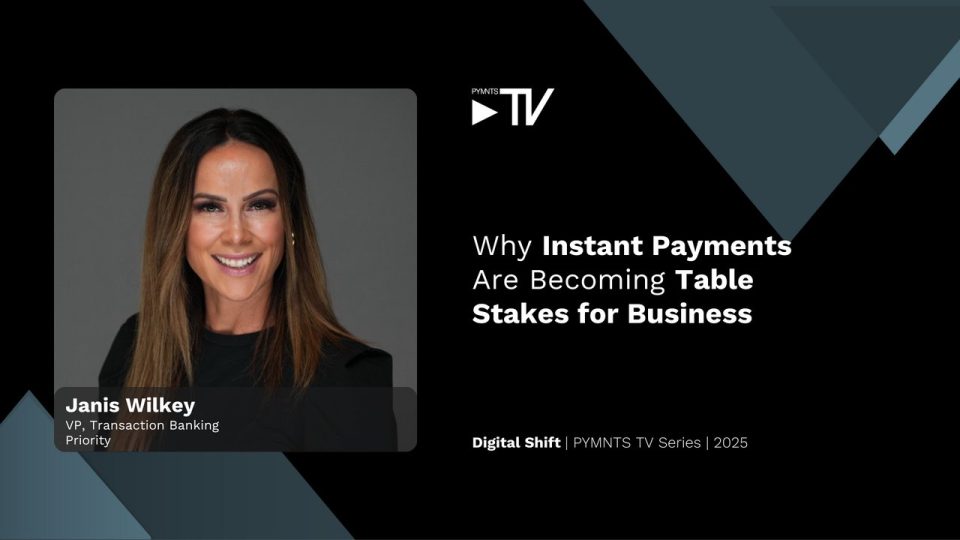
“Slow adoption doesn’t mean it’s not worth investing in,” Janis Wilkey, vice president of transaction banking at Priority, told PYMNTS, adding that the necessary groundwork for instant payments has now been successfully laid.
Real-time payments required new networks, new standards, new compliance visibility and new consumer habits, all of which now exist.
Still, when companies evaluate their real-time payment maturity, throughput and settlement latency dominate the conversation. But these metrics can obscure more meaningful measures of progress.
“We measure success differently,” Wilkey said, adding that Priority includes key performance indicators, like payment diversification or cost optimization, and qualitative measures, like client retention and customer satisfaction.
Businesses should assess not only whether payments move faster, but whether doing so creates value. She said she thinks relevancy stands as the undiscussed performance indicator that may determine winners and losers. To illustrate, she invoked a now-familiar cautionary tale.
“Think about the experience you may have had renting a movie a decade or two ago,” she said. “In today’s environment, is that optimal?”
Companies that dismissed streaming as a fad didn’t just lose revenue. They lost the market. The same could be said of instant payments today.
“Not adopting said change could create an opportunity for you … to become irrelevant to your target audience,” Wilkey said, adding that instant payments will soon become table stakes. “The most important fact is ensuring you are capable of doing so, and that you can meet the needs of your customers where they are.”
Boost From Embedded Payments
Even when the business case for instant payments is clear, implementation might not be. Much of the friction hindering broader adoption of faster payments lives not at the edge but deep inside enterprise systems. ERPs position themselves as embedded financial hubs, yet their real-time capabilities vary.
For businesses using older or less sophisticated software, simply adding a new payment type can require significant work, Wilkey said.
“Sometimes there’s a challenge just even adding a payment method into an accounting software,” she said, adding that elements as basic as storing banking details, formatting instructions or transmitting confirmations may not exist natively.
The difficulties don’t stop at configuration. Instant payments alter fundamental accounting rhythms, landing squarely in the middle of the internal tug-of-war between accounts payable (AP) and accounts receivable (AR). AP often wants to extend outgoing payments to optimize working capital; AR wants to accelerate incoming funds. Real-time rails can satisfy one side while disadvantaging the other.
“There needs to be consensus and buy-in,” Wilkey said. Each department needs to be on board, from tech to finance.
Instant payments also force companies to solve not just for speed, but for strategy.
It’s against this backdrop that Wilkey cited embedded payments as a critical unlock for real-time adoption. If relevancy is the goal, embedded payments may be the accelerant. Rather than asking customers to initiate real-time payments, businesses want those payments to be invisible, triggered automatically at the point where value is exchanged.
When embedding real-time payment capabilities, firms can also reframe the modernization issue. Businesses don’t need to use instant payments in every scenario, but they do need to be able to. Customers won’t tolerate friction simply because an enterprise is tied to legacy rails.
We’d love to be your preferred source for news.
Please add us to your preferred sources list so our news, data and interviews show up in your feed. Thanks!
Consumers Are Leading the Way
Part of the confusion around instant payments stems from the term itself.
“Although a lot of financial institutions even claim to have an instant payment mechanism,” Wilkey said. “The settlement or accessibility of those funds aren’t occurring at the same time.”
That gap between sending a payment instruction and actually making usable funds available can span anywhere from minutes to days. Banks often paper over this delay through provisional crediting.
But while businesses inch forward, consumers have already embraced instant payments.
“Consumers influence the way we do business,” Wilkey said, adding that Priority’s own acquisition of Sila reflects the company’s view that consumer-driven design will ultimately dictate business adoption.
“Sila has masterfully simplified the issuance of instant payments … in a compliant way that monitors transaction activity and has the right infrastructure to support these payments at scale,” she said.
On the demand side, the most explosive growth for instant payments continues to be in use cases where immediacy and low friction carry high emotional or operational value. This logic extends naturally into the gig economy. Workers performing on-demand labor expect on-demand pay.
“They like to receive payment in real time,” Wilkey said.
She recommended companies start with the characteristics of the payment itself rather than the rail. When goods or services are exchanged immediately, and irrevocability is essential, instant rails again make sense.
“If it’s important to you to deliver payments outside of business hours,” it will probably be an instant payment, Wilkey said.
Insurance claims are a natural use case that typically happens outside of business hours.
“You have a claimant who lost their roof in a hurricane,” she said, “and needs a repair on a Sunday.”
For all PYMNTS B2B coverage, subscribe to the daily B2B Newsletter.


 Add as Preferred Source