That is the central finding of “Beyond Speed: The Case for Instant Payout Adoption and Stickiness,” a September PYMNTS Intelligence report produced in collaboration with Ingo Payments.
Based on a survey of 2,237 consumers in the United States who received disbursements in the past year, the report found that instant payments have moved from novelty to default. The share of recipients who said instant is their most-used way to receive payouts has climbed steadily, even as overall adoption has leveled off. In other words, growth is no longer about convincing people to try instant payments. It is about what happens after they do.
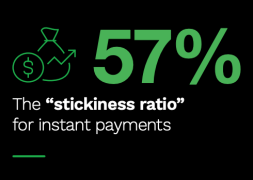 At the heart of the analysis is what PYMNTS Intelligence called “stickiness,” defined as the share of recipients who make an instant rail their primary payout method after receiving at least one instant payment. The report showed that instant rails now have a combined stickiness ratio of 57%, up from 39% in 2020.
The shift reflects bigger changes in how U.S. consumers get paid. Disbursements from gig work, marketplaces, tips, investment platforms and gaming winnings increasingly function as a paycheck replacement rather than a one-off event. For companies issuing payouts, that change raises the stakes. Instant payments are no longer just a cost or convenience decision. They are a lever for loyalty, retention and long-term engagement.
Three data points from the report underscore how far this transition has gone:
- The share of consumers who receive an instant payment and end up making an instant rail their most-used method for future disbursements is 57%, up 46% since 2021.
- Gig workers, contractors and other recipients who rely on disbursements as their core income convert from one-time use to regular use, at 68%.
- When instant payments are delivered through digital wallets, they see 58% higher conversion rates compared with bank account transfers.
Beyond these headline numbers, the report offered insight into how behavior differs by use case and demographic. Transactional payroll emerges as the strongest driver of habit formation. Among consumers who depend on payouts as a primary income source, nearly three-quarters received at least one instant payment in the past year, and more than two-thirds now prefer instant rails. That pattern holds even among recipients who receive smaller or less frequent payouts, suggesting that once expectations are set, speed becomes difficult to give up.
Age also matters less than many assume. While young consumers are more likely to have tried instant payments, stickiness ratios are consistent from Generation Z through Generation X. Bridge millennials stand out as the most likely group to turn trial into routine use, while baby boomers trail but still show conversion. The implication is that friction, not familiarity, is often the bigger barrier.
Payment rails themselves also shape outcomes. Digital wallets outperform push-to-debit and real-time bank transfers in creating repeat behavior, particularly for income and borrowing disbursements. Push-to-debit, however, leads for investment payouts and winnings, indicating that context matters as much as speed.
Taken together, the findings suggest that instant payments are becoming infrastructure, not a feature. Once recipients experience them, expectations reset. Companies that treat payouts as a one-way transaction risk missing a broader shift. The data showed that instant disbursements can anchor longer relationships when they are designed to be used again.