By the Numbers
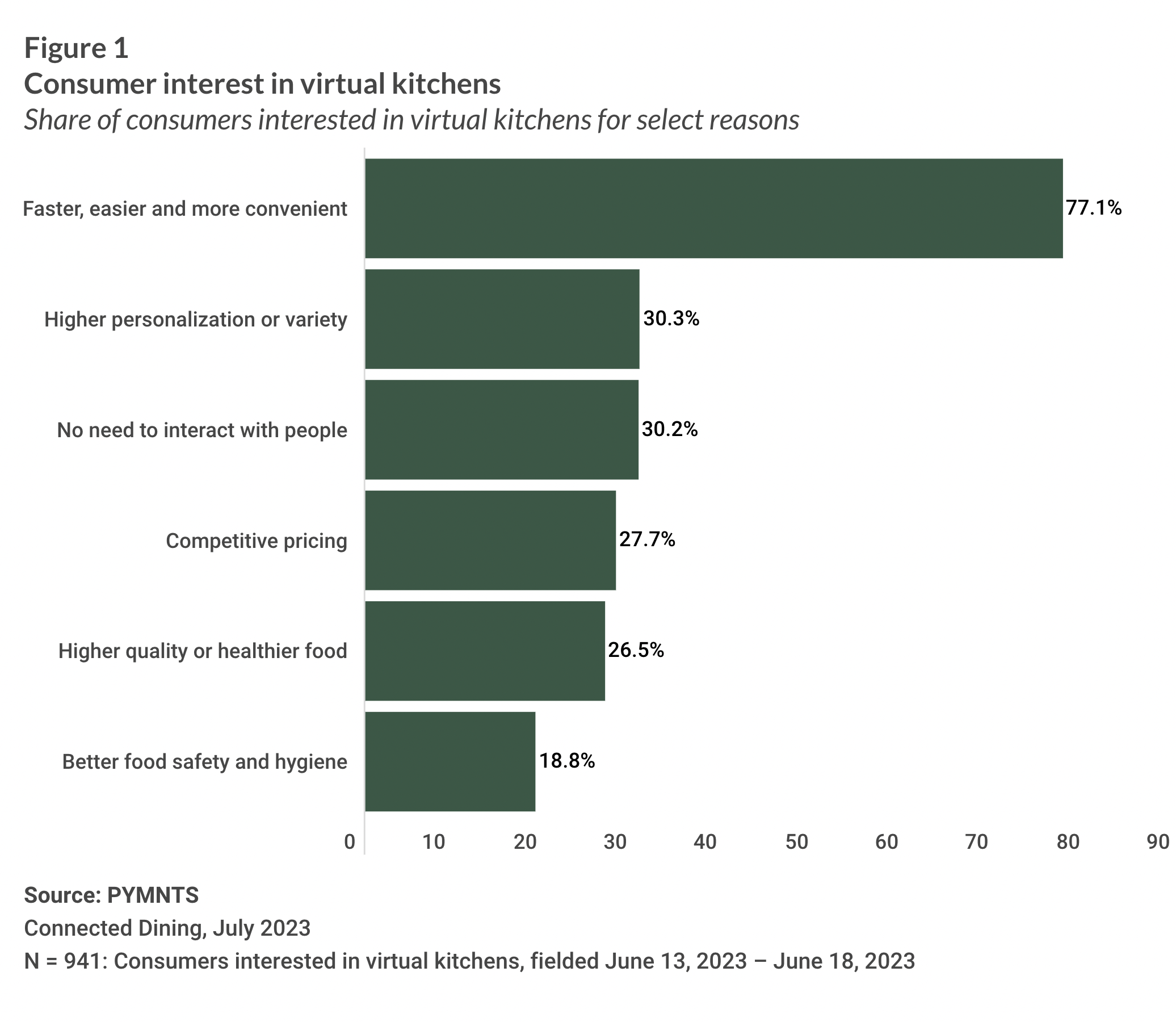
Research from PYMNTS’ new exclusive study “Connected Dining: The Robot Will Take Your Order Now,” which draws from a census-balanced survey of 1,971 U.S. consumers, reveals that, of these, only 941 report being interested in virtual kitchens — about 48%. The majority, conversely, are not interested in restaurants unless they have physical locations.
The Data in Context
Forty-eight percent, of course, remains a sizable share of consumers, and many technology providers and restaurants alike are looking to take advantage of this interest by launching new brands.
For instance, restaurant company WOWorks, which owns five fast-casual chains, announced July 11 that it is launching seven new fast-casual brands in partnership with Olo.
The launch comes as third-party aggregators “have become the driving force behind a culinary revolution,” the press release said, transforming the restaurant industry landscape.
Each brand is linked to one of the restaurant company’s five chains and is based on the ingredients those chains already have in their kitchens. These include a soup brand, a sandwich brand, a toast brand, a bowls brand, a smoothie brand, a gyro brand, and a mac and cheese brand.
With the rapid proliferation of virtual brands, many of which have had issues with quality, Uber Eats has been cracking down, most recently removing 8,000 virtual restaurants from its marketplace. This marks a reduction of 20% from the 40,000 virtual storefronts, by Uber’s count, in March.
“With the boom in virtual restaurants over the past several years, we’ve noticed a wide range of approaches to creating virtual restaurant brands,” John Mullenholz, Uber’s head of virtual restaurants and dark kitchens for the U.S. and Canada, said in a statement at the time.