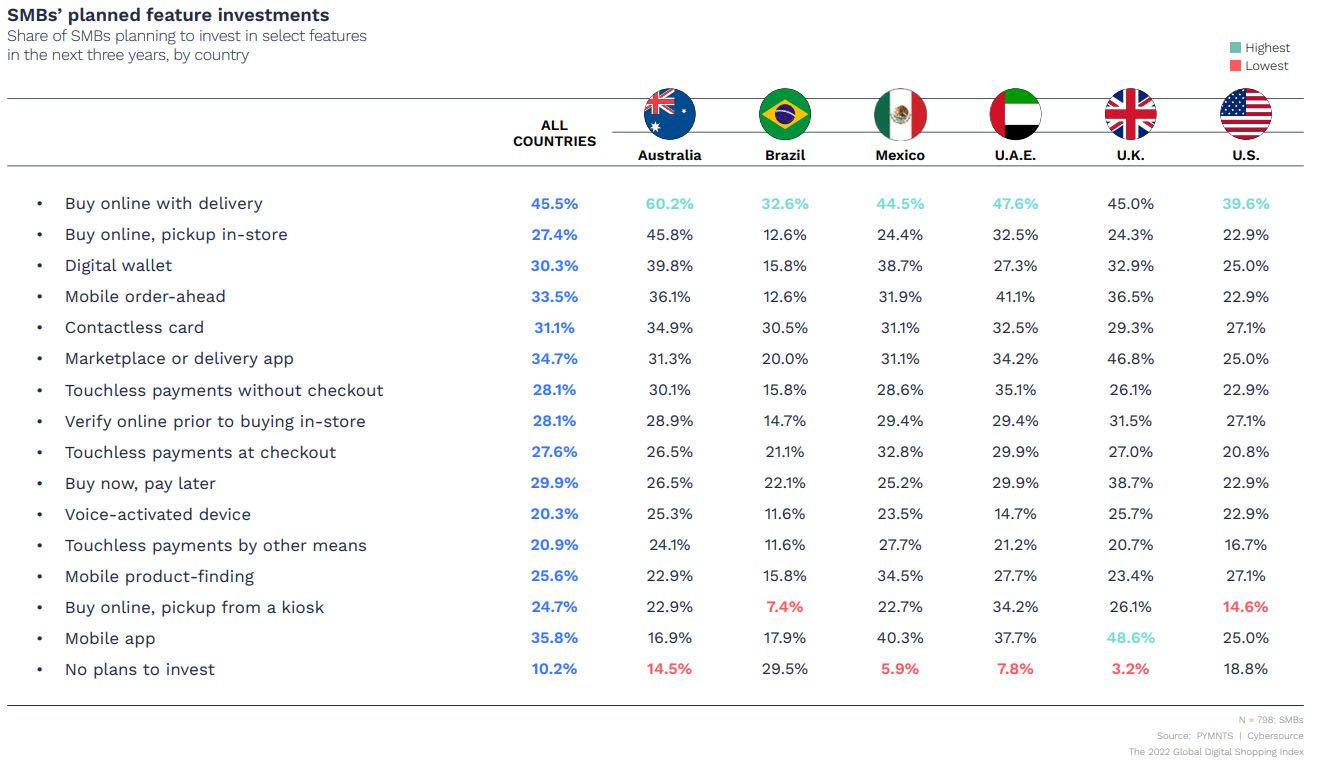
When it comes to investment plans in mobile order-ahead features, touchless payments at the brick-and-mortar point of sale (POS) and in-store kiosk pickup options for eCommerce purchases, small- and medium-sized businesses (SMBs) in the United Arab Emirates (UAE) are top of the list.
Their shopping index scores were higher than the average of those of six countries in a recent cross-country PYMNTS study based on a survey of 3,100 businesses and 13,114 consumers across six countries — Australia, Brazil, Mexico, the UAE, the United Kingdom and the United States.
Read the report: 2022 Global Digital Shopping Index – SMB Edition
The SMB-focused PYMNTS study, published in collaboration with Cybersource, showed that for mobile order-ahead, SMBs in the Middle Eastern country earned a score (41.1%), almost 8 points higher than the six-country average.
In touchless payments at the brick-and-mortar POS, UAE merchants also ranked highest among the six countries, scoring seven points higher than average when it involved contactless payments without checkout, and earning a little less than three points higher than the average for payments at checkout.
The highest gap was recorded for in-store kiosk pickup options for online purchases, with UAE merchants scoring 9.5 points higher than the average of 24.7%, with U.K. SMBs placing second at 26.1%.
Overall, the report showed that SMBs, regardless of location, offer far more of the features necessary to support a seamless cross-channel shopping experience than their larger competitors, a reason why they no longer feel the same need to invest in technology development.
For example, a mere 20% of these businesses planned on investing in voice-recognition technology in the next three years because the technology is already ubiquitous among the remaining 80%, while only 30% said they had plans to invest in buy now, pay later (BNPL) in the next three years because most of the remaining 70% already offer it.