Rental prices keep on rising year after year, and some rental contracts have been tightened by requiring larger deposits at the signing. To illustrate: since early 2020, house rents have increased nearly 30% overall, according to the real estate website Zillow. Higher rental costs and higher deposits can also mean higher rent-related refunds, such as a returned security deposit at the end of a tenancy. And just as digital options have proliferated for paying rent, data shows that the digitization of refunds has picked up steam. According to a recent PYMNTS Intelligence research study in collaboration with Ingo Money, 4 out of 10 consumers who received rent-related refunds primarily used instant methods. Those who did not opt for instant refunds despite having the ability to choose them cite a variety of reasons.
We’d love to be your preferred source for news.
Please add us to your preferred sources list so our news, data and interviews show up in your feed. Thanks!
Reasons for not choosing instant
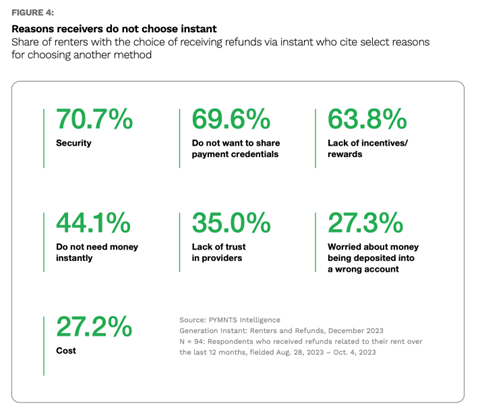
Per the PYMNTS Intelligence study, more than half of renters were given the option to receive refunds through instant payments, and two-thirds of this subgroup opted to receive the refunds via instant. Those who prefer not to receive their rent-related refunds via instant payment methods were most likely to indicate security concerns and lack of incentives as reasons why. Specifically, among these individuals, 7 out of 10 expressed security concerns and reluctance to share their payment credentials as their reasons for disinterest and 64% implicated the lack of incentives or rewards to use instant payments.
Renters typically receive rent-related refunds only sporadically, but when it is time, they increasingly expect them to be delivered digitally. The average size of a refund received non-instantly was nearly $850, with the size of these refunds correlating with the tenant’s income. Property management companies seeking to utilize instant pay to attract renters, especially among the high-income segment, may benefit from improved marketing that addresses these concerns.
About the numbers
“Generation Instant: Renters and Refunds,” is a PYMNTS Intelligence and Ingo Money research collaboration. The study is based on a census-balanced survey of 2,606 consumers across the United States that examines consumer satisfaction with disbursements received from government and non-government entities.
See More In:
faster payments, Ingo Money, instant payments, News, PYMNTS Intelligence, PYMNTS News, real estate, real time payments, refunds, Rent, renters



 Add as Preferred Source