For eCommerce firms, the European Union can present a tantalizing opportunity and a logistical labyrinth.
With 27 member states, 24 official languages, a range of economic profiles and unique consumer behaviors, the EU marketplace does its best to resist definition.
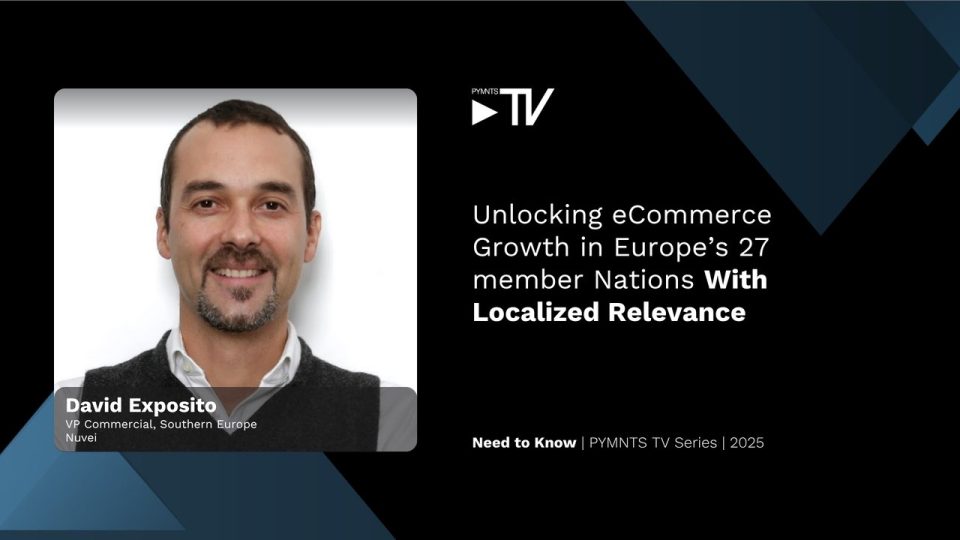
“Europe is the eternal dilemma,” David Exposito, vice president commercial, Southern Europe at Nuvei, told PYMNTS. “There is no one-size-fits-all strategy for market expansion.”
Between hyperlocal payment preferences, a regulatory patchwork and a demand for frictionless digital experiences, brands face a challenge more complex than simply putting products online.
“Unless you can do really well in every market, and I don’t know any company who can, I always recommend going step by step,” Exposito said.
That’s because the European expansion challenge is also an opportunity. Amid the continent’s complexity lies a powerful unlock: localized payments.
The New Playbook for European eCommerce Growth
From Sweden’s Swish to France’s Cartes Bancaires and the Czech Republic’s PayU, Europe’s payment landscape is a patchwork of preferences shaped by cultural trust, economic history and regulatory nuance. For merchants and platforms seeking to scale across the EU, aligning with these local nuances isn’t just good customer experience. It’s good business.
One of the biggest challenges of EU expansion can be meeting new standards for digital consumer expectations. Localization in this context isn’t just about functionality; it’s about trust, especially at checkout.
“Some merchants think offering credit cards is enough,” Exposito said. “But that’s not the preferred method for many customers.”
In the Nordics, for example, account-to-account payments are often favored.
Exposito shared a story from a Spanish merchant that struggled to gain traction in the Netherlands.
“Their conversion rates were very low,” he said. “So, we said, ‘You don’t have iDEAL — the local [payment method]. Let’s start there.’”
The result was a conversion spike, not just for iDEAL payments, but for credit cards.
“When a customer goes to a site and sees a logo they recognize as local, it generates trust,” Exposito said.
Many firms mistakenly assume that entering a market is a reversible decision.
“They think going to a new market is a two-way door decision,” he said. “You go, then if it doesn’t work, you pull resources and nothing happened. But the reality is quite different.”
Failures can come with reputational damage like bad reviews, broken partnerships and negative press coverage.
“I always advocate to go step by step,” Exposito said. “Analyze in which markets you have the ability to win, and then double down on those. Then in five years’ time, we will see.”
We’d love to be your preferred source for news.
Please add us to your preferred sources list so our news, data and interviews show up in your feed. Thanks!
Market Maturity Varies, and so Should Payment Strategies
The complexity of Europe’s 27 member states creates an ongoing tension for companies. Should they prioritize broad reach or deep relevance?
One of the clearest paths is through payments. Exposito said the importance of offering local, preferred payment methods can’t be overstated. He shared two examples: Amazon and Temu.
Amazon’s approach is hyperlocal.
“About 18 months ago, they launched Zum in Spain and Bancomat Pay in Italy,” he said. “But before that, for a couple of years, they had local experts talking to local banks to remove friction.”
Post-launch, the work didn’t stop.
“They kept speaking to the banks to improve the refund experience, eliminate clicks and make sure most transactions weren’t challenged,” he said.
Combining relevant payment methods with local bank relationships led to a double-digit increase in conversion rate, he said.
Temu, on the other hand, took a modular route.
“They don’t have local payments experts in every country,” Exposito said. “Instead, they delegated to us, as their [payment services provider (PSP)]. So, we handled the localization for Japan, Portugal, Poland, the Netherlands. And their conversion rates also spiked.”
Whether you build in-house or partner up, tailoring the payment journey to the local market works — and it works fast, he said.
“Once you choose, go deep on localization,” Exposito said. “Either build your own teams, like Amazon did, or work with the right partners, like Temu.”
And finally, stay agile.
“Today’s best partner may not be tomorrow’s,” Exposito said. “That’s why modularity is key. Markets shift, regulation changes, consumer habits evolve. Your infrastructure must evolve too.”


 Add as Preferred Source