FinTechs’ surge toward credit unions offers a clearer view of how technology firms are reshaping their growth strategies as competition from large banks intensifies.
There’s a shift in place that is less about chasing scale and more about finding partners willing to adopt tools that make everyday financial interactions faster, safer and easier for consumers.
We’d love to be your preferred source for news.
Please add us to your preferred sources list so our news, data and interviews show up in your feed. Thanks!
The PYMNTS Intelligence report, “Credit Union Innovation Readiness: How FinTechs Are Shifting Their Partnership Strategies,” a collaboration with Velera, finds FinTechs are rethinking who they work with and how they deliver value.
The review covers responses from 100 U.S. FinTech executives and points to a market recalibration. FinTechs remain focused on delivering modern digital experiences, but they are directing those features toward institutions that view third-party innovation as essential rather than optional. Middle-market financial institutions and software platforms now sit at the center of this strategy. Large banks, by contrast, increasingly build their own solutions. That leaves FinTechs to pursue sectors that want outside expertise rather than develop it internally. This dynamic has opened a new lane for credit unions.
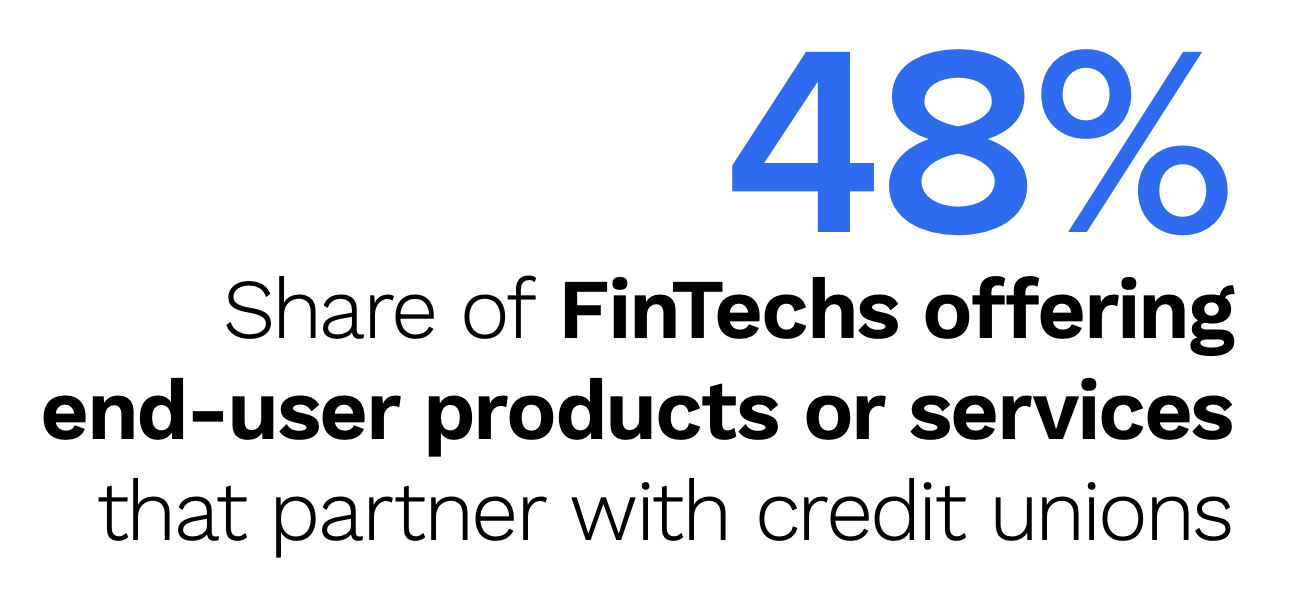
- FinTechs are now 19% more likely to partner with credit unions than a year ago, with 48% of those offering end-user products or services reporting a credit union partnership.
- Just 16% of FinTechs report partnering with national banks, a 56% decline from the previous year.
- Demand for transactional and security-focused tools is rising. Thirty-one percent of FinTechs offer or plan to offer card transaction management or alerts. Another 26% plan to provide biometric authentication or digital identity solutions by 2031.
The report argues that this shift is more than a pipeline change. It reflects a widening gap in how different financial institutions respond to innovation pressure. Credit unions often lack the internal resources to build new digital infrastructure, but they want to keep pace with consumer expectations. FinTechs see an opportunity to serve that need. Many credit unions still operate with legacy systems and slower decision cycles. FinTechs understand this. They are adjusting by emphasizing compliance readiness, faster onboarding and tools that reduce operational strain for their partners.
The data shows that 38% of FinTechs that currently sell to credit unions cite long decision timelines as their biggest hurdle, and 34% point to complex regulations. FinTechs work through these issues because the market pull is strong. Credit unions want capabilities such as artificial intelligence (AI)-powered support, embedded rewards and improved fraud protections. The top FinTech offerings align closely with those demands.
Other findings in the report help explain how FinTechs assess their competitive footing. Twice as many FinTechs that serve credit unions cite their ability to help partners stay competitive compared with those that do not. Forty-two percent of FinTechs that already work with credit unions report no significant impediments to partnership. FinTechs that hesitate often cite cultural or procedural barriers rather than technical ones. The firms that succeed say that understanding credit unions’ constraints is as important as the technology itself. FinTechs that align to those realities gain an advantage. FinTechs that do not risk losing a growing segment of the market.



 Add as Preferred Source