For decades, payroll has been treated as administrative plumbing — essential, regulated and largely invisible. It is something companies do every two weeks, employees fret about as they wait, and finance teams optimize for cost and compliance.
But a growing body of evidence in the latest “Wage to Wallet™ Index,” a collaboration between PYMNTS Intelligence, WorkWhile and Ingo Payments, suggests that this framing is no longer just outdated. It may ultimately be economically distorting.
As wage earners shoulder greater financial volatility and consumer spending becomes more sensitive to cash-flow timing, wages themselves are emerging as a form of infrastructure: one that shapes demand, credit, resilience and ultimately growth.
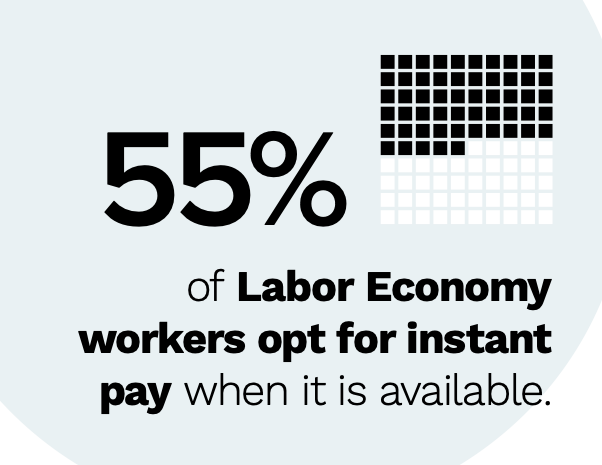
After all, the report data shows that the Labor Economy makes up over a third (36%) of employment and drives 15% of total consumer spending. This makes that same Labor Economy, comprised of the roughly 60 million U.S. workers who earn mostly modest wages in hands-on, shift-based roles, a statistically significant economic force.
Yet the financial lives of Labor Economy workers are highly sensitive to when money arrives, not just how much. Small disruptions in hours worked, schedules, or paycheck timing ripple outward, affecting spending patterns, credit usage and economic stability at scale.
Seen through this lens, wages are becoming a form of infrastructure, one that connects labor directly to spending, saving and financial stability. And when that infrastructure is modernized, the upside can be considerable.
Modern Wage Infrastructure Can Strengthen the Economy
The traditional payroll model of biweekly or semimonthly lump-sum payments was designed for an earlier era. It suited manufacturing schedules and paper-based accounting systems. Today’s economy operates continuously, and so do workers’ expenses. Rent, groceries, transportation and childcare do not align neatly with pay cycles.
Modern wage infrastructure helps close that gap. Tools that allow employees to access earned income in real time, or shortly after it is earned, transform wages from delayed compensation into usable liquidity. The result is smoother cash flow and greater financial confidence.
We’d love to be your preferred source for news.
Please add us to your preferred sources list so our news, data and interviews show up in your feed. Thanks!
Reframing wages as a real-time financial operating system (always on, programmable, and instantly usable) may help unlock a structural advantage: steadier household liquidity, more predictable consumer demand, and a new layer of economic control for the companies that modernize how earned money moves from work to wallet.
Importantly, this is not about accelerating spending for its own sake. It is about making the timing of money reflect the reality of work and life. When earnings and expenses are better synchronized, households operate more efficiently — and so does the broader market.
Read the report: Wage to Wallet Index: Measuring the Labor Economy’s Impact on U.S. Financial and Economic Health
Rewiring Pay for a Healthier Economy
Technology plays a crucial role. As payroll systems become more digital and API-driven, they are evolving into platforms rather than processes. This creates new possibilities for innovation that benefit workers and employers alike.
One of the most promising outcomes of modern wage infrastructure is the quality of information it generates. Traditional financial systems rely heavily on backward-looking indicators, such as credit scores, that reflect past behavior rather than present reality.
Payroll data tells a more immediate story. It reflects income continuity, schedule stability, and real-time earning capacity. When used responsibly, this data can support fairer, more accurate financial decisions — from short-term credit to insurance pricing to benefits eligibility.
For workers, this means greater access to financial products that reflect their true earning power. For financial institutions, it means improved risk assessment and the ability to serve broader markets sustainably. And for employers, it means that the stability they provide through predictable scheduling and reliable pay becomes a tangible asset.
Companies that invest in modern wage infrastructure can often see returns beyond employee satisfaction. Reduced turnover lowers recruitment and training costs. Improved financial well-being correlates with fewer absences and higher engagement. In competitive labor markets, flexible pay access has become a differentiator in attracting talent.
Payroll may never be glamorous. But as it evolves into a foundation for financial health and economic growth, it is becoming one of the most consequential systems businesses touch simply by quietly powering better outcomes for everyone connected to it.



 Add as Preferred Source