For many consumers, planning a trip now includes deciding how to divide the bill as carefully as deciding where to go.
The PYMNTS Intelligence report “Credit Card Installments Outrun BNPL in Summer Travel Surge,” the November edition of The Pay Later Ecosystem Report, examined how consumers used credit cards, card installments, and buy now, pay later (BNPL) across travel, essential expenses and discretionary purchases. The data offered a snapshot of how payment choice can become part of trip planning rather than a last-minute checkout decision.
We’d love to be your preferred source for news.
Please add us to your preferred sources list so our news, data and interviews show up in your feed. Thanks!
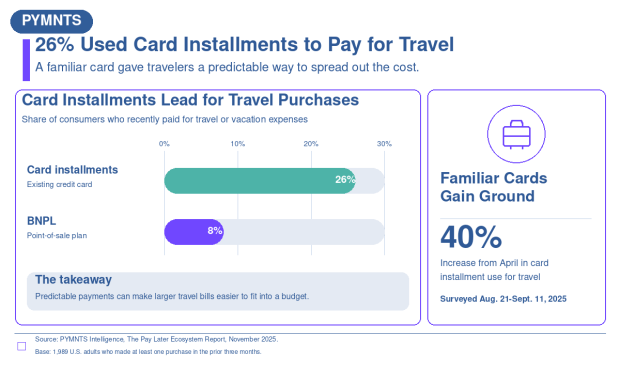
- Card installments carried more of the travel bill. Among consumers who paid for travel or vacation expenses, 26% used credit card installments, compared with 8% who used BNPL. A card installment plan can keep the purchase on an account the traveler already knows while turning a large charge into a fixed schedule. Like packing cubes, the plan divides one unwieldy item into small, more manageable parts.
- Young and high-income consumers showed the strongest appetite for flexible payments. Across all purchases, 45% of Generation Z consumers and 42% of millennials used card installments during the three months before being surveyed. Consumers earning more than $100,000 a year were 57% more likely to use card installments than those earning less than $50,000. That suggests installment use can reflect cash flow planning and rewards strategy as well as financial need.
- The appeal changed with the payment method. BNPL users placed the most value on selecting a payment frequency that fit their monthly budgets. Card installment users focused more on earning loyalty points or cash back. For a traveler booking transportation, lodging and activities at different times, that distinction may encourage the use of more than one payment tool across the same trip.
The report also found that one-third of consumers used card installments for some type of purchase during the prior three months, while 14% had used BNPL. Consumers used both methods for routine bills as well as occasional purchases, showing that installment payments have moved beyond any single spending category.
Those who used BNPL for both essential and discretionary purchases spent an average of $1,070 across the three-month period. Comparable card installment users spent $1,003. The findings point to a practical role for pay later plans. They can help consumers arrange spending around a budget while giving card issuers, BNPL providers and travel merchants more ways to serve them.
At PYMNTS Intelligence, we work with businesses to uncover insights that fuel intelligent, data-driven discussions on changing customer expectations, a more connected economy and the strategic shifts necessary to achieve outcomes. With rigorous research methodologies and unwavering commitment to objective quality, we offer trusted data to grow your business. As our partner, you’ll have access to our diverse team of PhDs, researchers, data analysts, number crunchers, subject matter veterans and editorial experts.


 Add as Preferred Source