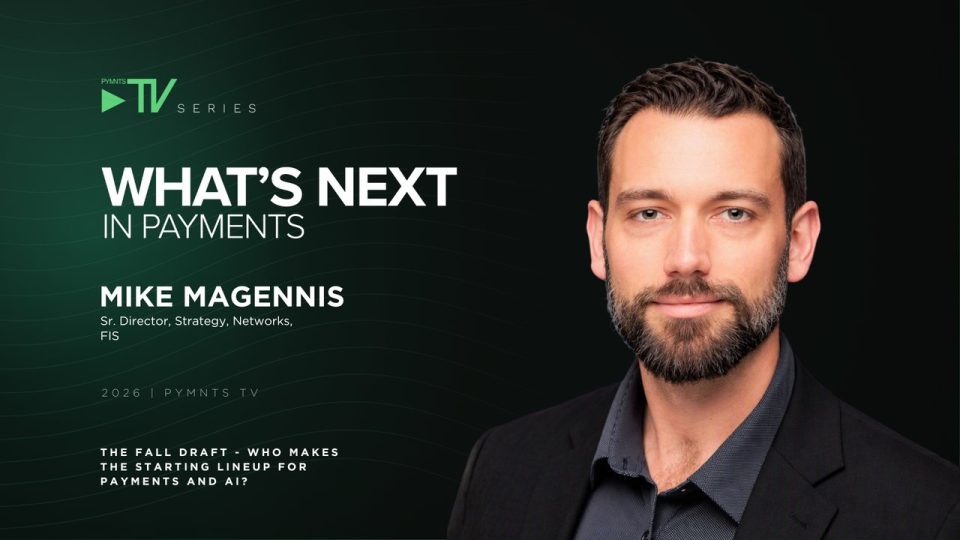
Fall brings football, starting lineups and plenty of arguments over who deserves the first pick.
Mike Magennis, senior director of Strategy, Networks at FIS, said he already knows what he would take first in a payments and artificial intelligence draft: transaction intelligence.
His long-term roster is more complicated.
AI agents could eventually move beyond finding products and helping consumers shop to deciding how to pay for a purchase, he said. That could require choosing among cards and other payment methods after considering rewards, offers, eligibility, risk and the circumstances of the transaction. Magennis said he sees considerable potential there, although he isn’t ready to give autonomous purchasing a starting job.
“As an AI agent begins to assist with purchasing decisions, the payment ecosystem has to make that value chain machine readable,” Magennis said. “An agent needs to understand not just whether a payment credential works, but which choice delivers the best relevant outcome for that consumer.”
Magennis spoke with PYMNTS for the September edition of What’s Next in Payments. “The Fall Draft: Who Makes the Starting Lineup for Payments and AI?” uses the return of football season to ask payments executives to assemble a 2027 roster. What deserves a first-round pick? What is ready for production? What belongs on the bench? Where should companies stop spending? Which capabilities could remain important over the next five years?
Magennis used his first pick on a problem that predates agentic commerce. Payments move money efficiently, but the information surrounding a purchase isn’t always put to equally effective use.
Offers provide an example. Consumers may have to find an offer, activate it and remember to use it. Merchants and brands can see redemption without always being able to determine whether the offer changed purchasing behavior.
“The problem today is not a lack of offers,” Magennis said. “It’s that too many offers arrive at the wrong time, require too many steps, or cannot be connected to an actual change in purchasing behavior.”
Transaction intelligence could bring the purchase, available value and timing together. Magennis also identified brand-funded rewards as an underappreciated part of that opportunity because promotional spending can be connected to actual purchases while consumers encounter fewer steps.
FIS is investing in transaction-level offers and item intelligence, Magennis said. Transaction-level information can already identify where a consumer is shopping and allow offers to be presented in real time rather than requiring consumers to manage the process themselves.
Autonomy Hasn’t Earned a Starting Job
The stakes change when AI moves from helping a consumer evaluate a purchase to acting for that consumer.
The underlying payment transaction could remain largely unchanged while more intelligence is applied around it, Magennis said. Identity, eligibility, purchase context, offers, loyalty and risk could eventually inform an agent’s choice of payment method.
We’d love to be your preferred source for news.
Please add us to your preferred sources list so our news, data and interviews show up in your feed. Thanks!
For now, Magennis said he would keep unrestricted autonomous purchasing on the bench.
“I would start with more bounded use cases where there’s more customer permission-focused deployments, where there’s spending limits that are clear, where accountability is clear,” Magennis said.
Those restrictions address a basic problem for agentic commerce. Allowing software to make a purchase requires agreement about what the agent may buy, how much it may spend and who bears responsibility for what it does. Bounded deployments can also give consumers time to develop trust before agents receive greater authority, Magennis said.
There are older plays he said he would cut from the book as well.
FIS deployed Smart Basket earlier this year and continues to invest in it, Magennis said. The work targets offers that are difficult to use or whose value can’t readily be attributed to a purchase.
“What we want providers to stop doing, whether that’s merchants, whether that’s issuers and FIs, whether that’s brands, CPGs, is to stop making the consumer experience difficult, stop adding steps, and stop making it too much work for a consumer to redeem or see that value,” he said.
Magennis said he applies a similar test to AI spending. He doesn’t regard AI itself as overvalued, but questions deployments that can’t demonstrate a useful outcome.
“Doing just a flashy demo isn’t enough,” he said. “You need to really use AI intelligently.”
The five-year bet is that payment processing will be accompanied by a richer intelligence layer capable of helping machines understand the choices surrounding a transaction. Agents may eventually select the card, reward or payment method that fits a consumer’s circumstances. Whether they get that assignment will depend on how well the payments ecosystem can supply the information, permission and accountability required to make the decision safely.
Watch the full interview with Mike Magennis to learn more about:
- Why transaction intelligence is his first pick in the payments and AI draft.
- How agents could eventually weigh offers, rewards and payment choices for consumers.
- Why unrestricted autonomous purchasing remains on the bench.
For all PYMNTS AI coverage, subscribe to the daily AI newsletter.

 Add as Preferred Source