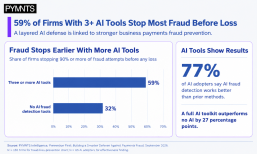
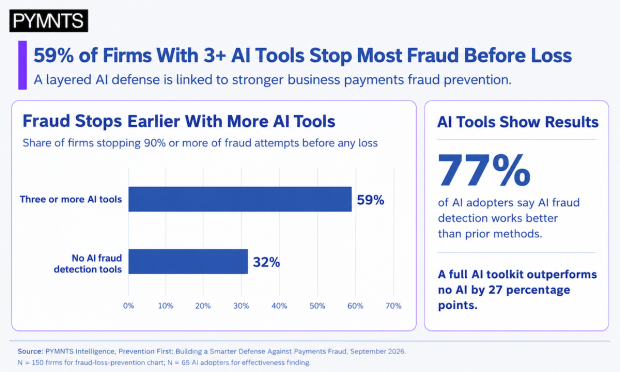
Businesses that combine several artificial intelligence tools to fight payments fraud are nearly twice as likely to stop at least 90% of attempted attacks before losing money, according to new PYMNTS Intelligence research.
“Prevention First: Building a Smarter Defense Against Payments Fraud” is a PYMNTS Intelligence report produced in collaboration with Bottomline and published in September. Based on a July survey of 150 treasury and finance executives at companies in the United States with annual revenues of at least $100 million, the report examined how businesses protect payments to suppliers.
Companies combining AI detection with account verification and stronger approval procedures are making progress against sophisticated fraud, according to the report.
Three findings illustrated the advantages of a more comprehensive approach:
- The share of firms using three or more AI tools stop at least 90% of attempted fraud before suffering a loss was 59%. Just 32% of companies without AI defenses achieved the same result, a 27-percentage-point difference.
- AI fraud detection performed better than previous methods for 77% of companies. Only 8% said it performs worse, suggesting that many early adopters were seeing returns from their investments.
- Real-time risk scoring was used by 83% of AI adopters. The process evaluates transactions for suspicious activity as they happen. Another 82% used automated document verification, and 78% scanned incoming messages for signs of AI-generated fraud.
The findings suggested that successful prevention depended on several defenses working together, much like a security system that combines cameras, alarms and reinforced locks.
We’d love to be your preferred source for news.
Please add us to your preferred sources list so our news, data and interviews show up in your feed. Thanks!
Technology alone doesn’t guarantee protection. Businesses also need reliable supplier information, procedures for verifying account changes and controls that prevent unauthorized payments.
The report offered examples of these safeguards working together. One company caught an attempted wire transfer to a fraudulent account after its monitoring software identified an unexpected change. Another stopped an effort to redirect an ACH payment when the transaction differed from the supplier’s normal activity.
The opportunity extends beyond current AI users. While 57% of surveyed companies had no AI fraud detection tools, 58% of those businesses said they are implementing the technology or expect to adopt it within 12 months.
Businesses are also prioritizing improvements that can strengthen existing defenses. Some 81% planned to improve supplier onboarding verification, 75% expected to invest in bank account validation before payment and 73% planned to enhance AI-driven transaction monitoring.
These investments could help companies catch more fraudulent requests before payments leave their accounts. For finance teams, the goal is to make legitimate payments easier to process while giving criminals fewer opportunities to succeed.
For all PYMNTS AI coverage, subscribe to the daily AI newsletter.
At PYMNTS Intelligence, we work with businesses to uncover insights that fuel intelligent, data-driven discussions on changing customer expectations, a more connected economy and the strategic shifts necessary to achieve outcomes. With rigorous research methodologies and unwavering commitment to objective quality, we offer trusted data to grow your business. As our partner, you’ll have access to our diverse team of PhDs, researchers, data analysts, number crunchers, subject matter veterans and editorial experts.


 Add as Preferred Source