Consumers increasingly choose among cards, account-to-account transfers, digital wallets, real-time payments and installment options based on circumstance rather than habit. Businesses are making similar calculations, weighing cost, speed, settlement requirements and customer preferences before deciding how money should move.
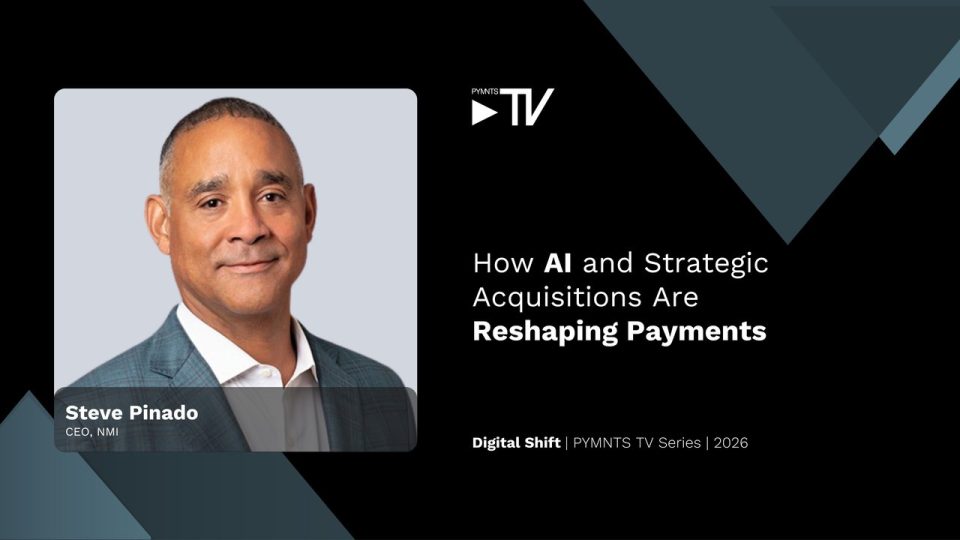
In a conversation with PYMNTS CEO Karen Webster, NMI CEO Steve Pinado said that shift is reshaping the role of payment providers, forcing them to think beyond transaction processing and toward helping businesses navigate a growing number of payment choices.
“The way that money moves will continue to change and evolve,” Pinado said. “It’s going to happen on branded rails and off branded rails, and be more and more flexible around payment modality.”
That belief sits behind NMI’s recent acquisitions of Dwolla and Fee Navigator. One expands the company’s account-to-account and money movement capabilities. The other adds AI-driven pricing and business intelligence tools. Together, they represent a view that the future of payments will not be defined by a single rail or payment method, but by the ability to determine which payment option best serves a particular transaction.
Webster put the question directly.
“Is it a bet on rails becoming commoditized?” she asked, suggesting that the economic value in payments may increasingly reside in the intelligence layer built above the underlying infrastructure.
Pinado resisted the idea that payment rails themselves are becoming commoditized, a topic they’d come back to later when chatting about monetizing value. Different payment methods, he argued, continue to solve different business problems. Some transactions prioritize immediacy. Others emphasize cost. Still others depend on richer data or more complex settlement requirements. What’s changing is the number of options available to businesses and consumers.
Pinado said that expansion of choice carries implications for customer retention. Consumers who find their preferred payment method available at checkout are often more likely to complete transactions and return, something that a recent PYMNTS Intelligence report with Visa Acceptance supports. Now, 2 in 3 consumers say that acceptance of preferred payment method drives merchant preference. Merchants increasingly recognize payment flexibility as part of the customer experience rather than merely an operational consideration.
The challenge for solution providers is that supporting additional payment methods creates complexity. More rails produce more transaction data, more pricing decisions and more opportunities to optimize performance.
“We sit on a trove of data, of settlement data, of transaction data,” Pinado said. “Using AI and being predictive and understanding how to best optimize for a transaction or portfolio performance or merchant performance or pricing or risk, there’s a lot of opportunity.”
That observation may be as relevant for banks as it is for payment processors.
For years, financial institutions have invested heavily in modernizing customer-facing experiences. Increasingly, the competitive question is whether they can transform transaction data into actionable intelligence. As payment choice expands, institutions that understand how customers pay may gain advantages over those that simply process payments after decisions have already been made.
Artificial intelligence (AI) is accelerating that dynamic.
Measuring AI Deployments
We’d love to be your preferred source for news.
Please add us to your preferred sources list so our news, data and interviews show up in your feed. Thanks!
Pinado said NMI is already seeing measurable benefits from internal AI deployments, particularly in development, support and operational efficiency. At the same time, the technology is changing how the company evaluates acquisitions.
“We’re building things faster, more efficiently. We’re rolling them out more quickly. We’re iterating more quickly,” he said.
The result is a higher bar for acquisitions. New capabilities must fit within a broader strategic vision rather than simply adding functionality.
Later in the discussion, Webster identified another tension emerging across payments.
“Everyone’s trying to be the single embedded platform,” she observed.
That competition extends across processors, banks, software providers and FinTechs. Each is attempting to become the primary platform through which merchants manage payment acceptance, money movement and business operations. Success increasingly depends on offering a combination of payment flexibility, data intelligence and workflow tools rather than any single capability.
The emergence of agentic commerce could raise the stakes further. As AI begins to play a larger role in product discovery and purchasing decisions, payment providers may need to support not only human decision-making but machine-assisted decision-making as well. Pinado acknowledged that questions surrounding authentication, liability and trust remain unresolved, but said those issues must be addressed before broader adoption can occur.
His closing observation may have been the clearest explanation of NMI’s recent moves.
“Strategy before M&A,” Pinado said. “Don’t stretch, don’t go beyond, don’t fall in love with an idea.”
The comment was directed at acquisitions, but it also serves as a useful lens through which to view the broader payments market. As businesses and consumers gain more payment choices, the winners may not be those offering the most rails. They may be those best equipped to help customers determine which rail to use, when to use it and why.
Watch the full interview with NMI CEO Steve Pinado to hear more about:
- Why payment choice is expanding beyond traditional card rails.
- How transaction and settlement data are becoming strategic assets.
- Why AI is changing both payment economics and acquisition decisions.


 Add as Preferred Source