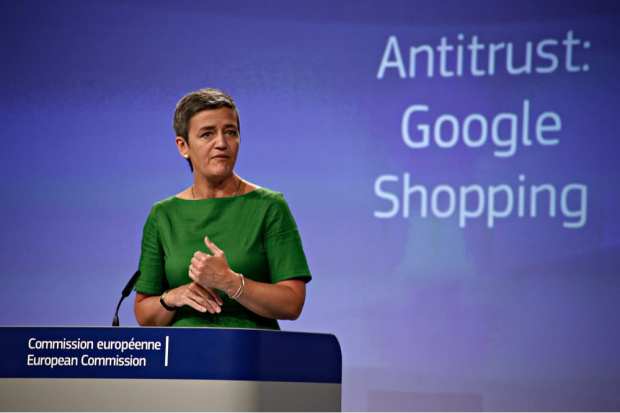
A European judge has hampered Google’s fight against a $2.6 billion fine, saying the company committed a “clear infraction” by putting its own price-comparison services above others in its search listings, according to a report by Reuters.
Judge Colm Mac Eochaidh made the remarks on Thursday (Feb. 13), on the second day of a three-day hearing at Europe’s second-highest court, the General Court. Google is trying to get the first of its three antitrust penalties overturned.
The search giant was initially fined in 2017 and has been appealing ever since. The European Commission said Google favored its own results over those of its rivals, and the judge agreed.
“For me, this case really is visibility. This is a very important point in the case. It is perfectly apparent [that] what has happened is this: You have promoted your own service and demoted that of others,” he said. “That is a clear infraction.”
Mac Eochaidh also asked Google what it was holding back from competitors that compelled them to turn to the EU for help.
Christopher Thomas, the lawyer from Google, blamed the Commission for not looking at Amazon when preparing its case for how it would measure Google’s actions. Thomas Hoppner, a lawyer for the complainants, said it was the right decision to not take Amazon into account.
“Merchant platforms and CSSs (comparison shopping services) simply cater to different needs of different types of online retailers. These different needs mean that CSSs cannot easily be transformed into merchant platforms and vice versa,” he said. “The entire Google story that the condemned conduct was a means to compete with Amazon has no merits.”
The ruling is expected to come in next year. If it doesn’t go in Google’s direction, the company can appeal to Europe’s highest court, the Court of Justice.