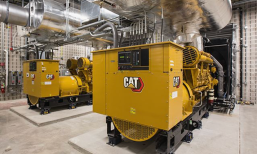
But these days, another side of the company’s business is powering sales: generators.
According to a Tuesday (Dec. 30) report from The Wall Street Journal (WSJ), Caterpillar’s power and energy business has become its fastest-growing sales unit, thanks to a surge in data center projects for artificial intelligence (AI) use.
The company expects this side of the business to help boost annual sales growth by 5% to 7% through 2030, compared to an average of 4% in recent years.
Caterpillar is also planning its largest factory spending in about 15 years to take advantage of the need for AI infrastructure. Demand for electricity at data centers is expected to triple by 2035, the report added, citing figures from the International Energy Agency.
The WSJ says Caterpillar is spending $725 million at its plant to Lafayeytte, Indiana to build more piston-driven engines for generators and aims to more than double the production capacity for turbine engines by the end of the decade, the report said.
Advertisement: Scroll to Continue
“I’ve been around a lot of capacity expansions at Caterpillar to know that there’s never a sure thing, but we have a better line of sight for these expansions than I’ve ever had in the past,” CEO Joe Creed, a 29-year veteran of the company, said in an interview with the WSJ. “With the onset of generative AI, it really caused an inflection point.”
In other artificial intelligence news, PYMNTS wrote Tuesday about the technology’s emergence as a “source of liquidity, resilience and revenue” as it plays a larger role in accounts payable (AP).
“Folks are just starting to understand that AI isn’t just automation with kind of sexier marketing,” Finexio CEO and founder Ernest Rolfson told PYMNTS. “Embracing it as infrastructure lets you use your data as a strategic asset.”
Traditionally, that report said, AP scale was held back by labor economics. Adding suppliers, invoices and payment methods meant more staff or added risk. Artificial intelligence changes that equation.
“In the past, we’ve had folks with big call centers doing manual outreach,” Rolfson said. “You’re kind of hoping for a conversion rate.”
This system was never sustainable. Companies were “fighting a math problem with labor,” he said. AI “really fixes that math.”
It allows for high levels of personalization, precisely timed supplier outreach and scalable engagement without adding staff, an especially key advantage as businesses wrestle with tighter labor markets and economic uncertainty heading into 2026.