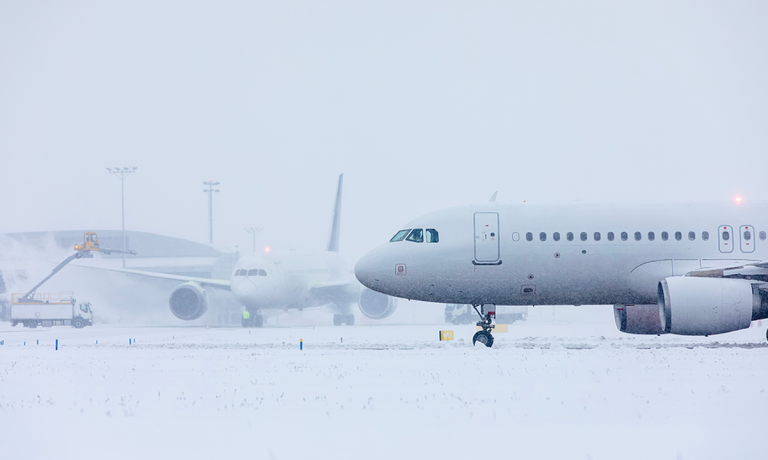
When winter storm Fern swept across the United States this past weekend, it forced the cancellation of more than 11,400 flights, marking the largest single-day disruption since the pandemic and affecting major hubs from the Northeast to the South. Airports including LaGuardia, JFK, Philadelphia and Dallas-Fort Worth saw cancellations approaching or exceeding 90% of scheduled departures, with more than 180 million people under winter weather alerts as the storm unfolded.
Events like this compress decision windows to minutes, forcing airlines to choose which flights to cut, how to reposition crews, and how to reroute thousands of passengers before disruption cascades across the network.
That pressure explains why, over the past year, Air France-KLM, Emirates and United Airlines have begun relying on artificial intelligence and generative AI systems running inside their core operations to make those calls faster. These carriers are moving fast because delay costs compound by the minute, and decision speed has become a competitive weapon.
Inside AI-driven Airline Operations
Air France-KLM has been working to push generative AI out of experimentation and into a shared production layer. The group has reportedly built a cloud-based generative AI factory designed to industrialize use cases across functions rather than let teams run isolated pilots, according to the airline’s own description of the effort. Operations teams, commercial units, and support functions can draw from the same models, data access, and governance.
United Airlines is following the same trend. In an interview with CIO.com, United CIO Jason Birnbaum described AI as a way to compress decision cycles during irregular operations, not just optimize at the margins. The strategy centers on putting AI into systems employees already use, so insights surface while decisions are being made, not afterward. United’s teams use AI to assess knock-on effects when weather or air traffic constraints disrupt the network, helping planners choose options that minimize downstream impact.
In both cases, AI is treated as shared airline infrastructure. Models, data pipelines and interfaces are reused across departments. That lowers friction and speeds adoption, especially in environments where safety, compliance and reliability are non-negotiable.
Decision Speed
Irregular operations remain the real stress test. Weather, crew availability and airport congestion create thousands of variables that change by the minute. Airlines have always relied on human judgment supported by optimization tools. What is changing is how quickly artificial intelligence systems can surface trade-offs and recommended actions at scale.
At United, AI-driven systems support real-time operational decisions and extend into customer-facing self-service. The airline has deployed conversational AI that allows travelers to rebook flights, find alternatives, and get answers during disruptions without waiting for an agent. For the airline, every successful self-service interaction reduces call center load during peak stress. For customers, it shortens the gap between disruption and resolution.
Emirates is taking a similar execution-first stance, pairing generative AI with its internal processes and customer channels. The airline’s collaboration with OpenAI is aimed at accelerating adoption across customer service, operations and internal productivity. Emirates has said gen AI will help employees retrieve information faster, draft responses and support consistent service across touchpoints, particularly when volumes spike.
AI as Airline Infrastructure
BCG finds that airlines’ AI maturity has moved from slightly below average to average compared with other industries in the past year, and only one of 36 airlines surveyed met the highest criteria for being built for an AI-enabled future. The analysis also projects that by 2030, carriers that put AI at the core of workflows could enjoy operating margins 5% to 6% points higher than peers that do not scale AI across their business, a significant gap in an industry where margins are typically tight and cyclical.
That upside is increasingly tied to how airlines manage time-critical decisions. Generative AI is moving into the operational core of airlines and airports, where choices about schedules, crews, aircraft rotations, and passenger recovery must be made in minutes. According to Microsoft, data-driven AI systems can reduce the underlying drivers of flight delays by up to 35% by improving disruption forecasting and recovery planning, limiting downstream effects while reducing pressure on frontline teams.
Airlines using AI-led personalization report revenue lifts of roughly 10% to 15% per passenger, according to Microsoft, while AI-powered customer service tools, including automated chat and self-service, have been shown to lower support costs by up to 30%, reshaping both the economics of service and the passenger experience.
For all PYMNTS AI coverage, subscribe to the daily AI Newsletter.